What to check on a Emergency Fire Fan.
Most ventilation fans exist to move air; an emergency fire fan exists as much to be stopped as to run. Engine room, cargo space and machinery space ventilation fans are grouped so that all of them, along with associated fire dampers, can be shut down together from a position outside the space they serve, typically at the fire control station or a position near the main exit. The fan itself is often no different mechanically from a standard axial or centrifugal supply fan, but its wiring, damper linkage and control…
What sets this type apart
Most ventilation fans exist to move air; an emergency fire fan exists as much to be stopped as to run. Engine room, cargo space and machinery space ventilation fans are grouped so that all of them, along with associated fire dampers, can be shut down together from a position outside the space they serve, typically at the fire control station or a position near the main exit. The fan itself is often no different mechanically from a standard axial or centrifugal supply fan, but its wiring, damper linkage and control logic are what make it an emergency fire fan rather than ordinary ventilation.
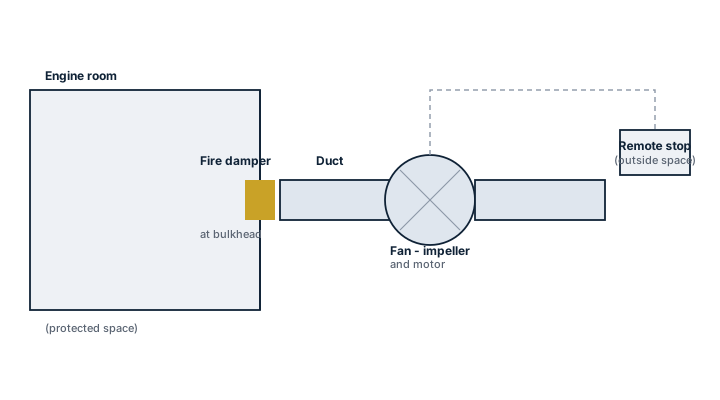
Main components
Fan and motor
An axial or centrifugal fan driven by an electric motor supplied from a circuit that can be isolated remotely; on some installations the motor is also on the emergency switchboard so ventilation to spaces needed for firefighting or escape can continue after a main power loss, while other fans in the same space are the ones stopped for fire isolation.
Remote stop station
A single control, or group of controls, at the fire control station or bridge stops the relevant fans without anyone entering the affected space. This remote stop is tested regularly, since a fan that cannot be stopped from outside a smoke-filled compartment defeats the purpose of the arrangement.
Quick-closing fire dampers
Dampers in the ducting close, either automatically on fan stop or by a separate remote control, to prevent a fan from continuing to feed a fire with air through open ducting even after the motor stops. Damper position indication, where fitted, tells the bridge or fire control station whether the damper actually closed, not just whether the command was sent.
Local isolating arrangements
Local hand controls allow normal operation and maintenance, but are overridden by the remote emergency stop, and the wiring must be arranged so a local switch left in the on position cannot restart the fan once it has been emergency-stopped remotely.
Regulations and class
SOLAS Chapter II-2 requires ventilation fans serving machinery spaces, galleys and certain other spaces to be capable of being stopped from a position outside the space, together with closure of the associated dampers, as part of the fixed fire safety arrangements. Class surveys check that stop stations are correctly labelled, that the stop function actually reaches every fan it is supposed to, and that dampers close fully, not partially.
Typical faults
- Remote stop wired to the wrong fan or missing a fan added later - a fan believed stopped keeps feeding air to the fire.
- Damper linkage seized by corrosion or paint - damper fails to close fully even when the actuator receives the command.
- Local switch left able to override remote stop - crew unintentionally restart a fan that was correctly shut down.
- Damper position indication out of calibration - bridge or fire control station shown a closed damper that is not actually closed.
- Motor circuit not on the arrangement it was designed for - fan loses power in a fire situation exactly when it is needed for smoke extraction or boundary cooling support.
What to look for in a supplier
- Fan and damper units certified as a matched fire-rated assembly, not generic ventilation components paired after the fact.
- Actuators and linkages rated for the corrosion and temperature conditions of the actual duct run, particularly exposed weather deck ducting.
- Clear documentation mapping each fan to its remote stop group, useful when the ship's ventilation has been modified since original delivery.
During fire drills, confirm each fan actually stops and each damper actually closes at the fan itself, not only that the indicator lamp at the control station changes - indicator faults are common and hide a fan that is still running.