What to check on a Supply Fan.
A supply fan draws air from open deck and delivers it into a space under positive pressure, the mirror image of an exhaust fan's job. Engine room supply has to cover two separate demands at once: combustion air for the main engine and auxiliaries, and general cooling of the space, which is why engine room supply capacity is checked against engine air consumption figures rather than a simple air-change target. Accommodation supply units condition the air first, usually with a heating and/or cooling coil upstream of the fan, before distributing…
The Job a Supply Fan Does
A supply fan draws air from open deck and delivers it into a space under positive pressure, the mirror image of an exhaust fan's job. Engine room supply has to cover two separate demands at once: combustion air for the main engine and auxiliaries, and general cooling of the space, which is why engine room supply capacity is checked against engine air consumption figures rather than a simple air-change target. Accommodation supply units condition the air first, usually with a heating and/or cooling coil upstream of the fan, before distributing it through ducted diffusers. The positive-pressure side of the ventilation balance is what defines this fan's role, whatever space it happens to serve.
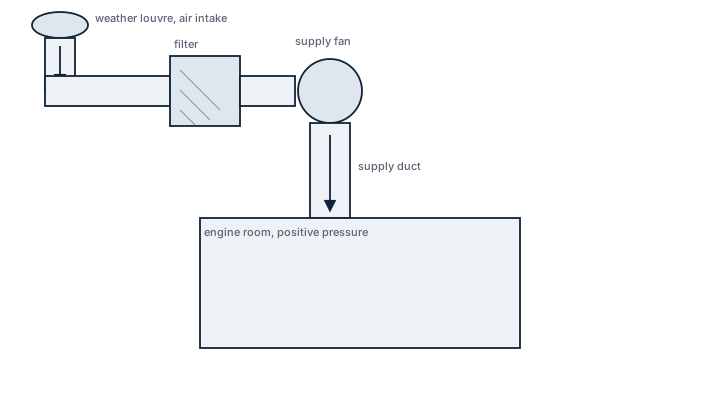
Main Components
- Impeller and casing – centrifugal for most ducted supply duties, sized against the full system resistance including any coil.
- Inlet filter – washable or disposable, protects the coil and downstream ductwork from salt and dust.
- Heating and/or cooling coil – steam, thermal oil or electric heating and a chilled water or refrigerant cooling coil on accommodation units.
- Weather louvre and intake screen – on the open-deck inlet, keeps out rain and spray while limiting pressure loss.
- Silencer – where the unit serves accommodation spaces with noise limits.
- Distribution ductwork – with volume control dampers and diffusers set to balance airflow between outlets.
Selection and Sizing
Engine room supply fans are sized to exceed the combustion air demand of the main and auxiliary engines running together, plus enough margin to remove radiant heat from the space; two fans each rated at roughly half the total demand is a common arrangement so one can be taken out of service for maintenance without losing all ventilation. Accommodation units are sized against occupancy and recognised air-change standards, with filter class and coil duty added on top. Static pressure has to include coil pressure drop, which is often the largest single loss in the system and easy to underestimate at the design stage.
Regulations and Class
SOLAS Chapter II-2 requires that ventilation supplying combustion air to machinery spaces can be stopped, automatically or by a remote control located outside the space, as part of the fixed fire-extinguishing system release sequence, so a fire cannot draw on an unlimited air supply. Emergency stops must be positioned where they remain accessible if the space itself becomes untenable. Class machinery rules set out the redundancy expected for engine room supply capacity.
Typical Faults
- Clogged intake filter – reduces airflow and lets engine room or accommodation temperatures climb, straining equipment that depends on ambient cooling.
- Belt slippage or wear on belt-driven fans – drops impeller speed and airflow well before the fan looks obviously faulty.
- Fouled or leaking heating/cooling coil – gives poor accommodation temperature control and, if leaking, condensate-driven corrosion nearby.
- Blocked louvre intake screen – salt crust or sea spray in heavy weather cuts capacity exactly when engine room cooling is most needed.
- Faulty emergency stop wiring – the fan either fails to stop on a fire alarm, a safety-critical failure, or fails to restart cleanly after a routine test.
What to Look for in a Supplier
- A verified airflow and static pressure curve for the actual duct and coil configuration, not a catalogue figure for the bare fan.
- Filter media that is genuinely available in the ship's trading area, not a proprietary cartridge with one source.
- A fire-safe shutdown interface that matches the ship's existing fire detection panel without rewiring.
- Documented redundancy sizing for engine room duties, showing the fan meets combustion air demand with one unit out of service.
Do not permanently defeat an engine room supply fan's automatic fire shutdown to stop nuisance trips; find and fix the false trigger instead, because that shutdown is doing exactly its intended job the one time it matters.