Manhole Cover
A manhole cover closes the access opening into a ballast, fuel or cargo tank and is designed to stay sealed for months between permit-controlled entries, not to see the routine traffic a watertight door does.
What to check on a Manhole Cover.
1 models from Alfa Laval in Manhole Cover. Below: the full model list.
What a manhole cover is for
A manhole cover closes the access opening cut into a tank top, bulkhead or deck so a person can enter a ballast, fuel or cargo tank for inspection or repair. Unlike a watertight door, it carries no operating mechanism for routine passage; it is designed to stay shut and sealed for months between entries, and every opening is a deliberate, permit-controlled event rather than everyday traffic.
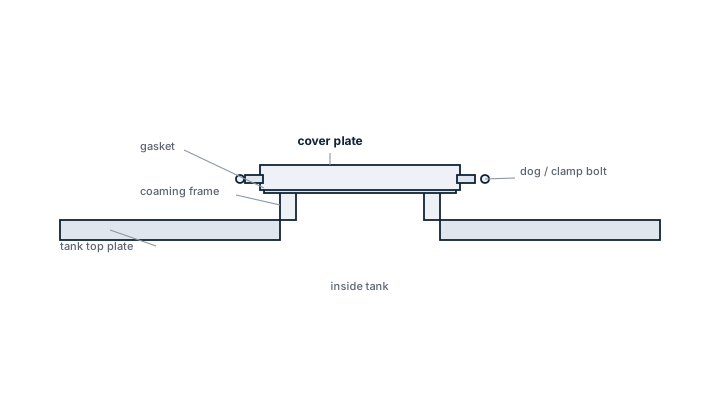
Legend
- cover plate
- gasket
- dog / clamp bolt
- coaming frame
- tank top plate
- inside tank
Main components
Cover plate
A steel or, on smaller access points, aluminium plate sized to the cut-out, usually oval or round so it cannot fall through its own opening during removal.
Coaming and seating
A raised coaming welded around the opening lifts the seal above the surrounding surface to keep standing water and cargo residue out, and provides the flat seating face the gasket bears against.
Read the full guide
Gasket
A compressible seal, typically nitrile or a similar oil- and fuel-resistant elastomer for tank covers, compressed between cover and seating to make the joint watertight and, for fuel or cargo tanks, gastight.
Fastening: bolts or quick-acting dogs
Smaller and less frequently opened covers use a ring of studs and nuts; covers opened more often, such as those on ballast tanks entered for regular inspection, may use quick-acting dogs or davit-assisted hinges to reduce the time and manpower needed to open and reseal.
Selection and sizing
Opening size is set by the enclosed space entry standard, not by convenience; it must be large enough for a person in rescue harness and breathing apparatus to pass through and be recovered if incapacitated. Cover thickness and bolting pattern follow the design pressure head of the tank contents, with fuel and cargo tank covers rated more conservatively than ballast tank covers of the same size because of the fire and pollution consequence of a leak.
Regulations and class
- SOLAS Chapter II-1 sets minimum opening dimensions for tank and void space access to allow safe entry and rescue.
- Class rules require manhole covers on structural boundaries to be included in the ship's periodic tank inspection and thickness measurement scheme.
- MARPOL Annex I applies where the cover closes an oil tank boundary; gasket condition is checked as part of oil pollution prevention surveys.
Typical faults
| Fault | Consequence |
|---|---|
| Gasket compressed flat or hardened from age | Seepage of tank contents, or water ingress into the tank |
| Studs over-torqued unevenly or corroded solid | Cracked cover, or cover impossible to remove without cutting |
| Coaming wasted by corrosion below the seating face | Cover no longer seats flat, chronic weeping leak |
| Cover left dogged down loosely after inspection | Tank not actually sealed, found only at the next survey |
What to look for in a supplier
- Gasket material compatible with the specific tank content, fuel, ballast water, or cargo, not a universal rubber grade.
- Cover plate thickness and stud specification matching the original design, especially when replacing a corroded cover rather than the whole coaming.
- Corrosion-resistant stud material where the tank atmosphere is known to be aggressive, to avoid seized fasteners at the next opening.
A manhole cover that needs a hammer to break the studs free is a warning sign for the next entry, not just an inconvenience; replace the studs while the tank is open rather than fighting the same fight at the next survey.
Models in this type.
The best-documented model of each manufacturer first, then the next — 1 of 1 models in Manhole Cover. Every row links to full specifications, documents and service notes.
Manufacturers.
All 6 manufacturers with models of Manhole Cover. Names with a manufacturer page open it; the others open a search across the full library.
All manufacturers in the libraryAlso in Deck Fittings & Hardware.
The other equipment types in this category.
Inspection findings for this equipment
From public port state control and US Coast Guard records; OceanSphere assigns them to this equipment type from the descriptions.
Deficiency codes – USCG port state control – foreign-flag vessels
- 03110 · Manholes/flush scuttles – 18 findings
USCG components
- Manholes/flush scuttles – 745 findings, 14 with detention
- Manhole – 16 findings
Write to us about your machine — the answer comes by e-mail.
Name the make and the model and what the job is: a spare, a service call, a second opinion on a data sheet. We answer by e-mail.
No details at hand? A photo of the rating plate or the part is enough — simply attach it to the request.
Questions that come up with this equipment.
Is Manhole Cover data free?
Yes. Every model page, every guide and every datasheet for this type is readable without an account. An account adds saved searches and requests, nothing is taken away.
My model is missing — what now?
Send us the nameplate. We identify it by hand, add it to the library, and if you need a part or a service, the request is already on our desk.
Can you source a Manhole Cover part?
Yes. Tell us the manufacturer, the model and what you need — a person reads every request and replies by e-mail.