What to check on a Chain Pipe & Spurling Pipe.
The spurling pipe, also called the chain pipe, is the tube that carries the anchor chain from the deck, past the windlass, down into the chain locker. It carries no load itself — the chain stopper and the windlass brake hold the chain when the anchor is deployed. Its only jobs are to keep the chain running true so it does not chafe against the deck edge or hull plating, and to stop spray and green water reaching the locker. On many vessels there are two spurling pipes per side…
What sets the spurling pipe apart
The spurling pipe, also called the chain pipe, is the tube that carries the anchor chain from the deck, past the windlass, down into the chain locker. It carries no load itself — the chain stopper and the windlass brake hold the chain when the anchor is deployed. Its only jobs are to keep the chain running true so it does not chafe against the deck edge or hull plating, and to stop spray and green water reaching the locker. On many vessels there are two spurling pipes per side, one for the chain running out and a second, smaller one for a securing pendant, though most merchant ships fit just one per anchor.
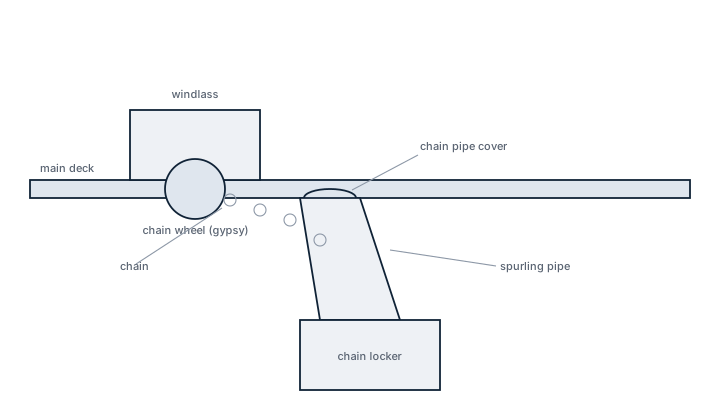
Main components
Pipe body
A welded steel tube, usually mild steel with a corrosion allowance, set at an angle that lets the chain fall freely without piling against one wall. The bore has to clear the chain links plus the swivel and any joining shackles with margin, or the chain will jam mid-drop when the locker fills and back-pressures the pipe.
Bell mouth / spurling ring
A flared casting or fabrication at the deck end that rounds off the entry so the chain does not bear on a sharp edge as it pays out at an angle. This is the part that wears fastest and is usually replaceable or at least re-weldable without cutting into the deck plate.
Chain pipe cover
A hinged or bolted cap, usually with a rubber or synthetic gasket, fitted over the pipe when the anchor is housed and the chain fully stowed. It stops water working down into the locker in a seaway and is one of the most commonly missing or seized fittings found at survey.
Locker connection
Below deck the pipe terminates over the chain locker, positioned so the chain self-stows in a cone rather than piling straight down, which would jam the last few links against the deckhead.
Selection / Sizing
| Parameter | What it drives |
|---|---|
| Chain grade and diameter | Sets minimum bore; pipe must clear the chain plus any studless-link swivel with margin |
| Windlass gypsy offset | Sets the pipe angle so the chain does not bear against one side under load |
| Chain locker geometry | Determines pipe length and whether a bend is needed rather than a straight run |
| Freeboard forward | Influences cover design and gasket rating against green water |
Undersizing the bore against the actual chain and swivel diameter is a common design fault seen on repeat newbuilds from the same yard — a drawing carried over from a slightly smaller sister ship.
Regulations / Class
There is no dedicated SOLAS chapter for spurling pipes, but class rules for anchoring equipment require the chain locker to be self-draining and the spurling pipe arrangement to prevent water accumulation that could affect stability or freeze in cold service. Surveyors check the cover and gasket condition at each annual anchor equipment inspection, since a missing cover is treated as a downflooding point on the freeboard deck.
Typical faults
- Cover missing or seized open — water enters the chain locker in every sea, corroding the chain from the bitter end up and adding free surface weight forward.
- Bell mouth worn to a knife edge — the chain starts to nick and eventually breaks a link exactly at the pipe entry point.
- Pipe bore undersized for a re-ranged, heavier chain fitted at dry-dock — the chain jams and the windlass stalls under load.
- Gasket perished — cover looks intact but no longer seals, a fault only found by hose test.
What to look for in a supplier
- Confirms bore against your actual chain diameter and swivel/shackle dimensions, not just the nominal anchor size.
- Supplies the cover and gasket as a matched, replaceable assembly, not a one-off weld-in fabrication.
- Can match an existing bell mouth profile for a like-for-like repair without deck plate modification.
- Uses a coating system rated for a permanently wet, abrasive environment, not standard deck primer.
At every anchor stow, walk forward and check the cover actually seats — a spurling pipe cover that has seized half-open is one of the most common findings at PSC inspections, and it costs nothing to fix if caught early.