"> Bitts - Equipment Database

Bitts

medium 2 models total

Bitts are the paired vertical posts a mooring line is figure-eighted around to hold it fast; cross bitts add a horizontal bar so two lines can be secured independently on the same fitting without one riding over the other.

Read more — Bitts explained

What sets bitts apart from other mooring fittings

A bollard or bitt does one job: it holds a mooring line under tension by friction, through the line being wound figure-eight fashion around two posts, rather than by clamping or gripping the line mechanically the way a winch drum or a mooring hook does. Bitts differ from a single bollard in having two posts close enough together that the figure-eight pattern actually generates friction, and cross bitts add a horizontal bar between or across the posts so a second line can be made fast independently without the two lines interfering as they are worked.
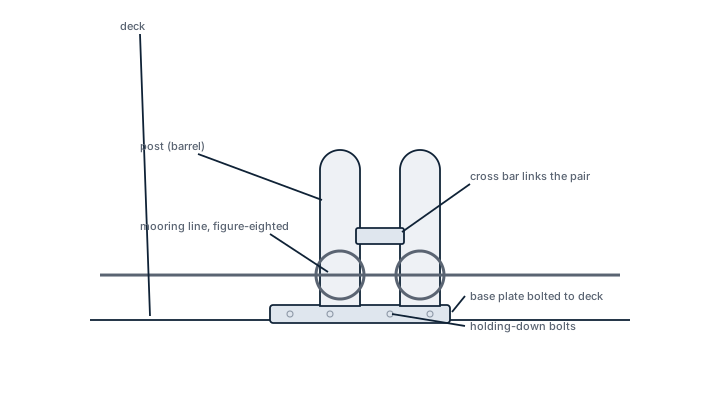
Cross bitts with mooring line
Side elevation of a pair of deck bitts joined by a cross bar, bolted to a base plate on deck, with a mooring line figure-eighted around the two posts.

Main components

Posts

Two vertical steel posts, cast or fabricated, through-bolted or welded to a base plate that spreads the mooring load into deck structure below.

Base plate and deck doubler

The load path from the posts into the hull; deck plating under a bitt is normally doubled or thickened locally because mooring loads concentrate here far above general deck loading.

Cross bar (cross bitts only)

A bar linking the two posts partway up, giving a second, separated point to belay a line so it does not have to share the same wraps as the first.

Sizing and selection

  • Safe working load required, set by the ship's mooring line breaking strength and the number of lines expected on that fitting.
  • Post diameter and spacing, which need to suit the mooring line size actually carried — too narrow a spacing and the figure-eight cannot develop enough friction.
  • Deck reinforcement required beneath the fitting, since bitts are structural attachments, not surface-mounted hardware.
  • Layout relative to fairleads, so the lead angle from fairlead to bitt stays within a safe range and does not chafe against the post edge.

Regulations and class

Class societies require mooring fittings including bitts to be sized against the ship's Equipment Number, which sets minimum safe working loads for anchors, chain and mooring equipment, with the bitt's SWL and the supporting deck structure checked at the design stage. There is no SOLAS chapter specific to bitts, but class rules for hull equipment cover their strength, and periodic survey checks for cracking, wastage, and deformation at welds and base plates, since a mooring fitting failure under load is a direct crew injury risk documented in numerous incident reports.

Typical faults

FaultConsequence
Cracking at the base plate weld from repeated snap loadingFitting can fail suddenly under a normal mooring load rather than a genuine overload
Corrosion wastage at the deck connection, hidden by paint buildupActual strength drops well below the rated SWL without visible warning
Sharp edges worn into the posts from years of line contactAccelerates chafe and cutting of mooring lines, shortening line life and risking parting under load
Fitting undersized for the mooring lines actually carried after a later upgradeLines are worked at a load the bitt was never rated for, especially during heavy weather or emergency towing use

What to look for in a supplier

  • SWL certified against the ship's actual Equipment Number and mooring line breaking strength, not a generic size chart.
  • Casting or fabrication quality with NDT records at the base plate weld, the highest-stress point on the fitting.
  • Post spacing and diameter matched to the line size in service, checked against the fairlead layout it will work with.
  • Corrosion protection suited to a fitting that cannot be taken out of service for recoating without disrupting mooring operations.

Inspect the base plate weld, not just the posts — bitts almost always fail at the deck connection under repeated snap loading, long before the posts themselves show visible wear.

1 manufacturers · 2 models

Generic (Class Approved)

2
Cross Bitts 60t SWL
SWL 60t · Deck Hardware · Heavy‑duty deck bitts
Safe working load tonnes
60
Type
cross_bitts
Common Failures & Inspection Points
  • Corrosion, wastage or coating breakdown causes visible section loss and weakens the fitting or surrounding structure
  • Wear in pins, rollers, hinges or bearing surfaces causes excessive play, stiffness or poor line guidance
  • Seal or gasket deterioration on closing appliances causes water ingress or loss of weathertight integrity
  • Loose foundations, fasteners or cracked welds cause movement, vibration or visible structural defects
  • Blocked drains, vents or passages cause water accumulation, pressure problems or restricted operation
Service: Inspect structural attachment, corrosion, welds, fasteners, moving parts, seals and coatings. Verify free movement, drainage, closing and securing functions according to the fitting type. Pay particular attention to load-bearing foundations and watertight or weathertight boundaries. Refer to class, vessel and manufacturer documentation for the exact figure for loads, clearances and acceptance limits.
Spare Parts: Carry seals or gaskets, pins, bushes, rollers, approved fasteners, lubrication items and small operating hardware appropriate to the installed fitting.
Strengths
  • High SWL (60 t) suitable for large vessels and heavy mooring loads
  • Class approved – meets standard classification society requirements
  • Simple geometry allows use with a wide range of hawser sizes
  • Easy visual inspection; horn surfaces can be polished to reduce line wear
Weaknesses
  • Heavy foundation requires robust deck reinforcement and quality welds
  • Foundation welds are prone to cracking if not inspected regularly (NDT required)
  • Horn surface wear from line friction necessitates periodic polishing or replacement
  • Base‑plate corrosion can develop in aggressive seawater environments
Typical Vessels: Bulk CarrierTankerContainer ShipOffshore Supply VesselPassenger Ferry
Decision Guide: Choose if you need a proven, high‑capacity bitt for heavy mooring or towing on vessels that can accommodate the required deck reinforcement and you have an NDT program for weld inspection. Avoid if vessel weight limits or deck strength cannot support the foundation, or if operating in highly corrosive conditions without a robust corrosion‑control plan.
Use Cases: Mooring, deck access, cargo access, drainage, ventilation and general deck service.
Mooring Bitts 100t SWL
SWL 100t · Deck Hardware · Class‑approved mooring bitts
Safe working load tonnes
100
Type
mooring_bitts
Common Failures & Inspection Points
  • Corrosion, wastage or coating breakdown causes visible section loss and weakens the fitting or surrounding structure
  • Wear in pins, rollers, hinges or bearing surfaces causes excessive play, stiffness or poor line guidance
  • Seal or gasket deterioration on closing appliances causes water ingress or loss of weathertight integrity
  • Loose foundations, fasteners or cracked welds cause movement, vibration or visible structural defects
  • Blocked drains, vents or passages cause water accumulation, pressure problems or restricted operation
Service: Inspect structural attachment, corrosion, welds, fasteners, moving parts, seals and coatings. Verify free movement, drainage, closing and securing functions according to the fitting type. Pay particular attention to load-bearing foundations and watertight or weathertight boundaries. Refer to class, vessel and manufacturer documentation for the exact figure for loads, clearances and acceptance limits.
Spare Parts: Carry seals or gaskets, pins, bushes, rollers, approved fasteners, lubrication items and small operating hardware appropriate to the installed fitting.
Strengths
  • High SWL (100 t) suitable for large vessels and strong currents
  • Certified by classification societies for structural integrity
  • Simple, robust steel construction with low maintenance requirements when inspected regularly
  • Standardised mounting pattern simplifies installation on new builds or retrofits
Weaknesses
  • Large footprint occupies significant deck space
  • Heavy component may require specialised lifting equipment during installation
  • Susceptible to impact damage; requires visual inspection after each berthing
  • Corrosion risk in aggressive marine environments if protective coating is compromised
Typical Vessels: Bulk carrierContainer shipTankerOffshore supply vesselCruise liner
Decision Guide: Choose if: you need a high‑capacity (100 t) mooring point on a vessel that meets class approval requirements and has sufficient deck space. Avoid if: the ship’s design limits available deck area, weight handling capacity is low, or a lighter alternative such as a bollard would suffice.
Use Cases: Mooring, deck access, cargo access, drainage, ventilation and general deck service.