Stores Davit
A stores davit is a small, manually or electrically operated crane fitted at a hatch or shell door purely to lift provisions, spares and stores aboard - light duty compared with a cargo crane, but the fitting that gets used almost every port call.
Read more — Stores Davit explained ▾
What sets a stores davit apart
Stores davits are not scaled-down cargo cranes. They are built for a narrow, repetitive job - lifting pallets of provisions, spare parts, or general stores from a barge, quay or tender up to a hatch or shell door opening - at working loads usually well under two tonnes. Where a cargo crane needs slewing range, boom luffing and a load chart covering a wide range of radius and angle, a stores davit typically has a fixed or limited slewing arc, a short reach just enough to clear the ship's side, and a single rated capacity. The tradeoff is size and simplicity against versatility: a stores davit is light enough to be manually swung out on some vessels, and cheap enough that most ships carry two or three at different deck levels rather than routing every stores lift through the main cargo gear.
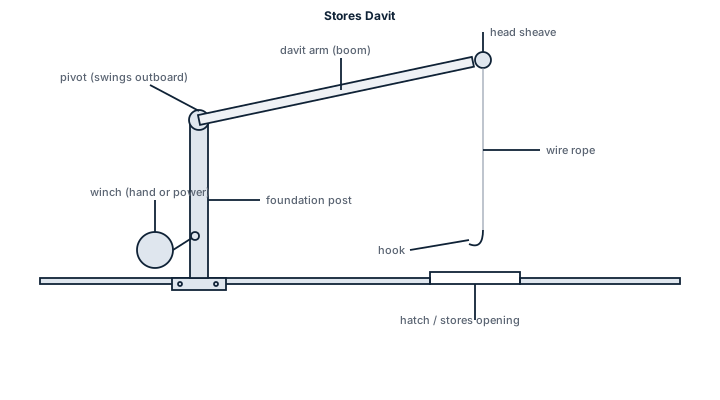
Main components
- Davit arm or crane jib, fixed-length on simple manual units or with limited luffing on powered versions, pivoting on a deck-mounted post or bracket
- Winch, hand-cranked with a worm gear on the simplest units, electric or hydraulic on larger stores davits handling routine heavy provisioning
- Wire rope or chain fall and hook block, sized to the davit's rated capacity with a safe working load marked on the arm
- Slewing mechanism, ranging from a simple pin-stop arrangement giving two or three fixed positions to a geared slew drive on powered units
- Stowage pin or securing arrangement holding the davit arm inboard and locked when not in use, since an unsecured arm swinging in a seaway is a hazard in its own right
Selection and sizing
Safe working load is set by the heaviest routine lift expected - typically a pallet of provisions or a crated spare part - with the standard practical range sitting between 0.5 and 2 tonnes for most stores davits. Reach needs to clear the ship's side and any rail or bulwark by enough margin to land a load cleanly on deck without swinging back into the hull, and mounting location is chosen to serve the provision store or engine room hatch it is meant to support, since dragging heavy stores across open deck to reach the nearest davit defeats the purpose of having one.
Typical faults
| Fault | Consequence |
|---|---|
| Wire rope corrosion or broken strands going unnoticed | Reduced breaking strength on a fitting that is rarely load-tested as rigorously as cargo gear |
| Slew pin or bearing seizure from lack of greasing | Arm cannot be swung out cleanly, tempting crew to force it or rig an improvised lift instead |
| Hook safety latch missing or bent | Load can slip off the hook under a slack-wire condition during landing |
| Securing pin left out after use | Davit arm free to swing in a seaway, striking the hull or crew working nearby |
What to look for in a supplier
- Rated capacity certificate and test documentation matching the davit's actual duty, since even light-duty lifting gear needs a proof load test and periodic inspection under class and flag rules
- Wire rope and hook block sized and certified to match the davit's SWL, not sourced separately without checking the pairing
- Corrosion protection suited to an exposed deck location, since stores davits are rarely as well maintained as primary cargo gear and need to tolerate some neglect
- Manual override or backup winding arrangement on powered units, so a stores lift is not stranded by an electrical fault
Treat a stores davit's annual load test and inspection with the same seriousness as the cargo cranes - it is easy to let light-duty gear slip through the maintenance schedule simply because the loads look harmless.
1 manufacturers · 2 models
Generic (Class Approved)
2- Wire-rope or chain wear causes visible damage, poor spooling or uneven lifting
- Brake, winch or holding-device wear causes load creep or poor holding
- Hydraulic or electric drive faults cause slow or failed lifting
- Pins, sheaves or bearings wear and cause abnormal play or noise
- Limit-switch or control faults cause blocked motion or unreliable stopping
- Simple hand‑operated mechanism – no power supply required
- Low maintenance; only pins need greasing monthly
- Compact footprint suitable for limited deck space
- Class approved design gives regulatory confidence
- Easy to train crew on operation and inspection
- Limited lifting capacity (2 t) compared with powered davits
- Manual handling can be labour‑intensive and slower
- Reach is shorter than hydraulic or electric alternatives
- Wear points such as boom pins and wire rope require frequent checks
- Not suitable for high‑frequency heavy‑lift operations
- Wire-rope or chain wear causes visible damage, poor spooling or uneven lifting
- Brake, winch or holding-device wear causes load creep or poor holding
- Hydraulic or electric drive faults cause slow or failed lifting
- Pins, sheaves or bearings wear and cause abnormal play or noise
- Limit-switch or control faults cause blocked motion or unreliable stopping
- Fast, single‑hand operation reduces crew man‑hours
- Integrated motor thermal protection limits overheating risk
- Class approved design meets basic regulatory safety standards
- Compact footprint suitable for vessels with limited deck space
- Low maintenance compared with hydraulic alternatives when electrical system is reliable
- Limited to a 3 t SWL – unsuitable for heavier stores or lifeboats
- Dependence on ship’s electrical supply; loss of power disables the davit unless backup is provided
- Reported issues with wire‑drum corrosion and pendant cable wear require regular inspection
- Motor thermal trips can interrupt operations if cooling is inadequate
- No built‑in redundancy (e.g., manual hand winch) on many generic units