What to check on a Hatch Coaming.
The coaming is a structural steel wall, not a fitting bolted on afterward - it is built into the deck plating and stiffened as part of the hull girder, because it interrupts deck plating over a large opening and has to carry compressive and shear loads that would otherwise pass through continuous plate. Unlike the padeyes, cleats and ladders covered elsewhere in deck fittings, a coaming is a primary structural member: its height above the deck is set by load line regulations specifically to keep boarding seas out of the…
What sets a hatch coaming apart
The coaming is a structural steel wall, not a fitting bolted on afterward - it is built into the deck plating and stiffened as part of the hull girder, because it interrupts deck plating over a large opening and has to carry compressive and shear loads that would otherwise pass through continuous plate. Unlike the padeyes, cleats and ladders covered elsewhere in deck fittings, a coaming is a primary structural member: its height above the deck is set by load line regulations specifically to keep boarding seas out of the hold, and its top edge and the compression bar welded to it form the sealing face the hatch cover gasket presses against.
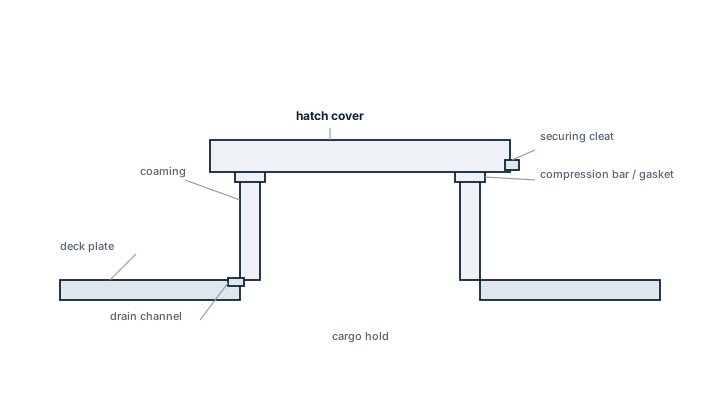
Main components
Coaming plate
Vertical steel plating, typically 10-16 mm depending on ship size and hatch position, welded to the deck and stiffened internally by vertical stiffeners at regular spacing to resist buckling under cargo shift or green water loading.
Compression bar / top bar
A rolled steel bar welded along the top edge of the coaming that the hatch cover rubber gasket compresses against to form a weathertight seal; its profile and alignment are what actually keeps water out, more than the coaming height alone.
Coaming stays / brackets
Diagonal or vertical brackets connecting the coaming to the deck structure below, transferring lateral loads from cargo or hatch cover operation into the hull.
Drain channels
Gutter and drain arrangements at the base of the coaming that carry water shed by the hatch cover gasket away to the deck drains rather than letting it pool against the sealing line.
Selection / Sizing
Coaming height is not a free design choice - the International Convention on Load Lines sets minimum heights above the deck (commonly 600 mm on the freeboard deck, less on superstructure decks in some conditions, more forward on Type A/B-100 ships in the forward quarter length), with reductions permitted only where compensating protection exists. Plate thickness and stiffener spacing follow class society structural rules based on hatch size, position on the vessel, and the deck loads the coaming must resist. The compression bar and gasket geometry must match whatever hatch cover system is fitted, so coaming design and hatch cover selection are done together, not independently.
Regulations / Class
The International Convention on Load Lines sets minimum coaming heights and the conditions under which they may be reduced. Class societies incorporate these into their structural rules and additionally specify plating and stiffener scantlings based on the hatch opening size and location. SOLAS Ch. I requires periodic survey of hatch covers and coamings as part of hull condition assessment, and many class societies run enhanced survey programmes on bulk carriers specifically because coaming and hatch cover integrity failures have caused flooding casualties.
Typical faults
| Fault | Consequence |
|---|---|
| Corrosion wastage of coaming plate, especially at the drain channel and deck connection | Reduced structural strength, potential for cracking under cargo or sea loads |
| Distorted or damaged compression bar | Gasket cannot seal evenly, water ingress into the hold during heavy weather |
| Cracked welds at stiffener or bracket connections | Local structural weakness that can propagate under repeated loading |
| Blocked or damaged drain channels | Water pools against the sealing line, accelerates corrosion and defeats the gasket seal |
What to look for in a supplier
- Fabrication and welding to class-approved procedures, since coamings are primary hull structure, not fitted equipment.
- Compression bar profile matched exactly to the intended hatch cover manufacturer's gasket design.
- Corrosion protection specification (coating system, sacrificial thickness) appropriate to the cargo and trade.
Check the compression bar for local flat spots or dents before every long ocean passage in ballast, when the coaming takes the most green water impact - a bent bar a few millimetres out of line is enough to let water track into the hold.