What to check on a Propeller Shaft.
1 models from Mercury Marine in Propeller Shaft. Below: the full model list.
What defines the propeller shaft
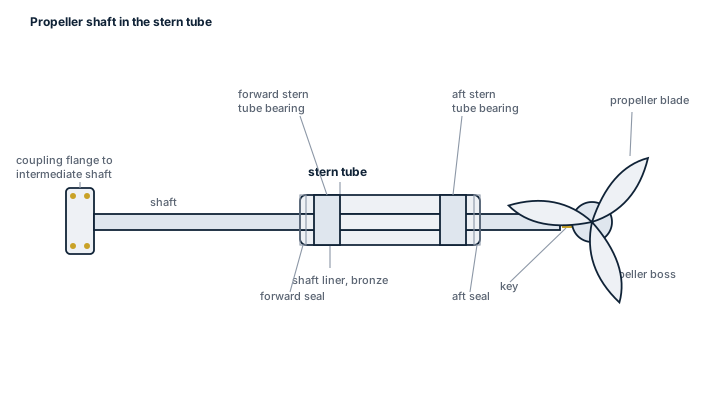
The propeller shaft is the outboard-most section of the shaft line, running from the intermediate shaft coupling, through the stern tube, to the propeller boss. It differs from the intermediate shaft in two respects that drive its whole design: it carries the propeller's thrust as well as the engine's torque, and it runs partly or wholly submerged inside the stern tube, sealed against sea water by shaft seals that the rest of the shaft line does not need. Its condition, more than any single engine parameter, sets the survey interval for the whole propulsion train.
Read the full guide
Main components
Shaft body and taper or flange
Forged steel shaft, either flanged directly to the propeller boss or, on older and smaller designs, tapered with a key and secured by a large retaining nut — the taper and keyway arrangement is the classic site for fretting and crack initiation and has been largely superseded by keyless, hydraulically fitted flange connections on modern tonnage.
Stern tube bearings
Forward and aft bearings support the shaft inside the stern tube. Oil-lubricated white-metal bearings and water-lubricated rubber or synthetic bearings are the two main families; the choice affects the whole sealing and monitoring arrangement around the shaft.
Shaft seals
Aft seal keeps sea water out of the stern tube, or on water-lubricated designs keeps lubricating water in; forward seal keeps stern tube oil out of the engine room bilge. Seal wear is monitored through oil consumption or leakage rate, not by direct inspection while the shaft is running.
Corrosion protection
Sacrificial anodes and, on many ships, a shaft earthing or grounding brush to bleed off stray currents generated by the rotating shaft in sea water, which otherwise accelerate corrosion and pit the shaft surface at the stern tube.
Selection and sizing
- Shaft diameter set by class rules from the transmitted torque, material yield strength and a fatigue margin, not by engine power alone
- Material grade and, where fitted, a corrosion-resistant liner or sleeve over the sections exposed to sea water
- Bearing type, oil or water lubricated, chosen against maintenance philosophy and, increasingly, environmental restrictions on oil-lubricated stern tubes near sensitive waters
- Coupling type at the forward end matched to the intermediate shaft and gearbox or engine flange
Regulations and class
Class rules, the IACS UR M-series requirements for shafting, set the minimum shaft diameter, the survey interval for shaft withdrawal or in-water inspection, and the conditions under which that interval can be extended, generally tied to oil sample condition monitoring and bearing clearance history rather than a fixed calendar alone. Water-lubricated stern tubes without oil are subject to separate environmental rules in several coastal states restricting oil-to-sea discharge risk.
Typical faults
| Fault | Consequence |
|---|---|
| Fretting or cracking at a taper/keyway connection | Progressive crack growth toward shaft failure, a known cause of catastrophic loss of propulsion |
| Aft seal wear or damage | Sea water ingress to the stern tube, contaminating lubricating oil and accelerating bearing wear |
| Stern tube bearing clearance beyond limit | Increased vibration, further accelerated wear, risk of shaft contact with the bearing |
| Shaft earthing brush worn or missing | Stray current corrosion pitting the shaft at the stern tube over time |
What to look for in a supplier
- Class-certified material and NDT records for the specific shaft forging, traceable by serial number
- Machining tolerances confirmed against the class-approved drawing, not a generic equivalent
- Ability to support in-water or dry-dock withdrawal work with the correct tooling for the actual coupling type fitted
Track oil sample trends and bearing clearance readings over successive surveys, not just the latest snapshot — a slow trend toward the limit is the warning that a fixed calendar interval will not catch on its own.