What to check on a Propulsion Equipment.
1 models from Vetus in Propulsion Equipment. Below: the full model list.
What this equipment covers
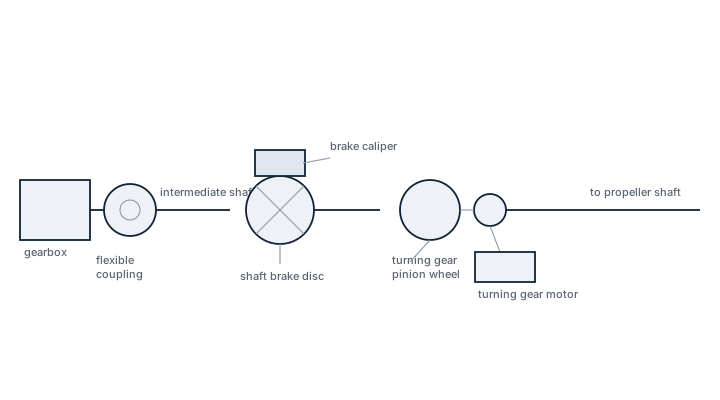
Propeller, shaft, stern tube seal and thrust bearing each have their own place elsewhere in this directory; propulsion equipment groups the remaining hardware that keeps the shaft line safe to work on and controllable at the ends of its speed range: flexible couplings that absorb misalignment and torsional shock between engine, gearbox and shaft, the shaft brake that stops a freewheeling shaft, turning gear for slow rotation during maintenance, and shaft earthing devices that bleed off induced electrical charge before it pits the bearings.
Read the full guide
Main components
Flexible couplings
Rubber-block, membrane or gear-type couplings sit between engine flywheel and gearbox, or gearbox and shaft, absorbing angular and torsional misalignment so the crankshaft and the shaft line do not have to be perfectly rigid together. Torsional flexibility also damps the torque pulses a diesel engine's firing order puts into the shaft line, which matters for avoiding resonance at certain running speeds.
Shaft brake
A caliper or drum brake acting on a disc fitted to the shaft, used to bring a freewheeling propeller to rest, for example after a crash stop or before divers work near the propeller, and to hold the shaft stationary during maintenance.
Turning gear
A small motor-driven pinion that engages the shaft or the engine flywheel to rotate it at a few revolutions per minute for inspection, alignment checks, or barring before starting a large slow-speed engine. Turning gear must be mechanically or electrically interlocked so the main engine cannot be started while it is still engaged.
Shaft earthing device
A brush or slip ring assembly bridges the rotating shaft to the hull, discharging the static and induced voltage that would otherwise arc across the oil film in the stern tube bearing, slowly pitting the bearing surface.
Selection and sizing
Couplings are selected on transmitted torque, permissible misalignment, and the torsional stiffness needed to keep the shaft line's natural frequencies clear of the engine's firing frequencies across the operating speed range, a calculation normally done by the engine or gearbox maker rather than picked from a catalogue by torque alone. Shaft brakes are sized on the kinetic energy to be absorbed in a crash stop from full sea speed, not on static holding torque. Turning gear is sized on the torque needed to break away a cold, stationary shaft line, which is higher than the torque to keep it turning once moving.
Regulations and class
- Class rules require a torsional vibration calculation for the complete shaft line, covering the coupling's stiffness, before a new engine, gearbox or coupling type is approved for a given hull.
- Turning gear interlocks preventing accidental main engine start are a standard class survey item, checked physically at each renewal survey.
- Shaft earthing device condition (brush wear, continuity) is checked at survey because a failed earthing brush is a common, easily missed contributor to stern tube bearing damage found only at drydocking.
Typical faults
| Fault | Consequence |
|---|---|
| Coupling rubber elements aged, cracked or oil-contaminated | Loss of torsional damping, increased vibration, and in severe cases coupling failure under load |
| Shaft brake pads worn or hydraulic system leaking | Extended stopping distance in an emergency, or failure to hold the shaft during maintenance work near the propeller |
| Turning gear interlock defeated or bypassed | Main engine can be started with turning gear still engaged, destroying the turning gear pinion and gear teeth |
| Earthing brush worn down or lifted off the shaft | Electrical pitting of the stern tube bearing surface, found only when the bearing is later inspected or replaced |
What to look for in a supplier
- Coupling supplied with a torsional vibration calculation matched to the actual engine and gearbox combination, not a generic torque-rated part.
- Documented crash-stop energy rating for shaft brakes, referenced to the vessel's actual displacement and sea speed.
- Turning gear with a certified mechanical or electrical interlock, not an advisory warning sign alone.
- Earthing brush material and spring tension suited to continuous running hours between planned replacements.
Log turning gear hours and interlock tests the same way you log main engine running hours; a defeated turning gear interlock is one of the few propulsion faults that can destroy two machines in a single mistake.