Inflatable Life Raft (SOLAS-A)
A SOLAS-A life raft is the fully equipped, ocean-service inflatable raft carrying the complete LSA Code equipment pack for unrestricted voyages, distinguished from a SOLAS-B or leisure raft by its equipment scale, self-righting canopy and the servicing regime that keeps its release gear and inflation system certain to work years after packing.
What to check on an Inflatable Life Raft (SOLAS-A).
91 models from Survitec Group in Inflatable Life Raft (SOLAS-A). Below: the full model list.
What defines this type
SOLAS-A denotes the equipment pack and construction standard, not the raft's size: it is the version required for ships on unrestricted or long international voyages, carrying the full LSA Code equipment scale rather than the reduced pack permitted on a SOLAS-B raft for shorter, better-supported routes. The defining engineering features are a self-righting canopy so the raft is usable whichever way it lands after inflation, and a hydrostatic release unit (HRU) on the painter line so the raft floats free and inflates automatically if the ship sinks before anyone can launch it by hand.
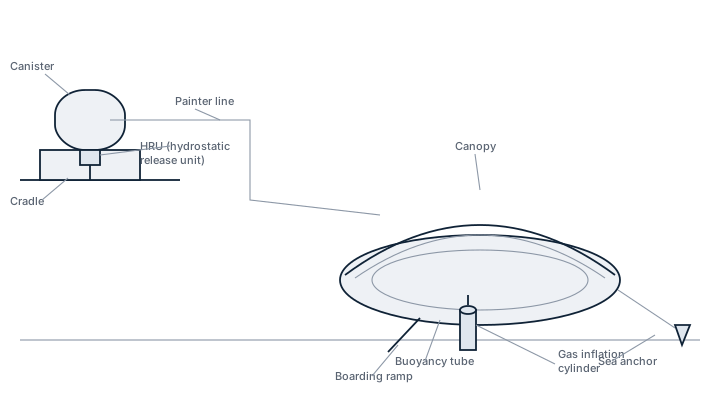
Main components
- Buoyancy tubes – two independent inflatable tube chambers, either can support the raft alone if the other is damaged.
- Floor – typically a double, inflatable insulated floor that keeps survivors off cold water beneath the raft.
- Canopy – self-erecting on inflation, shelters occupants and collects rainwater for drinking.
- Painter line and hydrostatic release unit – the line that triggers inflation on pulling, and the HRU that releases the raft automatically at a shallow depth if the ship goes down with the raft still in its cradle.
- Inflation system – a CO2 or CO2/N2 gas cylinder that inflates both buoyancy chambers and the canopy within roughly a minute of activation.
- Boarding ramp and righting strap – aids to board from the water and to right the raft if it inflates upside down.
- SOLAS-A equipment pack – rations, water, seasickness tablets, first aid, pyrotechnic flares, a signalling mirror and torch, fishing kit and repair materials to the scale set by the LSA Code.
Selection
The choice on a SOLAS-A raft is less about performance variants and more about matching stowage and capacity to the vessel:
- Capacity in persons, sized so the ship's total raft capacity covers the full complement with the required margin for a damaged raft.
- Container type: a rigid GRP canister for davit or float-free stowage on larger ships, versus a valise pack on smaller craft where a soft case is stowed in a dedicated locker.
- Float-free versus davit-launched arrangement, which decides whether an HRU is fitted at all and how the raft is cradled.
Regulations and class
SOLAS Chapter III sets out life-saving appliance carriage requirements, and the LSA Code fixes the SOLAS-A equipment scale and construction standard the raft and its pack must meet. Rafts require annual servicing at a manufacturer-approved service station, where the canister is opened, the raft inflated and inspected, the gas cylinder weighed, and the equipment pack checked against expiry dates. The hydrostatic release unit carries its own limited service life, commonly replaced on a fixed cycle rather than serviced, since its trigger mechanism cannot be reliably tested without destroying it. A raft or HRU running past its service or expiry date is a routine port state control detention item.
Read the full guide
Typical faults
| Fault | Consequence |
|---|---|
| Expired hydrostatic release unit | The raft may not release automatically if the ship sinks before manual launch, defeating its entire purpose |
| Canister seal degradation | Water ingress into the canister, corroding the gas cylinder valve and equipment pack |
| Gas cylinder underweight or leaking | Incomplete inflation on activation, found at annual service or, worse, in an actual launch |
| Painter line chafe or UV degradation | Line parts before the raft fully inflates and separates from a sinking ship |
| Overdue annual service | Certificate invalid, raft treated as not carried for compliance purposes, port state detention |
What to look for in a supplier
- A genuinely global approved service station network matching the ship's trading pattern, not just a home-port agent.
- Canister material and cradle dimensions compatible with the existing davit or float-free stowage.
- A capacity certificate matching the vessel's actual crew and passenger complement with the required spare margin.
- Valid type approval for the flag state the ship is registered under.
Log the HRU replacement date separately from the raft's own service date; the two run on different cycles and it is the HRU that most often gets missed at survey.
Models in this type.
The best-documented model of each manufacturer first, then the next — 91 of 91 models in Inflatable Life Raft (SOLAS-A). Every row links to full specifications, documents and service notes.
Manufacturers.
All 25 manufacturers with models of Inflatable Life Raft (SOLAS-A). Names with a manufacturer page open it; the others open a search across the full library.
All manufacturersAlso in Life Rafts.
The other equipment types in this category.
One request. A person reads it and replies by e-mail.
Tell us the manufacturer, the model and what you need — a part, a service call, a second opinion. A person reads every request and replies by e-mail.
No details at hand? A photo of the rating plate or the part is enough — simply attach it to the request.
Three things people ask first.
Is Inflatable Life Raft (SOLAS-A) data free?
Yes. Every model page, every guide and every datasheet for this type is readable without an account. An account adds saved searches and requests, nothing is taken away.
My model is missing — what now?
Send us the nameplate. We identify it by hand, add it to the library, and if you need a part or a service, the request is already on our desk.
Can you source a Inflatable Life Raft (SOLAS-A) part?
Yes. Tell us the manufacturer, the model and what you need — a person reads every request and replies by e-mail.