What to check on a Throw-Over Life Raft.
A throw-over life raft is stowed in a canister or valise, secured to the ship by a painter line, and launched by throwing it over the side and letting it inflate in the water — there is no davit, no powered lowering mechanism, and no requirement for a crane or launching arm. That makes it the standard fit for smaller vessels and for secondary or additional raft stations on larger ships where a davit-launched arrangement is not fitted, and it depends on a hydrostatic release unit to get it into…
What defines this type
A throw-over life raft is stowed in a canister or valise, secured to the ship by a painter line, and launched by throwing it over the side and letting it inflate in the water — there is no davit, no powered lowering mechanism, and no requirement for a crane or launching arm. That makes it the standard fit for smaller vessels and for secondary or additional raft stations on larger ships where a davit-launched arrangement is not fitted, and it depends on a hydrostatic release unit to get it into the water automatically if the ship sinks before anyone reaches the stowage point.
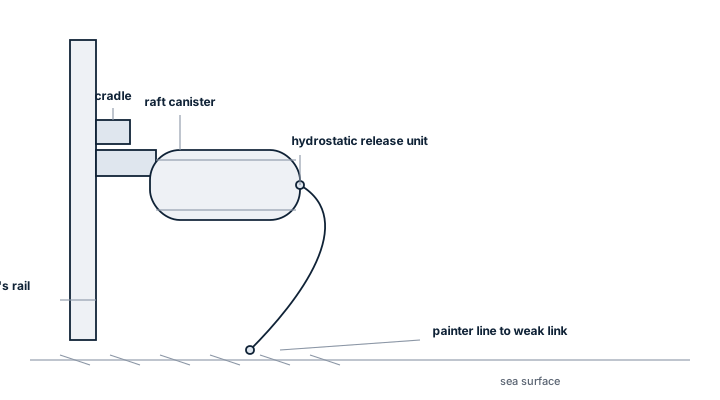
Main components
Container
A rigid GRP canister for open weather deck stowage, or a soft valise for sheltered or accommodation-area stowage; the canister protects the raft from UV and mechanical damage on an exposed deck, while the valise is lighter and easier to manhandle but only suitable where it is not directly exposed to weather.
Painter line and weak link
A line connecting the raft to the ship, used to trigger inflation by pulling it out to its full length and beyond, and fitted with a weak link designed to part at a defined load so a sinking ship does not drag the inflated raft down with it.
Hydrostatic release unit (HRU)
Releases the raft's lashing automatically at a shallow depth (typically around 1.5-4 metres) if the ship sinks without anyone launching the raft manually, letting it float free and then inflate as the painter line pays out.
Inflation cylinder and canopy
A CO2 or CO2/nitrogen cylinder inflates the buoyancy tubes and self-erecting canopy within roughly 30-60 seconds of the painter line pull, and the canopy provides shelter from exposure once occupied — often the single biggest survival factor after the first hours.
Selection / Sizing
| Parameter | What it drives |
|---|---|
| Rated capacity (persons) | Matched to muster station allocation, not vessel complement alone |
| Equipment pack (SOLAS A or B) | A-pack for long international voyages, B-pack for short/coastal service where permitted |
| Container type | Canister for exposed deck stowage; valise for sheltered stowage only |
| Stowage height | Must allow float-free launching within the HRU's operating depth as the ship sinks |
Stowage location has to give a clear drop path to the water with nothing to foul the raft on the way down, and cradle and lashing arrangements must be compatible with the specific HRU model fitted — mixing components from different manufacturers without an approved combination is a common source of survey findings.
Regulations / Class
SOLAS Chapter III and the LSA Code set the carriage, capacity and equipment pack requirements for life rafts, including the mandatory float-free arrangement via an HRU for rafts that are not davit-launched. The HRU itself has a manufacturer-stated service life (commonly two years) and must be replaced or serviced before expiry, checked at every safety equipment survey. Rafts require servicing at an approved service station at intervals set by the manufacturer and flag administration, typically annually, covering inflation testing, repacking, and inspection of the CO2 cylinder charge and painter line condition — a raft past its service due date is treated as not carried for survey purposes, regardless of physical presence on board.
Typical faults
- Expired or corroded HRU — the single point of failure for automatic float-free launching; an expired unit may not release at all, defeating the entire self-launching design.
- Canister seal degradation — UV and salt exposure over years can compromise the canister seal, letting moisture in and risking a raft that fails to inflate correctly when needed.
- Painter line incorrectly secured — attached to a point that does not hold under load, or led so it can foul on deck fittings during launch, preventing the inflation trigger from working as designed.
- Overdue servicing — the most common finding at port state control inspections; a raft outside its service interval is a detention-grade deficiency on most flags.
- Incorrect stowage height — a raft stowed too high for the HRU's rated release depth, or too low and exposed to routine wave damage, undermines the float-free arrangement it depends on.
What to look for in a supplier
- SOLAS/MED type approval for the specific raft and capacity, matched against the vessel's safety equipment certificate.
- Confirmed compatibility between the raft's cradle, the HRU model, and any weak link specified — not a generic "fits most" claim.
- A servicing station network that actually covers the vessel's trading pattern, since an overdue raft cannot simply wait for the home port.
- Clear documentation of pack contents (SOLAS A or B) so the equipment inside matches the voyage type the vessel actually undertakes.
Check the HRU expiry date at every monthly lifeboat drill, not just at annual survey — it is a small, easily overlooked component that determines whether the entire raft launches itself if no one is left to throw it.