What to check on a Davit-Launched Life Raft.
A standard throw-overboard life raft is thrown or lowered into the sea in its container, inflates on the painter line, and survivors board it from the water or via a ladder, which works but is slow and exposes people to the sea before they are safely aboard. A davit-launched raft instead hangs from a purpose-built davit, is inflated and lowered under control while still connected to the ship, and lets survivors board directly from the embarkation deck, then be lowered to the water already loaded, similar in principle to lifeboat…
What makes a davit-launched raft different
A standard throw-overboard life raft is thrown or lowered into the sea in its container, inflates on the painter line, and survivors board it from the water or via a ladder, which works but is slow and exposes people to the sea before they are safely aboard. A davit-launched raft instead hangs from a purpose-built davit, is inflated and lowered under control while still connected to the ship, and lets survivors board directly from the embarkation deck, then be lowered to the water already loaded, similar in principle to lifeboat launching but far lighter and faster to rig.
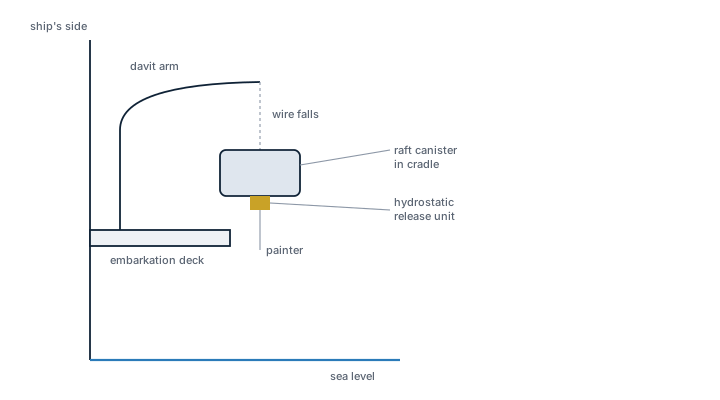
Main components
Raft container and canister
A rigid fibreglass container houses the folded raft, inflation system, and equipment pack, mounted at the davit head rather than in a standard stowage cradle.
Inflation system
A compressed CO2/nitrogen cylinder inflates the buoyancy chambers and canopy arch within roughly a minute of activation, with the raft designed to inflate and stabilise the right way up even in a seaway.
Lifting bridle and hook
A dedicated lifting bridle, separate from the painter line, connects the inflated raft to the davit hook so it can be raised and lowered under load with people aboard, distinct from a throw-overboard raft's simple painter arrangement.
Davit and winch
A powered or manually backed-up davit lowers the loaded raft to the water and can recover it, and must include a means of quick release once waterborne, plus a secondary manual lowering method if power is lost.
Equipment pack
SOLAS-specified rations, water, flares, first aid, and a repair kit are packed inside, sized to the raft's certified capacity and sealed until an inspection or an actual launch.
Selection and sizing
Capacity (number of persons) must match the muster station's allocated complement with the vessel's approved arrangement, and davit safe working load must cover the raft's fully loaded weight plus dynamic loading during lowering, not just the static weight of raft and equipment. Ambient service temperature range of the inflation system and raft material matters for the trade the vessel actually operates in, since cold-water and cold-climate rated rafts use different inflation gas mixes and materials than warm-water standard rafts.
Regulations and class
- SOLAS Ch. III and the LSA Code set construction, capacity, equipment pack contents, and launching time requirements for davit-launched life rafts, including a maximum time allowed from the order to launch to the raft being waterborne with its full complement.
- Annual service by an approved life raft service station is required, plus a periodic (typically five-yearly) hydrostatic and full inflation system overhaul, with the interval and scope defined by the raft's approval certificate.
- Davit load testing and function testing form part of the periodic survey, separate from the raft's own service, since a raft passing its annual service does nothing if the davit cannot lower it.
Typical faults
| Fault | Consequence |
|---|---|
| Inflation cylinder pressure or hydrostatic release unit past its service life | Raft may fail to inflate fully or on time when launched, discovered only at the worst possible moment |
| Davit wire or winch brake corroded from lack of use | Lowering under load stalls or runs away, exactly the kind of fault a routine visual inspection without an actual load test will miss |
| Lifting bridle chafed or a shackle seized | Bridle fails or cannot be released once waterborne, trapping the raft against the ship's side |
| Equipment pack contents past expiry (flares, rations, batteries) | Survivors have a working raft but non-functional signalling or supplies once aboard |
What to look for in a supplier
- Approval certificate matching the exact davit and raft combination, since davit-launched rafts are approved as a system, not as interchangeable parts from different manufacturers.
- Service station network reachable at the vessel's actual ports of call within the annual service window, since a raft overdue for service is a detention item.
- Cold-water or tropical rating matched to the vessel's actual trading area, not a default specification.
- Spare hydrostatic release units and painter lines in stock, since these are consumable safety items with fixed expiry dates rather than components that last the raft's full service life.
Treat the davit as part of the life raft, not a separate item; a raft that passes its annual service on a bench proves nothing about whether the davit that has to lower it under a full load will actually work on the day.