Speed Log
A speed log measures the ship's actual speed through the water, which is not the same figure a GPS reports as speed over ground, and it is what feeds squat and manoeuvring calculations that current alone cannot supply.
What to check on a Speed Log.
3 models from Furuno Electric in Speed Log. Below: the full model list.
What sets the speed log apart
A speed log measures the ship's own speed, either through the surrounding water or over the seabed, and feeds that figure to ECDIS, radar vector calculations, the autopilot and engine performance monitoring. It is not interchangeable with GPS-derived speed over ground: GPS tells the ship how fast it is covering distance across the earth, including the effect of current, while a true speed log measures motion relative to the water itself, which is what manoeuvring, squat and set-and-drift calculations actually need.
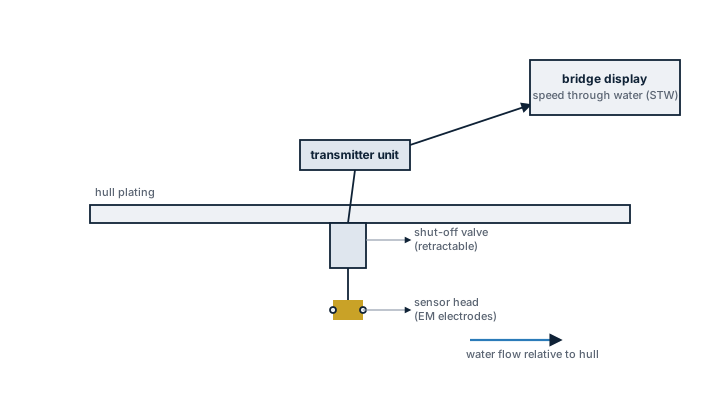
Legend
- bridge display speed through water (STW)
- hull plating
- transmitter unit
- shut-off valve (retractable)
- sensor head (EM electrodes)
- water flow relative to hull
Main components and types
Electromagnetic log
A sensor probe protrudes slightly through the hull and measures the small voltage induced as water flows past it, giving speed through water on the fore-aft axis and, on dual-axis units, athwartship speed as well, which matters during berthing on larger ships.
Doppler log
An acoustic transducer sends a signal toward the seabed and measures the frequency shift of the return, giving speed over ground while the seabed is within range, typically up to a few hundred metres of water depth; beyond that range it reverts to measuring against a water layer instead, giving speed through water without always making the switch obvious to the user.
Read the full guide
Sensor housing
Many logs use a retractable housing so the sensor can be withdrawn for cleaning or inspection without dry-docking the ship, sealed by a valve when retracted.
Selection and sizing
- Single-axis logs cover fore-aft speed only; dual-axis logs add transverse speed, useful for ships that need close manoeuvring data during berthing.
- Doppler bottom-tracking range against the ship's typical operating depths, since deep-water passages rely on water-track mode instead.
- Retractable versus fixed sensor housing, weighed against maintenance access and the hull maintenance schedule.
Regulations and class
SOLAS Chapter V requires ships above a certain size on international voyages to carry a speed and distance measuring device, and IMO performance standards set accuracy requirements for it. Class surveys check the transducer seacock or valve for watertight integrity, since it is a hull penetration below the waterline.
Typical faults
| Fault | Cause | Consequence |
|---|---|---|
| Sensor fouling | Marine growth on the electromagnetic sensor face | Reading drifts and typically underreads actual speed |
| Bottom-lock loss | Doppler log operating in water too deep for seabed return | Silent switch to water-track mode, speed over ground accuracy lost without a clear warning |
| Retraction mechanism seizure | Corrosion or lack of exercise of the housing | Sensor cannot be withdrawn for maintenance, forcing a dry-dock delay |
| Calibration bias | Hull cleaning or repainting changing flow characteristics at the sensor | Systematic speed error across the whole operating range |
What to look for in a supplier
- Transducer material and coating compatible with the ship's hull coating regime.
- Reliability record of the retractable housing mechanism.
- Calibration support after installation, hull cleaning, or dry-docking.
- Standard data output, typically NMEA, compatible with the existing bridge systems.
GPS speed over ground looking correct on the display is not proof the log is working — through-water speed is what manoeuvring and squat calculations actually rely on, and only the log measures it independently of current.
Models in this type.
The best-documented model of each manufacturer first, then the next — 3 of 3 models in Speed Log. Every row links to full specifications, documents and service notes.
Manufacturers.
All 24 manufacturers with models of Speed Log. Names with a manufacturer page open it; the others open a search across the full library.
All manufacturersAlso in Position & Heading.
The other equipment types in this category.
One request. A person reads it and replies by e-mail.
Tell us the manufacturer, the model and what you need — a part, a service call, a second opinion. A person reads every request and replies by e-mail.
No details at hand? A photo of the rating plate or the part is enough — simply attach it to the request.
Three things people ask first.
Is Speed Log data free?
Yes. Every model page, every guide and every datasheet for this type is readable without an account. An account adds saved searches and requests, nothing is taken away.
My model is missing — what now?
Send us the nameplate. We identify it by hand, add it to the library, and if you need a part or a service, the request is already on our desk.
Can you source a Speed Log part?
Yes. Tell us the manufacturer, the model and what you need — a person reads every request and replies by e-mail.