Freefall Lifeboat
A freefall lifeboat is stern-mounted and dropped down its own ramp straight into the sea under gravity, rather than lowered on wires. Tankers and bulkers fit them because a burning sea surface can spread faster than a davit-launched boat can clear the ship's side.
What to check on a Freefall Lifeboat.
36 models from MacGregor in Freefall Lifeboat. Below: the full model list.
What makes this type
A freefall lifeboat sits on an inclined ramp at the stern, above the propeller and rudder, and is released to slide down and enter the water bow-first under its own weight and momentum. The forward speed built up during the drop, combined with the hull's impact-absorbing bow, is what drives the boat clear of the hull before the engine even engages. This is fundamentally different from a davit-launched boat, which is lowered slowly on falls and depends on the crew rowing or motoring away from the ship's side while the sea state and any spreading fire allow it. On a laden tanker with a flame-engulfed deck, that window may not exist, which is the actual reason free-fall systems became standard on tankers and bulk carriers rather than an alternative on passenger ships, where mustering large numbers at the stern is impractical.
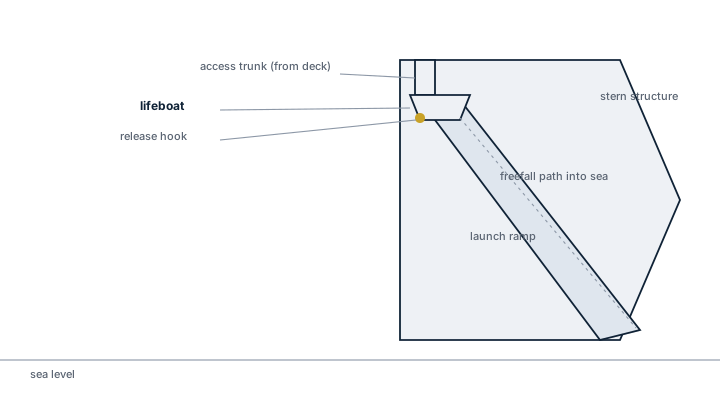
Legend
- Access trunk (from deck)
- Lifeboat
- Release hook
- Launch ramp
- Stern structure
- Freefall path into the sea
- Sea level
Main components
Hull and occupant restraint
The hull is GRP (glass-reinforced plastic), shaped with a reinforced, energy-absorbing bow section to survive repeated impact drops during drills. Seats face aft (away from the direction of travel) with full harnesses, because the deceleration on water entry is severe enough to injure an unrestrained occupant.
Release hook and hydrostatic interlock
A single on-load release hook holds the boat on the ramp. It is fitted with a hydrostatic interlock that prevents the hook from opening until the boat is waterborne, and prevents the coxswain from releasing prematurely while still on the ramp. Following several fatal accidents where hooks released unexpectedly during recovery or maintenance, IMO introduced revised on-load release gear requirements that most fleets retrofitted in the years after adoption.
Read the full guide
Launch ramp and skid
The ramp fixes the launch angle and is engineered together with the hull design; changing ramp angle, greasing, or skid surface without maker and class approval changes the drop dynamics the hull was tested for.
Engine and, on tankers, sprinkler protection
A self-contained diesel engine gives the boat way once waterborne. Boats intended for use where the sea surface may be on fire carry a self-contained air supply and an external water-spray system that keeps the hull wetted while running through flame for a limited period.
Selection / Sizing
Capacity is set by the vessel's maximum complement, not by deck space, and boats are ordered to seat that number plus margin. Launch height above the waterline follows from freeforeboard and stern geometry; a VLCC in ballast can have a drop height well beyond that of a small bulk carrier, and the hull and restraint system must be tested and marked for that specific height range. Fire-protected (sprinkler) versions are mandatory on tankers carrying flammable cargo; a standard GRP boat without spray protection is not an acceptable substitute even if capacity matches.
Regulations / Class
Freefall lifeboats fall under SOLAS III/31 and the LSA Code, with prototype and production testing against the IMO test standard for lifesaving appliances. On-load release gear must meet the post-2013 IMO requirements introduced after a string of release-gear casualties. Class requires five-yearly overhaul of the release gear and hook by an approved service provider, annual thorough examination, and periodic launching drills; SOLAS allows drills without full launch under specific conditions on some ship types, but the release mechanism must still be operated.
Typical faults
- Corroded or seized hydrostatic interlock — the boat either cannot be released when waterborne or, worse, releases prematurely on the ramp during maintenance, which has caused fatalities during drills.
- Hook mechanism wear or misadjustment — inconsistent release load, sometimes requiring excessive force from the coxswain, sometimes releasing under load it should hold.
- Engine failure to start — flat batteries or stale fuel from long periods of inactivity between drills.
- Sprinkler pump or piping blockage — the fire-protection function fails silently unless tested, since it is not needed for a routine launch.
- GRP hull degradation — UV exposure and repeated drop-testing over years produce gel-coat cracking that, if ignored, becomes a structural issue.
What to look for in a supplier
- MED wheel-mark type approval and on-load release gear compliant with the current IMO release-gear standard, not a legacy design.
- An approved service station network with realistic turnaround for the five-year overhaul, since the boat is out of service during it.
- Documented free-fall drop testing at the launch height range actually fitted to the ship, not a generic certificate.
- Spare-parts availability for the hook and interlock assembly specifically, which is the part that fails most often in service.
Never let a drill schedule slip into "launch without release testing" as standard practice — the interlock and hook are the parts that kill people when nobody has actually cycled them in years.
Models in this type.
The best-documented model of each manufacturer first, then the next — 36 of 36 models in Freefall Lifeboat. Every row links to full specifications, documents and service notes.
Manufacturers.
All 186 manufacturers with models of Freefall Lifeboat. Names with a manufacturer page open it; the others open a search across the full library.
All manufacturersShow all 186 manufacturers
- Aalesund Protective Wear AS1
- AB Volvo Penta1
- ACR Electronics1
- ACTA A/S2
- Akana Deniz Teknolojileri San. Tic. Ltd. Sti.1
- ALBATROSS S.R.L.1
- Aquamate Products T/A Echomax1
- AquaSpec3
- Asiatic Fire System Pte Ltd1
- ASIS Boats LLC1
- Aukra Maritime4
- AUXILIAR DE SEGURIDAD EN LA MAR, S.A.6
- BADA Heavy Industries8
- Boatbuilding Yard,8
- Brødr Hukkelberg AS4
- Brunswick Marine in EMEA2
- Bryne Winch Solution AS1
- BUKH5
- C M HAMMAR AB2
- Chongqing Gathering Marine Equipment3
- D-i Davit International-hische3
- D.M.C. Co., Ltd.2
- Damen Shipyards Hoogezand1
- Datrex1
- DELTA POWER GROUP1
- Dongtai City Dongfang Marine Fitting Co., Ltd.3
- Dongtai City Jianghai Lifesaving & Fire-Fighting Equipment Co., Ltd.3
- Dongtai Martian Ship Equipment Co., Ltd.1
- DREWIL ENTERSHIP1
- Epsilor-Electric Fuel Ltd.1
- EVAL – E.G. Vallianatos4
- Fama Sp. z o.o.1
- Fassmer-Marland China Ltd.7
- Fristad Plast AB1
- Frydenbø Forward AS3
- Frydenbø Industri AS3
- GC Rieber Compact AS1
- Gepa Fiberglass San ve Tic.A.S1
- Global Davit11
- GRUPO DE INGENIERIA APLICADA GALLEGA,S.L3
- Gürdesan Gemi Makina1
- H.M.B. GmbH1
- Haean Machinery Ind. Co., Ltd.1
- Haimen Jianghai Marine Life-Saving Equipment Co., Ltd.3
- Hansson PyroTech3
- Harding Safety AS2
- Heinrich A. Schröder GmbH & Co. KG1
- Helgeland Plast AS1
- HLB CO., LTD.1
- Huahai Marine Signals Manufacturing Co., Ltd.4
- Hyun Chang Industries Co., Ltd.1
- Hyundai Lifeboats3
- Inflatable Marine Craft c.c.1
- Jiangsu Haining Marine Equipment Co., Ltd.6
- Jiangsu Haitai Ship's Whole Set Co.,Ltd.2
- Jiangsu Yiqi Ship Technology Co., Ltd.1
- Jiangyan City Marine Outfitting Co. Ltd.2
- Jiangyin Norsafe F.R.P. Co. Ltd.2
- Jiangyin Yongda Cord Net Co., Ltd.1
- Jiangyinshi Beihai LSA Co., Ltd.2
- Jiaxing Rongsheng Lifesaving Equipment Co., Ltd.12
- JUNG-A Marine Co., Ltd.1
- Kent Water Sports Holdings, LLC1
- Knierim Yachtbau GmbH1
- Kolberg Caspary Lautom4
- Kverneland Aqua AS8
- Lalizas Hellas12
- Lankhorst Taselaar b.v.2
- Leon Sports Ltd.3
- Liferaft Systems Australia5
- LSA-service GmbH2
- Mariner Ship's Equipment Ltd.1
- Maritime Deck Machinery B.V.10
- Maritime Partner13
- Matchanu Marine (Thailand) Co., Ltd.2
- Mercury Marine - Division of Brunswick8
- Mustang Survival1
- Nanjing Dongsheng Marine Equipment Co., Ltd.1
- Nanjing Nautical Instrument Plant No. 2 Co., Ltd.1
- Nantong Haizhou Marine Equipment11
- Nantong Heting Mechanical and Electrical Equipment Co., Ltd.3
- NARWHAL BOATS4
- Neuenfelder Maschinenfabrik GmbH2
- Neumaticas de Vigo, S.A.U.2
- Ningbo Kairong New Energy Co., Ltd.3
- Ningbo Neptune Life-Saving Equipment Co., Ltd.7
- Ningbo New Marine4
- Ningbo Zhenhua Life-saving Equipment Co., Ltd.3
- Ocean Safety5
- Ocean Signal1
- Oceanwide8
- Pesbo S.A.4
- Peters + Bey GmbH1
- Polish Baltic Company Phz S.C.1
- PTR Holland Group2
- Qingdao Beihai Boatbuilding Co., Ltd.11
- Qingdao Beihai Shipbuilding Heavy Industry11
- Qingdao Good Brother Marine Lifesaving Appliances Co. Ltd.6
- Restech Norway4
- RIS MARINE1
- Rudolf Seldis GmbH & Co. KG1
- S.C. SANTIERUL NAVAL BRAILA S.A.1
- Scandia Gear Europe B.V.1
- SERVO SHIP, S.L.6
- Sezamor Rem3
- Shanghai Cunhong Marine Lifesaving Appliance3
- Shanghai Fang Zhan fire Technology Co., Ltd.5
- Shanghai Haian Lifesaving Equipment3
- Shanghai Huaxiang Dacheng Rubber Plastics Co., Ltd.3
- Shanghai Qiangang Industrial Co., Ltd.1
- Shanghai TongQing Marine Equipment Co., Ltd.1
- Shanghai Yibei Safety Equipment9
- Shanghai Youlong Rubber Products Co., Ltd.10
- Shanghai Zhouqin Maritime Equipment Co., Ltd.10
- Sheyang Saifute Marine3
- Shigi1
- Shin Myung Tech. Co., Ltd.1
- Steel Recon Industries5
- Stocznia Ustka Sp.z.o.o.8
- Storm Cranes AS1
- Survitec14
- Survitec Survival Craft7
- Survival One2
- Suzhou Haixing Maritime Equipment Co., Ltd.7
- Suzhou Parsun Power Machine Co., Ltd.4
- T-ISS B.V.1
- Tecklenborg, Kegel GmbH1
- Tohatsu Corporation2
- Torunskie Zaklady Urzadzen2
- TR.EM. - S.R.L.3
- ULSTEIN FAMA Spolka z.o.o.5
- Umoe Schat-Harding GmbH15
- Vanguard Marine LDA2
- Vestdavit1
- Vetus2
- VIKING15
- Walter Hering1
- WESCOM SIGNAL AND RESCUE GERMANY GMBH2
- White Glacier Manufacturing Corp.1
- Wuxi Huahai Marine Equipment Factory3
- Wuxi Xingtai Shipping Equipment Co., Ltd.4
- Yamaha Motor Co., Ltd.12
- Yancheng Shenli Rope-Making Co., Ltd.1
- Yanmar Power Technology Co., Ltd. Tsukaguchi Factory1
- Yantai Huayang Lifesaving Equipment Manufacturing5
- Zhejiang Winner Fire Fighting Equipment Co., Ltd1
- Zhenjiang DH Marine Equipment Co., Ltd.1
- Zhenjiang Siyang Diesel Engine Manufacturing Co.Ltd1
- ZIPA Marine Wholesale Limited1
- Zollern GmbH & Co. KG7
Also in Lifesaving Appliances (LSA).
The other equipment types in this category.
One request. A person reads it and replies by e-mail.
Tell us the manufacturer, the model and what you need — a part, a service call, a second opinion. A person reads every request and replies by e-mail.
No details at hand? A photo of the rating plate or the part is enough — simply attach it to the request.
Three things people ask first.
Is Freefall Lifeboat data free?
Yes. Every model page, every guide and every datasheet for this type is readable without an account. An account adds saved searches and requests, nothing is taken away.
My model is missing — what now?
Send us the nameplate. We identify it by hand, add it to the library, and if you need a part or a service, the request is already on our desk.
Can you source a Freefall Lifeboat part?
Yes. Tell us the manufacturer, the model and what you need — a person reads every request and replies by e-mail.