What to check on a Davit-Launched Lifeboat.
A davit-launched lifeboat stays attached to its falls throughout launching: the crew boards it in the stowed position, a winch pays out the wire falls under brake control, and the boat is lowered to the waterline before the falls are released. That is the defining difference from a free-fall lifeboat, which is boarded at an angle on a ramp and simply drops into the sea, falls and davit playing no part in the descent. It is also different from a liferaft, which has no launching appliance at all beyond a…
What sets a davit-launched lifeboat apart
A davit-launched lifeboat stays attached to its falls throughout launching: the crew boards it in the stowed position, a winch pays out the wire falls under brake control, and the boat is lowered to the waterline before the falls are released. That is the defining difference from a free-fall lifeboat, which is boarded at an angle on a ramp and simply drops into the sea, falls and davit playing no part in the descent. It is also different from a liferaft, which has no launching appliance at all beyond a hydrostatic release and inflates on contact with the water. The davit-launched arrangement gives more control over the descent and allows recovery of the boat back on board without craning it, but it depends on gravity or luffing davits, wire falls and a release hook working correctly under load, and that mechanical chain is where most lifeboat accidents during drills have occurred.
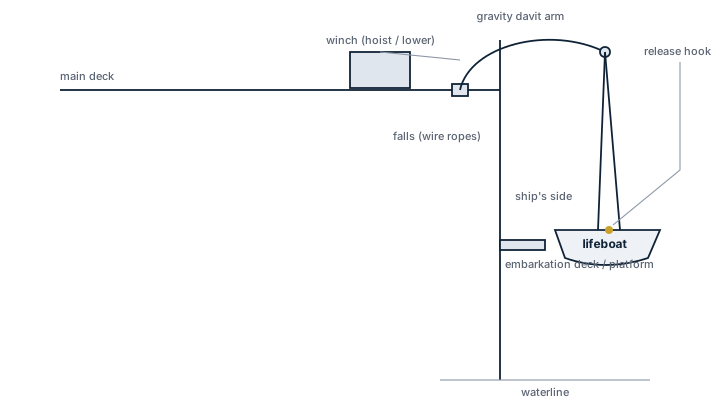
Main components
Davit
Gravity davits are the most common arrangement on cargo ships: the boat swings out under its own weight once the gripes are released, with the fall wires running through sheaves at the davit head. Luffing davits use a hydraulic or electric winch to slew the arm out before lowering. Either way the davit structure and its holding-down bolts carry the full dynamic load of the boat plus a safety margin during launch and recovery.
Falls and winch
Two wire falls, one forward and one aft, run from the winch drum through the davit head sheaves to the hook. The winch has a mechanical brake that must hold the boat stationary at any point of the descent and a centrifugal brake that limits lowering speed, typically to no more than about 36 metres per minute regardless of load.
On-load and off-load release hook
The release hook lets the falls be slipped either with the boat still suspended and taking way off, on-load release, needed on ships where the boat cannot be safely kept alongside, or only once fully waterborne, off-load release. Hook mechanisms have been the subject of repeated IMO and flag-state safety alerts after falls-release failures caused fatal drops.
Painter and gripes
The painter is a forward line used to hold the boat alongside the ship or to keep the bow into a sea after release; the gripes are the lashings that secure the boat in its stowed cradle and must release cleanly and simultaneously, or the boat swings out unevenly.
Selection and sizing
The number and capacity of davit-launched lifeboats a ship carries is fixed by SOLAS occupancy rules, not by choice, but the davit type, safe working load and lowering speed are matched to the boat's loaded mass and the ship's freeboard. Key figures to check against the boat and davit certificates:
- Safe working load of the davit versus the fully loaded mass of the boat, including full complement and equipment
- Maximum lowering height, since deep-sea bulk carriers and container ships need davits rated for a greater fall than coastal or offshore vessels
- Winch brake holding capacity, tested to a defined multiple of the maximum static load
Regulations and class
Davit-launched lifeboats and their launching appliances fall under SOLAS Chapter III and the LSA Code, with davit design, testing and maintenance intervals additionally set by class rules. On-load release gear must meet enhanced testing requirements introduced after IMO guidance following a series of falls-release fatalities, and annual thorough examination plus five-yearly dynamic testing of the winch brake and falls is required under the LSA Code maintenance schedule.
Typical faults
- Hook not fully reset after a drill, so the boat drops under its own weight at the next lowering
- Corroded or kinked falls that part under load, usually caused by skipping the required wire inspection or greasing interval
- Winch brake linings glazed by water or oil contamination, letting the boat run away during lowering
- Gripes releasing unevenly, twisting the boat against the davit arm on swing-out
What to look for in a supplier
- Type approval certificate for the specific davit and hook model, not just a general LSA approval
- Documented compliance with the on-load release retrofit standard where applicable
- Availability of spare hooks, brake linings and wire falls matched to the exact winch model, since many yards fitted now-obsolete designs
- A service network that can carry out the five-yearly dynamic winch test without shipping the whole assembly ashore
Treat every lifeboat drill as if the hook has not been reset since it last fired; more crew have been hurt by a boat dropping during a routine lowering than by anything happening once it is waterborne.