"> Life Raft (Inflatable, SOLAS) - Equipment Database

Life Raft (Inflatable, SOLAS)

critical IMO Required 16 models total

A SOLAS inflatable life raft is a self-contained survival craft stowed in a rigid canister or valise, designed to inflate automatically or on release and support a fixed number of survivors until rescue. Its safety depends entirely on service intervals being kept, not on the raft's apparent condition.

Read more — Life Raft (Inflatable, SOLAS) explained

What sets the inflatable life raft apart

Unlike a rigid lifeboat, an inflatable life raft carries no engine and no steering; it is a compact, stowed survival platform that only becomes usable at the moment of inflation, either by manual painter pull, automatic hydrostatic release, or davit launch depending on the installation. Its entire safety case rests on components the crew cannot inspect visually once the canister is sealed, which is why the service regime exists in the first place.
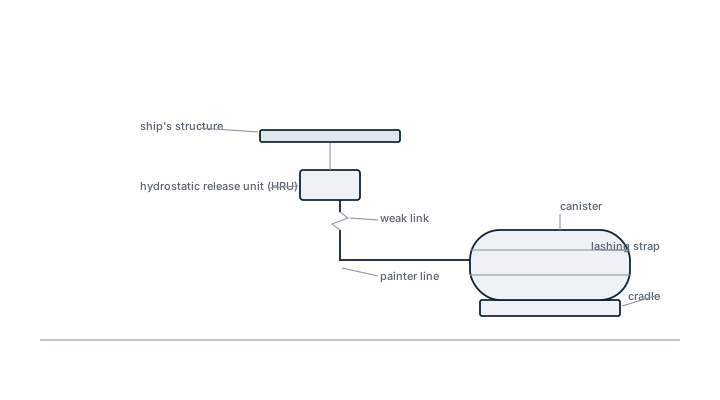
SOLAS life raft stowage arrangement
Arrangement of a canister-stowed SOLAS inflatable life raft at the ship's rail, showing the canister on its cradle with lashing straps, the painter line with a weak link, the hydrostatic release unit and its fixing to the ship's structure.

Main components

Container

A rigid fibreglass canister for deck-stowed rafts, or a soft valise for rafts stowed in a purpose-built cradle, protecting the folded raft from weather and UV.

Inflation system

A CO2 or CO2/nitrogen gas cylinder connected through an inflation valve, triggered by pulling the painter line, which fills the buoyancy tubes and erects the canopy in well under a minute.

Painter line and hydrostatic release unit (HRU)

The painter connects the raft to the ship and triggers inflation; the HRU releases the raft automatically if the ship sinks before the raft can be launched manually, a critical function with its own separate expiry date.

Canopy, sea anchor and equipment pack

The canopy protects survivors from exposure; the sea anchor limits drift; the SOLAS A or B equipment pack carries rations, water, flares, first aid and signalling equipment scaled to the raft's capacity.

Selection and sizing

Capacity is chosen to match or exceed the vessel's maximum complement, in whole-raft increments since a raft cannot be partially rated. Davit-launched rafts allow controlled boarding from deck height; throw-over rafts are simpler but require survivors to enter the water or board from a lower freeboard. Equipment pack type (A for unrestricted service, B for near-coastal) is set by the vessel's trading area, not by preference.

Regulations and class requirements

SOLAS Chapter III and the LSA Code set construction, capacity and equipment standards. Rafts require annual service at a manufacturer-approved shore station, where the canister is opened, the raft inflated, checked and repacked. The HRU has its own fixed service life, commonly two years, after which it must be replaced regardless of apparent condition, and periodic hydrostatic pressure testing of the raft fabric itself is required on a longer cycle, typically around five years or per manufacturer schedule.

Typical faults

  • Expired hydrostatic release unit, which either fails to release the raft in an emergency or, worse, releases it prematurely in heavy weather.
  • Canister corrosion or cracking allowing water ingress, which can damage the folded raft fabric or the inflation mechanism unnoticed between services.
  • Painter line chafe or incorrect securing at the weak link, risking the raft being lost before boarding or dragged under with a sinking ship.
  • CO2 cylinder pressure loss from a slow valve leak, discovered only at the annual service when the raft under-inflates.
  • Missed service intervals, which invalidate the raft's certification even if nothing is physically wrong with it.

What to look for in a supplier

  • Service performed only at a station approved by the raft's original manufacturer, not a generic life-saving equipment shop.
  • Correct SOLAS pack type supplied for the vessel's actual trading area.
  • Traceable service records and replacement part certificates retained for the survey file.
  • Stock availability of HRUs and CO2 cylinders matched to the exact raft model, since substitutes are not always compatible.

A raft's canister looking clean tells you nothing about the HRU date stamped inside; check the expiry tag before assuming the raft is in date.

8760h
Service Interval

Typical Manufacturers

Viking Survitec (DSB/RFD) Fujikura

4 manufacturers · 16 models

SSI

7
SSI SOLAS A Pack 25P unverified
25 persons
Equipment Type
life_raft
Capacity (persons)
25
Solas type
SOLAS A
Pack type
A
Life raft — A pack
SSI SOLAS A Pack 20P unverified
20 persons
Equipment Type
life_raft
Capacity (persons)
20
Solas type
SOLAS A
Pack type
A
Life raft — A pack
SSI SOLAS B Pack 25P unverified
25 persons
Equipment Type
life_raft
Capacity (persons)
25
Solas type
SOLAS B
Pack type
B
Life raft — B pack
SSI SOLAS B Pack 20P unverified
20 persons
Equipment Type
life_raft
Capacity (persons)
20
Solas type
SOLAS B
Pack type
B
Life raft — B pack
SSI Throw-Over Raft 25P unverified
25 persons
Equipment Type
life_raft
Capacity (persons)
25
Solas type
SOLAS
Pack type
throw-over
Life raft — throw-over pack
SSI Throw-Over Raft 20P unverified
20 persons
Equipment Type
life_raft
Capacity (persons)
20
Solas type
SOLAS
Pack type
throw-over
Life raft — throw-over pack
SSI Throw-Over Raft 12P unverified
12 persons
Equipment Type
life_raft
Capacity (persons)
12
Solas type
SOLAS
Pack type
throw-over
Life raft — throw-over pack

VIKING

7
VIKING 25DK+ Life Raft unverified
25 persons
Equipment Type
life_raft
Capacity (persons)
25
Solas type
SOLAS A
Series
DK+
DK+ throw-over life raft
VIKING 20DK+ Life Raft unverified
20 persons
Equipment Type
life_raft
Capacity (persons)
20
Solas type
SOLAS A
Series
DK+
DK+ throw-over life raft
VIKING 16DK+ Life Raft unverified
16 persons
Equipment Type
life_raft
Capacity (persons)
16
Solas type
SOLAS A
Series
DK+
DK+ throw-over life raft
VIKING 12DK+ Life Raft unverified
12 persons
Equipment Type
life_raft
Capacity (persons)
12
Solas type
SOLAS A
Series
DK+
DK+ throw-over life raft
VIKING 10DK+ Life Raft unverified
10 persons
Equipment Type
life_raft
Capacity (persons)
10
Solas type
SOLAS A
Series
DK+
DK+ throw-over life raft
VIKING 6DK+ Life Raft unverified
6 persons
Equipment Type
life_raft
Capacity (persons)
6
Solas type
SOLAS A
Series
DK+
DK+ throw-over life raft
VIKING RescYou Pro Life Raft unverified
6 persons
Equipment Type
life_raft
Capacity (persons)
6
Solas type
ISO 9650
Series
RescYou
Leisure/coastal life raft

Fujikura

1
Fujikura FRN-SV SOLAS Life Raft
25 persons · Crew Evacuation / Safety · self‑inflating SOLAS life raft
Common Failures & Inspection Points
  • Floor inflation failure
  • Rain catchment tube blockage
  • Battery-powered light failure
Service: Annual servicing per SOLAS. Replace emergency equipment pack per expiry dates.
Spare Parts: Ersatzteile über Fujikura oder zugelassene Vertriebspartner. Lead time: 2-6 Wochen.
Strengths
  • SOLAS certification ensures compliance on all international vessels
  • Compact storage size with high inflation speed (≤10 seconds)
  • Integrated emergency equipment pack (thermal blankets, water, rations)
  • Durable PVC/nylon canopy resistant to UV and saltwater exposure
  • Designed for wind resistance up to 30 knots
Weaknesses
  • Floor inflation system can fail if seals are not inspected regularly
  • Rain‑catchment tube may become blocked by debris, reducing water collection
  • Battery‑powered light relies on battery health; failure possible after long storage
  • Limited capacity options compared with larger multi‑person rafts
Typical Vessels: TankerContainer shipBulk carrierGeneral cargo vesselOffshore supply vesselPassenger ferry
Certifications: IMO SOLAS
Decision Guide: Choose if you need a compact, SOLAS‑compliant life raft with fast inflation and an integrated emergency pack for vessels up to 30 m LOA. Avoid if your maintenance regime cannot guarantee regular inspection of the floor inflation system, rain‑catchment tube, or battery‑powered lighting.
Use Cases: Mounted on deck at lifeboat stations of merchant ships, offshore platforms, and ferries where rapid egress is required; commonly used in temperate to tropical waters where rain collection and night illumination are valuable.

Viking

1
Viking Viking SOLAS 25DK Life Raft
Viking SOLAS 25DK Life Raft
25 persons · Crew Evacuation / Safety · CO2 inflation system
Common Failures & Inspection Points
  • Hydrostatic release unit expiry
  • CO₂ inflation cylinder corrosion
  • Container fiberglass cracking
Service: Service every 12 months at approved service station. HRU replacement every 2 years.
Spare Parts: Ersatzteile über Viking oder zugelassene Vertriebspartner. Lead time: 2-6 Wochen.
Strengths
  • High passenger capacity (up to 25 persons)
  • SOLAS compliant with built‑in hydrostatic release unit
  • Rapid inflation via CO₂ cylinder
  • Durable fiberglass container provides protection in storage
Weaknesses
  • Hydrostatic release unit must be replaced every two years to remain serviceable
  • CO₂ cylinders are prone to corrosion if not inspected regularly
  • Fiberglass containers can develop cracks over time, requiring careful inspection
  • Mandatory annual servicing at an approved station adds operational cost
Typical Vessels: Bulk CarrierContainer ShipTankerGeneral Cargo VesselPassenger Ferry
Certifications: SOLAS
Decision Guide: Choose if you need a high‑capacity, SOLAS‑approved life raft with automatic deployment and can commit to the required two‑year HRU replacement and annual service. Avoid if maintenance intervals are difficult to meet or if operating in highly corrosive environments where CO₂ cylinder degradation is a concern.
Use Cases: Deployed on large commercial vessels for crew evacuation during abandon‑ship situations, especially when rapid, unattended launch is required in open sea conditions.