What to check on a Life Jacket.
Unlike a lifeboat or life raft, a life jacket is worn on the body and has to work correctly on an untrained person, in the dark, in the water, possibly already injured. That drives its two fundamentally different designs. Inherently buoyant life jackets use closed-cell foam that floats immediately with no action needed, at the cost of being bulky to stow and wear. Inflatable life jackets pack flat and are far more comfortable to wear continuously on deck, but rely on a CO2 cylinder fired either automatically by a water-soluble…
What Makes a Life Jacket Different from Other LSA Items
Unlike a lifeboat or life raft, a life jacket is worn on the body and has to work correctly on an untrained person, in the dark, in the water, possibly already injured. That drives its two fundamentally different designs. Inherently buoyant life jackets use closed-cell foam that floats immediately with no action needed, at the cost of being bulky to stow and wear. Inflatable life jackets pack flat and are far more comfortable to wear continuously on deck, but rely on a CO2 cylinder fired either automatically by a water-soluble bobbin or manually by the wearer pulling a toggle, and on oral topping-up tubes if the automatic inflation partly fails.
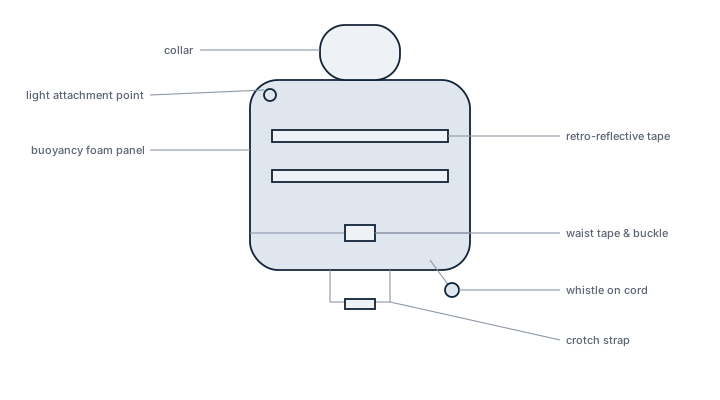
Main Components
Buoyancy Material or Chamber
Closed-cell foam panels in an inherently buoyant jacket, or one or two inflatable chambers, with dual-chamber designs increasingly favoured for redundancy over single-chamber designs.
Inflation Mechanism
A CO2 cylinder, firing head with water-soluble bobbin for automatic activation, manual pull toggle, and oral inflation tube; the firing head and cylinder are the components serviced and replaced on the maintenance schedule.
Retro-Reflective Tape and Light
SOLAS-pattern retro-reflective tape placed for visibility in a search light, plus a water-activated or manually switched light attached at the shoulder to mark the wearer's position at night.
Whistle
A pea-less whistle, chosen because a traditional pea-type whistle can jam when wet, secured to the jacket for the wearer to attract attention.
Crotch Strap and Harness Points
A crotch or thigh strap stops the jacket riding up over the head of an unconscious wearer in water; many modern designs add a lifting becket or harness attachment point for helicopter or fast rescue craft recovery.
Selection and Sizing
Life jackets are selected against the crew and passenger complement by size band, adult, child and infant where required, and by the vessel's SOLAS category, since passenger ships carry additional lifejacket provisions beyond the basic crew allocation, including jackets stowed at muster stations and in public spaces. Buoyancy rating is fixed by SOLAS at a minimum of 150 Newtons for an adult SOLAS lifejacket, deliberately higher than the recreational 100N standard because it must turn an unconscious face-down person face-up in the water.
| Parameter | SOLAS Adult Requirement |
|---|---|
| Minimum buoyancy | 150 N |
| Turning capability | Must right an unconscious wearer face-up within a set time |
| Visibility | Retro-reflective tape plus attached light |
| Colour | High-visibility, typically international orange |
Regulations and Class
Life jackets are governed by SOLAS Chapter III and the LSA Code, which set buoyancy, donning time, retro-reflective material and light requirements, and by wheelmark or equivalent flag-state type approval before a jacket can be carried. LSA Code amendments introduced tighter requirements around inflatable jacket servicing and a harness or lifting point on newer designs. Servicing intervals for inflatable life jackets are set by the manufacturer and enforced through the ship's safety management system, commonly annual for the inflation mechanism and gas cylinder, alongside the five-yearly hydrostatic release unit and general LSA equipment survey.
Typical Faults
| Fault | Cause | Consequence |
|---|---|---|
| Failed automatic inflation | Corroded firing head or expired/discharged CO2 cylinder | Jacket does not inflate when it enters water, must be manually or orally inflated |
| Torn or perished fabric (inflatable) | UV degradation from storage in direct sunlight, or chafe | Slow leak, loss of buoyancy after inflation |
| Foam degradation (inherently buoyant) | Age and repeated compression over years of storage | Reduced buoyancy below the SOLAS minimum |
| Missing light or whistle | Not reattached after inspection or drill use | Reduced chance of location during a night rescue |
What to Look for in a Supplier
- Wheelmark or flag-state type approval certificate matching the vessel's flag and trading requirements.
- Servicing network availability for inflatable jacket firing heads and CO2 cylinders in the vessel's usual ports.
- Consistent sizing and design across the fleet if replacing a partial stock, since mixed types complicate crew familiarisation and drills.
- Documented shelf life and storage condition guidance, particularly UV and temperature limits for jackets stowed on open deck stations.
Check the CO2 cylinder weight and the firing head's water-soluble bobbin at every routine inspection, not just the annual service -- a cylinder that has lost gas through a slow thread leak looks identical to a full one until it fails to fire.