Auxiliary Engine (Generator Set)
An auxiliary engine is a diesel genset built to run at constant speed for frequency-stable electrical output, not to drive a propeller — a distinction that shapes its governor, cooling, and load-acceptance design from the ground up.
What to check on an Auxiliary Engine (Generator Set).
229 models from Caterpillar in Auxiliary Engine (Generator Set). Below: the full model list.
What makes this type
An auxiliary engine (generator diesel engine, or "aux") is coupled directly to an alternator and runs at a fixed synchronous speed — typically 1200, 1500, or 1800 rpm depending on frequency (50 or 60 Hz) and pole count — because the alternator's output frequency is locked to shaft speed. This is the core difference from a main propulsion engine, which is allowed to vary speed continuously with load. An aux engine's governor is tuned for tight speed regulation under sudden load steps, since connecting or dropping a large consumer (a cargo pump starting, a bow thruster engaging) has to be absorbed within a few percent of frequency deviation without tripping protective relays or blacking out the switchboard. Auxiliary engines usually run in multiples — two to four sets per ship — specifically so load can be shared and units can be swapped out for maintenance without losing power generation capability.
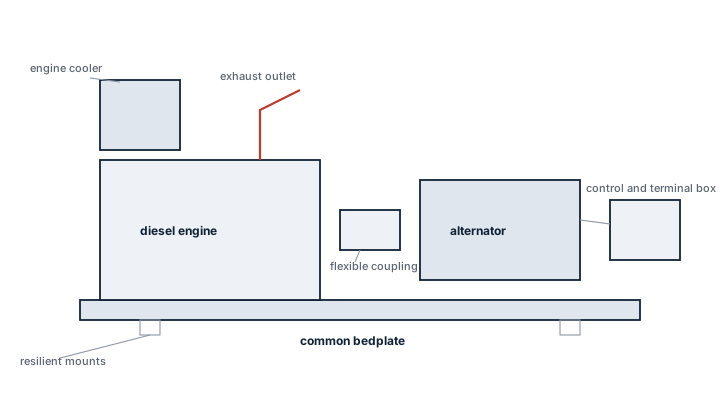
Legend
- Engine cooler
- Exhaust outlet
- Cooling water to and from the engine
- Control and terminal box
- Diesel engine
- Alternator
- Flexible coupling
- Common bedplate
- Resilient mounts
Main components
Engine block and fuel injection
Most modern aux engines are medium- or high-speed four-stroke trunk-piston diesels, mechanically or electronically fuel injected; electronic (common-rail or unit-injector) control has become common because it improves transient load response, which matters more for a genset than a main engine.
Governor and AVR
The governor holds engine speed (hence frequency) constant; the alternator's automatic voltage regulator holds terminal voltage constant. Both must respond fast enough that a step load change does not push frequency or voltage outside the narrow band the switchboard protection allows.
Read the full guide
Alternator
Directly coupled, sized in kVA with a power factor rating (commonly 0.8) that determines real kW output versus apparent power capacity.
Cooling and lube oil systems
Sized for continuous duty at rated load, since unlike a main engine that may run at reduced load for long passages, gensets are commonly loaded close to their rating whenever running to keep specific fuel consumption reasonable.
Selection / Sizing
Sizing starts from the ship's electrical load list at different operating conditions (at sea, in port, cargo operations, manoeuvring) and picks a genset combination that covers peak load with one unit out of service (N+1 redundancy is standard practice, and mandatory in some class notations). Running gensets well below rated load for long periods causes its own problems — incomplete combustion, cylinder glazing, exhaust valve fouling — so the number and size of units is chosen to keep each running set reasonably loaded across the ship's typical load profile, rather than fitting one oversized set that is always lightly loaded.
Regulations / Class
Class rules require a minimum number of generating sets such that with the largest set out of service, the remainder can supply all services needed for propulsion, steering, and safety. MARPOL Annex VI NOx Tier limits apply based on engine build date and size, same as main engines, and an Engine International Air Pollution Prevention (EIAPP) certificate is required per engine. SOLAS requires an emergency source of power separate from the main gensets, which is a different piece of equipment entirely (see Emergency Generator Sets).
Typical faults
- Cylinder liner glazing from prolonged light-load running — poor ring seating leads to rising lube oil consumption and blow-by.
- Governor hunting — speed oscillation under load, often from worn linkage or actuator issues, that causes frequency instability across the switchboard.
- Turbocharger fouling — reduced air supply under load, showing up as high exhaust temperature and falling power output at rated load.
- Injector wear affecting load sharing — uneven fuel delivery between cylinders shows up as vibration and uneven exhaust temperatures across units.
- AVR drift — slow voltage regulation that causes reactive load-sharing problems when running gensets in parallel.
What to look for in a supplier
- NOx certification (EIAPP) matched to the intended trading area and build date, since retrofitting Tier III compliance later is costly.
- Genset packages tested together (engine, alternator, governor, AVR) rather than components sourced separately and matched on paper.
- Parts and service network reach in the ship's actual trading pattern, not just the flag state.
- Documented load-acceptance figures (percentage step load the set can absorb without exceeding frequency/voltage transient limits) for the specific application.
A genset that never gets loaded above 40% for weeks at a time is quietly glazing its liners — rotate load between units and run one hard periodically rather than always splitting load evenly and lightly.
Models in this type.
The best-documented model of each manufacturer first, then the next — 100 of 229 models in Auxiliary Engine (Generator Set). Every row links to full specifications, documents and service notes.
Manufacturers.
All 88 manufacturers with models of Auxiliary Engine (Generator Set). Names with a manufacturer page open it; the others open a search across the full library.
All manufacturersShow all 88 manufacturers
- Adriadiesel d.d1
- Alaska diesel electric3
- Bergen Engines8
- Beta Marine3
- Caterpillar Marine Power4
- Caterpillar Motoren, Kiel, Germany9
- CSSC/Hudong18
- Cummins Mercruiser diesel1
- Cummins Power Generation8
- Daihatsu Diesel Aux9
- Detroit Diesel13
- Discovery Energy10
- Doosan Infracore Marine14
- Doosan Power1
- Electro-Motive Diesel2
- Engines2
- Fairbanks Morse4
- FPT Industrial S.p.A.19
- Generac18
- Guascor (Siemens Energy)1
- Hatton Marine & Industrial Repair1
- HD Hyundai Infracore2
- HSD Engine2
- Hyundai Heavy Industries2
- isotta fraschini motori S.P.A2
- John Deere Marine Aux1
- Kennedy Engine2
- Legacy Marinediesel6
- Mase Generators1
- Mastervolt16
- Mecc Alte1
- Mitsubishi Heavy Industries11
- Mitsubishi Heavy Industries Engine & Turbocharger12
- Niigata18
- Perkins Marine Aux5
- Pielstick (MAN)10
- Progress Rail Locomotive, Inc.5
- Rolls-Royce Solutions America2
- SKL18
- SOLE S.A.1
- STEYR MOTORS Betriebs1
- STX Engine10
- Tognum America1
- Transp. systems bus. opS. of general electric1
- Transportation systems bus. ops. of general electric1
- Transportation systems business operations of general electric4
- Vestbork Diesel ApS8
- Volvo Penta Power5
- Wabtec Transportation Systems, LLC7
- Westerbeke1
- Yanmar Power Technology Co., Ltd.6
- Zhenjiang Cme1
Also in Auxiliary Engines.
The other equipment types in this category.
One request. A person reads it and replies by e-mail.
Tell us the manufacturer, the model and what you need — a part, a service call, a second opinion. A person reads every request and replies by e-mail.
No details at hand? A photo of the rating plate or the part is enough — simply attach it to the request.
Three things people ask first.
Is Auxiliary Engine (Generator Set) data free?
Yes. Every model page, every guide and every datasheet for this type is readable without an account. An account adds saved searches and requests, nothing is taken away.
My model is missing — what now?
Send us the nameplate. We identify it by hand, add it to the library, and if you need a part or a service, the request is already on our desk.
Can you source a Auxiliary Engine (Generator Set) part?
Yes. Tell us the manufacturer, the model and what you need — a person reads every request and replies by e-mail.