Radar Level Gauge
Radar gauges read cargo level from the top of the tank by timing a microwave pulse reflected off the liquid surface, so they need no moving parts inside the tank and keep working through vapour that would fool a float or capacitance probe.
What to check on a Radar Level Gauge.
818 models from Endress+Hauser in Radar Level Gauge. Below: the full model list.
What sets radar gauging apart
A radar level gauge sits on the tank top and sends a microwave signal down through the vapour space to the liquid surface, then measures either the time the reflection takes to return, known as pulse radar, or the frequency shift of a continuously swept signal, known as FMCW radar, to calculate distance and therefore level. Unlike a float gauge or a servo tape, nothing moves inside the tank, so there is no mechanism to jam, no tape to snap and no float to sink in a dense or viscous cargo. Unlike a capacitance probe, the reading does not depend on the cargo's dielectric constant staying within a narrow band, though a very low-reflectivity cargo can still weaken the return signal.
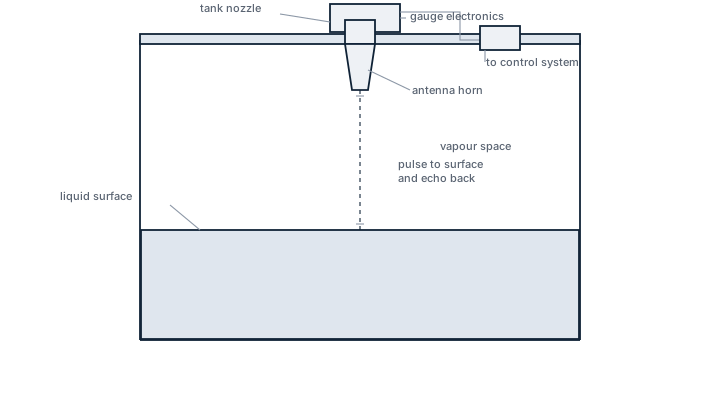
Legend
- Gauge electronics
- To control system
- Tank nozzle
- Antenna horn
- Vapour space
- Pulse down, echo back
- Liquid surface
Main components
Antenna and transducer
The antenna, whether a horn, parabolic dish or rod depending on tank size and cargo, both transmits and receives the microwave signal. It is mounted through a process connection rated for the tank's pressure and the cargo's vapour, and on gas carriers this connection has to remain gas-tight under the full design pressure.
Still-pipe or stilling well
Many installations run the antenna into a still-pipe that reaches down through the tank, which damps out surface turbulence and slosh and gives the signal a clean path free of reflections from internal structure such as heating coils or swash bulkheads.
Read the full guide
Electronics unit
Converts the raw echo into a level value, applies temperature and density compensation, and outputs to the local display and to the cargo control room. On tankers this feeds the loading computer directly.
Reference and calibration point
A fixed reference target or a manual dip point lets the gauge be checked against a physical measurement, which is the only way to catch electronic drift between class surveys.
Selection and sizing
The choice is driven by the tank's height range, the cargo's dielectric properties and the vapour condition expected above it, since inert gas and hydrocarbon vapour both change the signal's travel time slightly and a good installation compensates for this. Custody transfer duty calls for the tightest accuracy class the system offers; general operational gauging can use a coarser one.
- Frequency band matched to tank height and required resolution, since higher frequency narrows the beam and improves accuracy over long ranges
- Process connection rating matched to the tank's design pressure and the cargo's vapour pressure
- Antenna material compatible with the cargo, since chemical carriers rotate through very different products
- Accuracy class stated against a recognised custody transfer standard if the reading is used for commercial quantity
Regulations and class
The IGC Code requires gas carriers to have a level gauging system independent of the high-level alarm, and both are surveyed separately. Chemical and oil tankers under MARPOL are increasingly required to use closed gauging so cargo vapour is not released to check the level, which radar naturally supports since the tank is never opened. Class societies survey the gauging system's function and calibration at intervals set in the ship's survey scheme, and a custody transfer installation is also checked against national metrology or OIML-referenced accuracy requirements where the cargo is sold on the reading.
Typical faults
| Cause | Consequence |
|---|---|
| Foam or heavy turbulence on the cargo surface | Scattered or lost echo, gauge freezes or jumps to a false level |
| Buildup or condensation on the antenna face | Weakened signal, growing error that is easy to miss until a manual dip disagrees |
| False echoes from tank internals | Misread level if the electronics lock onto a coil or ladder reflection instead of the surface |
| Low-reflectivity cargo with a very low dielectric constant | Weak return signal, reduced accuracy or loss of reading near tank bottom |
| Electronics drift uncorrected between surveys | Growing disagreement with manual dip, risk on a custody transfer cargo |
What to look for in a supplier
- Type approval for the specific hazardous area zone and gas group the tank requires
- A stated accuracy class with supporting test data, not just a manufacturer's claim
- Compensation software that accounts for the actual vapour composition the ship carries, not only air
- Service support able to recalibrate or replace the electronics unit without gas-freeing the tank where possible
Cross-check the radar reading against a manual dip at the start of every cargo the ship has not carried recently - a change in dielectric constant between products is the most common reason a previously accurate gauge starts to drift.
Models in this type.
The best-documented model of each manufacturer first, then the next — 100 of 818 models in Radar Level Gauge. Every row links to full specifications, documents and service notes.
Manufacturers.
All 362 manufacturers with models of Radar Level Gauge. Names with a manufacturer page open it; the others open a search across the full library.
All manufacturers in the libraryShow all 362 manufacturers
- 2 FRANCE MARINE S3
- ABB Xiamen Low Voltage Equipment Company Limited1
- Ados1
- Advanced Pneumatic Marine GmbH1
- ADZ NAGANO GmbH Gesellschaft für Sensortechnik2
- Afriso-Euro-Index2
- Air Liquide Advanced Technologies1
- AIX MONITORING SYSTEMS LTDA1
- AJD Instruments1
- Akkodis Edge Norway3
- Alphatron Marine3
- Altronic LLC2
- ALTUS SISTEMAS DE AUTOMACAO2
- AMOT UK HOLDINGS LIMITED2
- Ampac Pty Limited1
- Anschütz2
- API Marine2
- APLISENS S.A.3
- Apollo Fire Detectors1
- Applied Electronics Corporation2
- AppliTek1
- Aquametro Oil & Marine1
- ATECH - NEGOCIOS EM TECNOLOGIAS S.A.1
- Autic System AS1
- Auto-Maskin3
- Autronica Fire and Security3
- AUXQUIMIA S.A.U. (Perimeter Solutions)1
- AVAT Automation GmbH3
- Aventics GmbH1
- Axiomtek Co., Ltd.1
- AYK ENERGY Ltd.1
- B&R Industrial Automation GmbH1
- B+B Thermo-Technik GmbH1
- B-I INDUSTRIAL CO., LTD.2
- Baker Hughes Sensing & Inspection (Changzhou) Co., Ltd.1
- Baumer1
- Baway Technology (Weifang) Co., Ltd.2
- BD SENSORS3
- Beckhoff Automation GmbH & Co. KG4
- Beijer Electronics2
- BEMAC Corp. Mirai Factory1
- Bently Nevada, LLC2
- Beta1
- BIZCLAP S.R.L.1
- Bloomfoss Pte. Ltd.1
- BOLL & KIRCH Filterbau GmbH1
- Bosch Rexroth1
- BoxPlus Information Technology Company1
- BROEN Poland Sp. z o.o.1
- Bühler Technologies GmbH4
- C W F Hamilton & Co. Ltd.1
- Captec America Inc.1
- Caterpillar2
- Caterpillar Motoren GmbH & Co. KG1
- CMR Group1
- COMAC CAL s.r.o.1
- ComAp a.s.1
- Compressor and Machine Controls N.V.1
- Condor-Werke Gebr. Frede1
- Consilium Safety Netherlands B.V.2
- Corvus Energy2
- CROUZET S.A.S.1
- Crystal Engineering Corporation1
- CSSC Power (Group) Co., Ltd.1
- Dae Hwa Engineering Sensor Co., Ltd.1
- Danelec Norway AS1
- Danfoss Ixa A/S1
- Daniamant4
- Data Respons Solutions AS2
- DECKMA-Decksmaschinen und Automation Vertriebsgesellschaft mit beschränkter Haftung1
- DeepSea Technologies1
- DEIF4
- Dell Inc.3
- Detector Electronics Corporation (Det-Tronics)3
- Doo Ik Eng. Co., Ltd.1
- Dräger Safety AG & Co. KGaA4
- Duon System2
- Eaton Industries GmbH4
- Eaton MEDC Ltd1
- Eco Bearings AS1
- eddylab1
- Egon Harig1
- Eltorque Automation (Xiamen)1
- Emerson Process Management Power & Water Solutions, Inc.1
- EMRI1
- Endress+Hauser SICK GmbH+Co. KG2
- Enraf2
- ENVICO Environment Control B.V.1
- Epec Oy1
- Esa S.P.A.1
- ESI Technology Ltd1
- Fernsteuergeräte Kurt Oelsch GmbH1
- FineTek2
- Fischer Meß- und Regeltechnik GmbH4
- Fisher-Rosemount Systems, Inc.2
- FossTech AS2
- Fr. Sauter AG2
- Friedrich Lütze GmbH1
- Fugro Norway AS1
- Fuji Electric1
- Gastron1
- GE Energy Power Conversion UK Ltd.2
- Geislinger2
- General Monitors2
- Gestra3
- GICOM S.r.l.1
- Glamox Marine and Offshore1
- Göpfert AG1
- Governors America1
- Green Instruments4
- Grosshandel uad Marine- & Industrieautomation Hans-Joachim Schulz1
- Guangzhou Fokstone Automation2
- Hangzhou Chuomei Technology Co., Ltd.1
- HANGZHOU HUAYAN DIGITAL ELECTRON1
- Hanshin Electric Mfg. Co. Ltd.1
- HANSHIN ELECTRONICS3
- Hansol Oriontech Co., Ltd.1
- Hatteland Technology1
- Haverkamp GmbH1
- HD Hyundai Heavy Ind. Co., Ltd. Engine & Machinery Division1
- HD Hyundai Marine Solution Co., Ltd.1
- Heinzmann1
- Henri Systems Holland B.V.1
- Høglund AS1
- HGTEK Co., Ltd.1
- HIMA Paul Hildebrandt2
- HMAP Pte Ltd1
- Honeywell Analytics1
- Honeywell Enraf1
- Honeywell Integrated Technology (China)2
- Hoppe Marine3
- HORIBA, Ltd. Head Office1
- Huba Control AG1
- Hydac Electronic3
- HYDAC Filtertechnik1
- IDEC Corporation2
- IGEMA1
- IMB Industrielle Messtechnik GmbH & Co. KG3
- IMI International s.r.o.1
- IMS Technologies AS1
- INDUSTRONIC Industrie-Electronic GmbH & Co. KG1
- Inelteh d.o.o.2
- INGETEAM POWER TECHNOLOGY, S.A.1
- IRONTECH SOLUTIONS, S.L.1
- ISIC1
- Istec International B.V.1
- J.P. Sauer & Sohn Maschinenbau GmbH3
- JiangSu Enda General Equipment Group2
- Jiangsu Highland Integration Technology1
- Jiangsu SIBO Electric Co., Ltd.1
- Jiangsu Yongan Control Equipment Co., Ltd.1
- Jiangsu Yuanwang Instrument Group Co., Ltd.4
- Jiaxing Kexun Electron Co., Ltd.1
- Jiujiang Huozhi Shipbuilding Industry Co., Ltd.1
- JK E-solutions ApS1
- John Deere Power Systems1
- JOHNSON CONTROLS DENMARK ApS - Sabroe Factory / Holme Plant1
- JRCS3
- KAEFER Schiffsausbau GmbH1
- Kaeser Kompressoren SE1
- KEI System Co., Ltd.2
- Kistler Instrumente AG4
- Knick Elektronische Messgeräte GmbH & Co. KG1
- Kockum Sonics2
- Kongsberg3
- Kuk Dong Level3
- Kumoh Mach. & Elec. Co. Ltd.3
- Kwant Controls B.V.3
- Labotech International Co., Ltd.1
- Larsen & Toubro Limited1
- Lenovo (United States) Inc3
- Liaoyang Shuanghua Instrument Co., Ltd.1
- Light Structures AS2
- Lindenberg-Anlagen GmbH1
- Liquid Level Systems Ltd1
- LITTAU GmbH1
- LS ELECTRIC Co., Ltd. (Cheon-an Plant)1
- M&C Techgroup Germany1
- Macron Co., Ltd.1
- Magnet-Schultz GmbH & Co. KG1
- MAN Energy Solutions1
- MAN Truck & Bus SE1
- Manner Sensortelemetrie GmbH1
- Manta Marine Technologies AB1
- maresystems GmbH & Co. KG1
- MARIDIS Maritime Diagnose & Service GmbH1
- Mariner Systems (UK) Ltd.2
- Marsen2
- MARTEC MARINE S.p.A.1
- Martek Marine1
- Meiyo Electric Co. Ltd.3
- Micro Motion, Inc.1
- Micro Sensor Co., Ltd.1
- Microdata Due1
- MIROS AS1
- Mitsui E&S Systems Research Inc.2
- MMC International Corp.1
- motcom GmbH2
- Moxa3
- mPower Electronics (Shanghai) Co., Ltd.1
- MRC GLOBAL NORWAY AS, Instrumentation Division1
- MRC Inc.2
- MSA Europe GmbH1
- MTE Instruments Inc.1
- Müller Industrie-Elektronik GmbH2
- Musasino4
- N2KB B.V.1
- Nagman Instruments and Electronics Private Limited1
- Nakakita Seisakusho Co., Ltd.4
- Nanjing Southeast Industrial Equipment Corporation1
- NANTONG ARK MARINE TECHNOLOGY CO., LTD.1
- Nantong Haishi Marine Machine Co., Ltd1
- Nantong Jiuzhou Ship Mechanical Fittings Co., Ltd.1
- Nantong Sanhe Energy Technology CO., Ltd,1
- Navico Forlì S.r.l.1
- Neuver Maritime AS2
- NIPPON HAKUYO electronics, ltd.1
- NIT Co., Ltd.1
- Nivelco Ipari Elektronika Zartköruen Muködo Reszvenytarsasag1
- Nöding Messtechnik GmbH2
- Nogva Motorfabrikk1
- Nohmi Bosai2
- Nordic Flow Control Pte. Ltd.1
- North Invent Norway AS1
- O Øverland AS1
- OceanRND Co., Ltd.1
- OK T&T Co., Ltd.1
- Omron Manufacturing of the Netherlands B.V.1
- OnLogic, Inc.1
- OPSIS AB1
- Orion Technology Co., Ltd.1
- Parker Hannifin Manufacturing2
- Parker Hannifin Manufacturing Germany GmbH & Co. KG1
- Paul Rüster & Co. GmbH1
- Pentronic AB1
- Pepperl+Fuchs SE1
- Plöger Sensor GmbH2
- PR electronics A/S2
- Prodrive Technologies B.V.5
- Prognost Systems GmbH1
- PSM Instrumentation3
- Q&T Instrument Co., Ltd.1
- Q-TAGG R&D AB1
- QRP TECH1
- R. STAHL Schaltgeräte2
- RECO Gesellschaft für Industriefilter-Regelung mit beschränkter Haftung1
- Riken Keiki Korea Co., Ltd.1
- Riken Marine China Co., Ltd.1
- Rivertrace1
- Rockson Automation GmbH1
- Rockwell Automation Asia Pacific Business Center Pte. Ltd.1
- Rolls-Royce Solutions GmbH2
- Rosemount Inc.5
- Rössel-Messtechnik GmbH1
- Rutter1
- SAACKE1
- safetec Brandes und Niehoff3
- SAGINOMIYA SEISAKUSHO, INC.3
- Scanjet Ariston AS2
- Scientific Devices (Bombay) Pvt. Ltd.1
- Sea Structure Technology co., Ltd.1
- SELCO2
- SEMCO2
- Senaco Co., Ltd.1
- Setra Systems1
- SHANGHAI CHENZHU INSTRUMENT CO., LTD.2
- Shanghai Farquan Industrial Co., Ltd1
- Shanghai KSR-Kuebler Automation Insturment Co., Ltd.2
- Shanghai Noris-Sibo Automation Co., Ltd.2
- Shanghai Rongde Engineering Equipment Co., Ltd.2
- Shanghai Tianmin Automation Instruments Co., Ltd.2
- SHINKAWA Sensor Technology, Inc.1
- Siegrist GmbH1
- Siemens AG GWA5
- Siemens AG SIMATIC Type Test1
- Siemens Energy Global GmbH & Co. KG1
- SIGEVAL, S.A.1
- SIGRIST-PHOTOMETER AG1
- sm electrics GmbH services & more2
- Solar Solve Marine1
- Sonove1
- SONTEC Sensorbau GmbH1
- Specs Corporation2
- Spirax Sarco S.r.l.1
- steute Technologies GmbH & Co. KG2
- STS Sensor Technik Sirnach AG5
- Stucke Elektronik1
- Sunil Instrument Co., Ltd.3
- Swede Marine Propulsion AB1
- Taixing Thermal Meters Factory Co., Ltd.1
- Taiyo Valve Mfg. Co., Ltd.2
- Tangqi (Shanghai) Industrial Co., Ltd.1
- Tanktech1
- Terasaki Electric2
- TERMOTECH S.r.l.1
- TERRANOVA2
- Testo SE & Co. KGaA3
- Tetradyne Co., Ltd.1
- TIVAL Sensors GmbH1
- TMS Solution Co., Ltd.1
- Trelleborg Marine Systems UK Ltd1
- TriOS Mess- und Datentechnik GmbH1
- Tunable AS2
- Tyco Fire & Integrated Solutions Ltd1
- Tyco Fire & Security3
- VAF Instruments4
- Vaisala1
- Valmet Automation Oy2
- Vard Electro AS1
- Varec2
- WAGO3
- Wärtsilä Defence Solutions Limited (WDSL)1
- Watts Regulator2
- Weidmüller Interface2
- WIKA Alexander Wiegand5
- WinGD1
- Wise Control Inc.1
- Woodward3
- Xiyi Co., Ltd.1
- XTronica AS1
- Yangzhou Win Bang Electronic Co., Ltd.1
- Yumyung Co., Ltd.1
- Zenitel Norway AS avd Horten1
- Zhejiang Xinya Electric Development Co., Ltd.1
- Zhenjiang SaierNico Automation Ltd.2
- Ziztel1
Also in Cargo Level & Temperature Gauging.
The other equipment types in this category.
Write to us about your machine — the answer comes by e-mail.
Name the make and the model and what the job is: a spare, a service call, a second opinion on a data sheet. We answer by e-mail.
No details at hand? A photo of the rating plate or the part is enough — simply attach it to the request.
Questions that come up with this equipment.
Is Radar Level Gauge data free?
Yes. Every model page, every guide and every datasheet for this type is readable without an account. An account adds saved searches and requests, nothing is taken away.
My model is missing — what now?
Send us the nameplate. We identify it by hand, add it to the library, and if you need a part or a service, the request is already on our desk.
Can you source a Radar Level Gauge part?
Yes. Tell us the manufacturer, the model and what you need — a person reads every request and replies by e-mail.