What to check on a UTI Equipment.
A fixed radar or servo gauge reads the tank continuously and feeds the cargo control room, but every custody transfer and most loading plans still call for an independent manual check with a portable instrument lowered by hand. The UTI (Ullage, Temperature, Interface) unit is that manual instrument: a sensor head on a graduated steel tape, wound off a hand-cranked or motorised reel, lowered through a dedicated vapour-tight valve on top of the tank. It measures three things with one lowering — the ullage (distance from the tank reference point…
What sets UTI equipment apart from a fixed tank gauge
A fixed radar or servo gauge reads the tank continuously and feeds the cargo control room, but every custody transfer and most loading plans still call for an independent manual check with a portable instrument lowered by hand. The UTI (Ullage, Temperature, Interface) unit is that manual instrument: a sensor head on a graduated steel tape, wound off a hand-cranked or motorised reel, lowered through a dedicated vapour-tight valve on top of the tank. It measures three things with one lowering — the ullage (distance from the tank reference point down to the liquid surface), the temperature at chosen depths, and, where a probe includes a conductivity sensor, the position of a free water interface at the tank bottom. Because it is operator-held rather than permanently wired in, it also serves as the independent cross-check that catches a fixed gauge reading wrong.
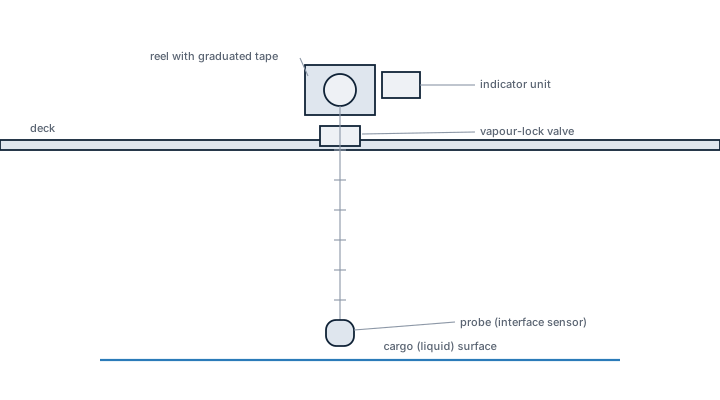
Main components
Tape and reel
A graduated stainless tape, typically wound on a reel with a counter, carries both the mechanical measurement and the electrical conductors to the sensor head. Tape condition and calibration of the counter directly set the accuracy of every reading taken with the unit.
Probe and sensor head
Combines an ullage float or optical/electronic level detection with a resistance temperature sensor, and on interface-capable probes, a separate conductivity element that responds differently in water than in oil or condensate.
UTI valve
A vapour-lock valve fitted to the tank top, sized to pass the probe while keeping the tank closed to atmosphere except during the actual lowering, which matters on tanks running inert gas or handling flammable cargo.
Indicator / display unit
Handheld or reel-mounted readout showing ullage, temperature and interface value, usually intrinsically safe and battery powered.
Selection points
- Measurement range needed against the tank's actual depth and the ullage range the loading computer expects.
- Temperature sensor accuracy, since a small error here moves the calculated cargo volume at custody transfer.
- Interface detection method — conductivity is standard for oil-over-water, but some cargoes need a different discrimination method.
- Intrinsic safety certification matching the tank's zone classification.
Regulations and class
ISGOTT, the tanker and terminal safety guide referenced throughout the industry, sets out the closed and restricted gauging practice that UTI equipment is built around, and terminal custody transfer procedures generally require a manual UTI reading to confirm or correct the fixed gauge before figures go on the bill of lading. Class societies check that the UTI valve is a certified vapour-lock type appropriate to the cargo, and that portable electronic gauging equipment carries valid intrinsically safe certification for use in a hazardous zone.
Typical faults
| Fault | Consequence |
|---|---|
| Tape stretched or kinked from rough handling | Ullage reading drifts from true value, throwing off calculated cargo quantity |
| UTI valve packing worn or valve left open under pressure | Vapour escapes to atmosphere during gauging, a safety and emission issue on volatile cargoes |
| Conductivity probe fouled with wax or sludge | Interface reading reports a false or no water bottom, so water is loaded or discharged undetected |
| Battery or intrinsic safety barrier degraded | Unit fails or is used outside its certified condition in a hazardous area |
What to look for in a supplier
- Intrinsically safe certificate current and matching the vessel's zone classification, not just a general IP rating.
- Calibration traceability for both the tape length and the temperature sensor, since terminals may ask to see it.
- Spares availability for the tape, probe and valve packing, which are the parts that wear from routine use.
- Compatibility of the probe's interface detection with the range of cargoes the ship actually carries.
Never fight a UTI valve that will not close properly against pressure — that is a sign of internal damage or fouling, and forcing it risks losing control of the gauging point while the tank is open to the probe.