What to check on a Servo Level Gauge.
A servo level gauge measures level by direct mechanical contact with the liquid surface, not by timing a reflected signal. A small displacer hangs from a precision wire on a motor-driven drum; the servo motor pays out or reels in wire to keep the displacer riding exactly at the surface, sensed through a change in the wire tension caused by buoyancy. The drum position, converted through a precision encoder, gives the level to within a few millimetres. Because it responds to buoyancy rather than reflectivity, a servo gauge works reliably…
What Makes This Type Different
A servo level gauge measures level by direct mechanical contact with the liquid surface, not by timing a reflected signal. A small displacer hangs from a precision wire on a motor-driven drum; the servo motor pays out or reels in wire to keep the displacer riding exactly at the surface, sensed through a change in the wire tension caused by buoyancy. The drum position, converted through a precision encoder, gives the level to within a few millimetres. Because it responds to buoyancy rather than reflectivity, a servo gauge works reliably on cargoes with a poor dielectric contrast or a turbulent, foaming surface that can confuse a radar unit — a common reason servo gauges remain the reference instrument on many tankers even where radar gauges are also fitted.
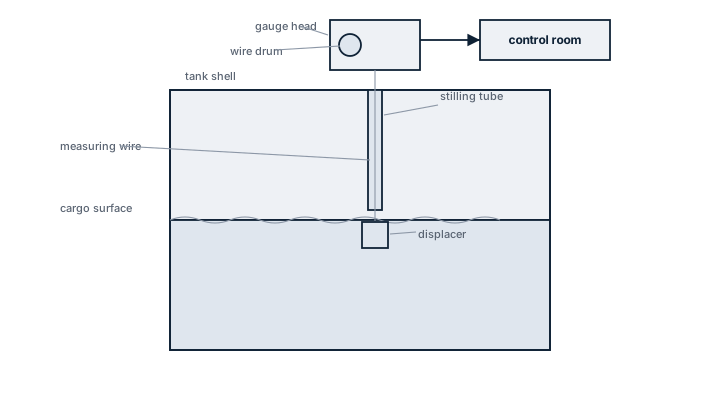
Main Components
Displacer
Small stainless steel float, sized so that its buoyancy change at the liquid interface is detectable but not so large that it disturbs the reading.
Wire and Drum
Precision wire wound on a drum inside the gauge head; wire wear and drum calibration drift are the main sources of long-term measurement error.
Servo Motor and Encoder
Motor drives the drum to chase the surface; the encoder converts drum rotation into a level reading, which the transmitter sends to the cargo control room.
Still Pipe or Stilling Well
Many installations run the displacer inside a perforated still pipe to dampen surface turbulence and wave motion so the servo does not chase every swell.
Local Display and Transmitter
Local readout at the tank plus a transmitter output to the cargo control system, usually with both level and, on gauges fitted for it, an interface or density measurement.
Selection and Sizing
- Tank height and pressure rating: the gauge head and stilling arrangement must match the tank's design pressure and maximum liquid column.
- Cargo compatibility: displacer and wetted parts material checked against the cargo's chemical compatibility, critical on chemical tankers carrying varied cargoes.
- Accuracy class: custody transfer duty demands tighter accuracy than a general operational tank, which affects the gauge grade selected.
- Interface detection: some servo gauges also track a water-oil interface, relevant for crude and product tanks with free water at the bottom.
Regulations and Class
Servo gauges used for custody transfer or for MARPOL Annex I ullage reporting must meet the accuracy demanded by class approval and, where applicable, by the terminal's custody transfer requirements; class surveys check calibration certificates and functional response against a known reference level. On tankers, the independent high-level alarm required for overfill protection is typically a separate device rather than the servo gauge itself, since a single-instrument failure should not remove both the reading and the alarm.
Typical Faults
| Fault | Consequence |
|---|---|
| Wire stretched or kinked from repeated cycling | Level reading drifts out of calibration over time |
| Displacer coated in wax, sludge or viscous cargo residue | False buoyancy reading, level shown incorrectly |
| Drum encoder contamination or mechanical wear | Erratic or frozen level readout despite the displacer moving freely |
| Still pipe perforations blocked by cargo residue | Servo chases wave motion, unstable readings in a seaway |
What to Look for in a Supplier
- Calibration certificate traceable to a recognised standard, especially where the gauge feeds custody transfer figures.
- Wetted parts material matched to the full range of cargoes the tank will carry, not just the cargo at time of order.
- Spare wire and displacer kits genuinely compatible with the installed drum mechanism — mixed-brand parts are a frequent source of calibration error.
Log the servo gauge reading against an independent manual ullage at least once a voyage — a slow calibration drift is easy to miss day to day but adds up fast on a custody transfer figure.