What to check on a Freefall Lifeboat.
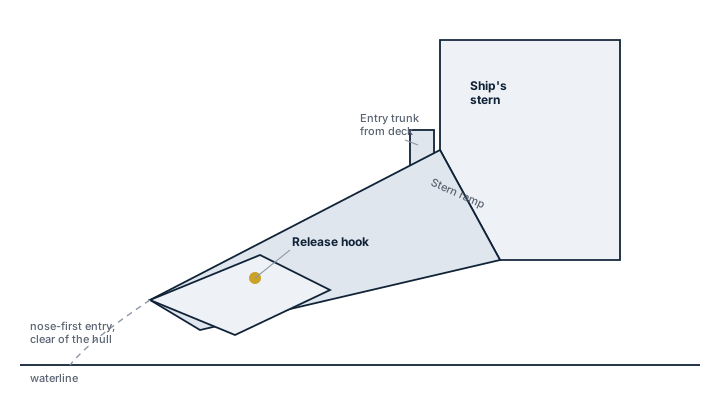
A freefall lifeboat is stowed on an inclined ramp at the stern, held by a release hook, with the crew strapped into aft-facing, energy-absorbing seats. Launch means releasing the hook so the boat slides down the ramp and falls into the sea nose-first, reaching a safe distance under its own propulsion within roughly a minute of the crew boarding. This matters on tankers and bulk carriers, where a fire or explosion can make a slow, wire-lowered davit launch unacceptably risky — freefall removes the davit wire, the winch and the…
What sets the freefall lifeboat apart
A freefall lifeboat is stowed on an inclined ramp at the stern, held by a release hook, with the crew strapped into aft-facing, energy-absorbing seats. Launch means releasing the hook so the boat slides down the ramp and falls into the sea nose-first, reaching a safe distance under its own propulsion within roughly a minute of the crew boarding. This matters on tankers and bulk carriers, where a fire or explosion can make a slow, wire-lowered davit launch unacceptably risky — freefall removes the davit wire, the winch and the time spent lowering, replacing it with a single release action. The trade-off is that the release mechanism itself becomes the single point of failure for the whole launch, and it is the part of the system with the most troubled safety record of any lifesaving appliance at sea.
Main components
Hull
A reinforced GRP hull is built to absorb the freefall impact load, which is substantially higher than the load a davit-launched boat structure needs to withstand — hull strength requirements for freefall boats are set specifically around the drop height and angle the boat is certified for.
Ramp and release hook
The ramp fixes launch angle and speed; the release mechanism (hydrostatic, mechanical, or a combination) holds the boat until deliberately triggered. Following a series of accidents where on-load release hooks fired unintentionally or failed to release under load, the LSA Code was amended to require redesigned, more failsafe release gear on new installations and retrofits.
Seating and restraints
Aft-facing seats with full harnesses and energy-absorbing padding protect occupants from the deceleration load at water entry — sitting the wrong way, or an unsecured harness, is a real injury risk during an actual freefall launch, not a theoretical one.
Engine and fire protection
A self-contained engine starts automatically or by a simple control after launch; boats intended for tankers often carry a water-spray system that wets the hull exterior to extend survival time when launching through or near a fuel fire on the water surface.
Selection and sizing
- Rated capacity (persons) and stowage weight, which set the ramp structure and release hook load rating
- Launch height above the waterline, certified within a minimum and maximum range — too low risks inadequate clearance from the hull, too high increases impact load beyond what the hull and occupants are certified for
- Whether a fire-protection water spray system is required, standard for tankers under the relevant fire-fighting appliance rules
- Drop test certification for the specific hull and release combination at the vessel's actual stowage height and angle
Regulations and class
SOLAS Ch. III and the LSA Code set freefall lifeboat requirements including launch performance, structural strength and release gear design. Following IMO's review of lifeboat release gear accidents (addressed through MSC circulars and subsequent LSA Code amendments), on-load release mechanisms delivered or retrofitted after the amendment must meet stricter design and testing requirements. Class requires periodic launching tests — typically at defined survey intervals, either with the full rated complement or an accepted test-weight equivalent — plus regular servicing of the release gear by an approved service provider, given its safety-critical role.
Typical faults
| Cause | Consequence |
|---|---|
| Release hook mechanism corroded, misadjusted or poorly maintained | Failure to release on demand, or accidental release without command — both have caused fatalities historically |
| Ramp fouling or corrosion | Boat hangs up partway down the ramp instead of a clean freefall launch |
| Harness not worn or seat not correctly adjusted | Injury to occupants from the deceleration load at water entry even when the launch itself is successful |
| Engine not started/serviced between drills | Boat lands in the water but cannot manoeuvre clear of the ship or a surface fire |
What to look for in a supplier
- Release gear compliant with the amended LSA Code design and testing requirements, with documentation showing which standard the specific unit meets
- Drop test certification matched to the vessel's actual stowage height and ramp angle, not a generic model certificate
- Approved service network for the release hook specifically, since class requires this maintained by competent, approved personnel
- Fire-protection water spray system where the vessel type requires it, tested as part of the same certification package
Release gear servicing is not a boat-in-general maintenance item to defer — it is the safety-critical single point of failure for the entire launch, and its documented accident history is exactly why class treats its overhaul interval as non-negotiable.