Offshore / Heavy Lift Crane
An offshore or heavy lift crane is built around active heave compensation and a load path rated for dynamic amplification at sea, not just static SWL - the same nominal tonne rating means something different once the vessel is moving.
What to check on an Offshore / Heavy Lift Crane.
12 models from Huisman in Offshore / Heavy Lift Crane. Below: the full model list.
What sets an offshore crane apart from a standard deck crane
A general cargo deck crane is sized for the heaviest lift it will make alongside or at anchor, with the vessel reasonably still. An offshore or heavy lift crane has to move loads between a moving vessel and a fixed platform, another moving vessel, or the seabed, which means the rated capacity has to account for dynamic loading from vessel motion, not just the static weight on the hook. Many carry active heave compensation (AHC), which pays winch wire in and out in real time to hold the load's absolute position steady while the crane base moves under it - the difference between landing a module gently on a platform deck and slamming it.
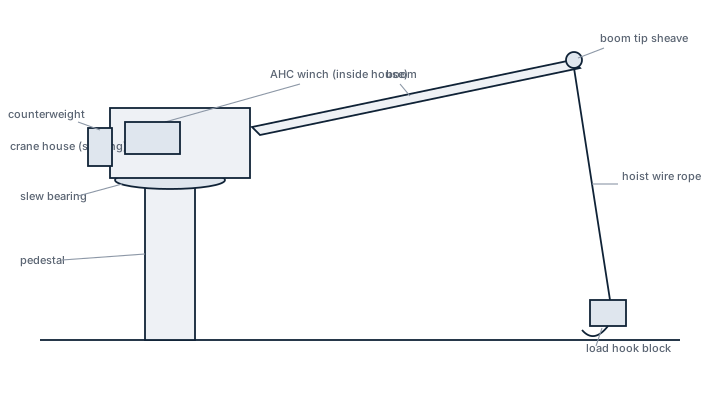
Legend
- boom tip sheave
- boom
- crane house (slewing) counterweight
- AHC winch (inside house)
- slew bearing
- hoist wire rope
- pedestal
- load hook block
Main components
- Pedestal and slew ring - the fixed base and bearing that carries the whole crane's weight and moment loading into the ship's structure; on heavy lift cranes this is a substantial structural item in its own right.
- Boom - lattice or box-section, fixed-length or luffing, sized for the reach and capacity envelope required.
- Main and auxiliary hoist winches - the auxiliary winch handles lighter, faster lifts so the main hoist is not run at part-load for routine work.
- Active heave compensation system - hydraulic accumulators or electric drives that sense vessel motion and adjust wire length to hold load position.
- Load monitoring and rated capacity indicator (RCI) - continuously computes actual load against the capacity curve for the current boom angle and radius, and cuts the lift before an overload.
Sizing and selection
The nameplate SWL is only the starting point. What actually decides fitness for a job is the full capacity curve against radius and boom angle, the AHC stroke and response time, and the sea state limits the manufacturer has tested and certified the crane against - a crane rated to lift 150 tonnes at the quay may be limited to a much lower dynamic capacity once significant wave height exceeds its certified operating window.
Regulations and class
Offshore cranes are certified against class rules for lifting appliances, generally aligned with IACS positions on lifting gear, plus, where applicable, recognised standards for offshore crane design. Proof load testing is required at commissioning and at periodic intervals set by class, typically annual thorough examination with a full load test at longer intervals. Wire ropes, hooks, and load-bearing structural members carry their own survey and discard criteria independent of the crane's overall certificate.
Read the full guide
Typical faults
- AHC accumulator pressure drift - slow nitrogen precharge loss changes the compensation response, showing up as the load 'chasing' instead of holding still.
- RCI sensor miscalibration after boom repair - a repaired or replaced boom section that is not recalibrated against the load table gives false capacity readings.
- Wire rope fatigue at the compensation sheave - the sheave that does the AHC work cycles far more than a standard hoist sheave and wears the rope faster than the discard interval assumes if not tracked separately.
- Slew ring bolt loosening - vibration from continuous offshore operation works pedestal bolts loose faster than in general cargo service, and is easily missed in a routine visual check.
What to look for in a supplier
- A certified capacity curve that states the sea state and significant wave height the dynamic rating was tested against, not just a static SWL.
- AHC system with documented response time and stroke, matched to the vessel's expected motion characteristics.
- Class approval from a society the vessel's own class society will recognise without a separate re-certification.
- Local service and parts support for the hydraulic or electric AHC drive, which is the component most likely to need attention.
Never read a heavy lift crane's capacity off the static SWL plate alone - pull the dynamic capacity curve for the actual sea state on the day, because the plate number and the safe number are only the same thing at the quay.
Models in this type.
The best-documented model of each manufacturer first, then the next — 12 of 12 models in Offshore / Heavy Lift Crane. Every row links to full specifications, documents and service notes.
Manufacturers.
All 15 manufacturers with models of Offshore / Heavy Lift Crane. Names with a manufacturer page open it; the others open a search across the full library.
All manufacturers in the libraryAlso in Deck Cranes.
The other equipment types in this category.
Write to us about this model — the answer comes by e-mail.
Name the make and the model and what the job is: a spare, a service call, a second opinion on a data sheet. We answer by e-mail.
No details at hand? A photo of the rating plate or the part is enough — simply attach it to the request.
Questions that come up with this equipment.
Is Offshore / Heavy Lift Crane data free?
Yes. Every model page, every guide and every datasheet for this type is readable without an account. An account adds saved searches and requests, nothing is taken away.
My model is missing — what now?
Send us the nameplate. We identify it by hand, add it to the library, and if you need a part or a service, the request is already on our desk.
Can you source a Offshore / Heavy Lift Crane part?
Yes. Tell us the manufacturer, the model and what you need — a person reads every request and replies by e-mail.