Freshwater Generator (Evaporator)
A freshwater generator makes drinking and boiler water from seawater by boiling it under vacuum at a low temperature, low enough that waste heat from the main engine's jacket cooling water alone is normally sufficient to do the evaporating, without needing a dedicated heat source.
What to check on a Freshwater Generator (Evaporator).
10 models from Alfa Laval in Freshwater Generator (Evaporator). Below: the full model list.
What defines this type
A freshwater generator, commonly called an evaporator, produces freshwater from seawater by distillation under vacuum, and the vacuum is the defining feature: it lowers the boiling point of seawater to roughly 40-60°C, low enough that the main engine's jacket cooling water, which would otherwise just be rejected overboard through the heat exchanger, can supply all the heat needed. This is what separates it from a reverse osmosis plant, which uses membrane filtration under high pressure rather than a phase change, needs no heat source but does need significant electrical power for the high-pressure pump.
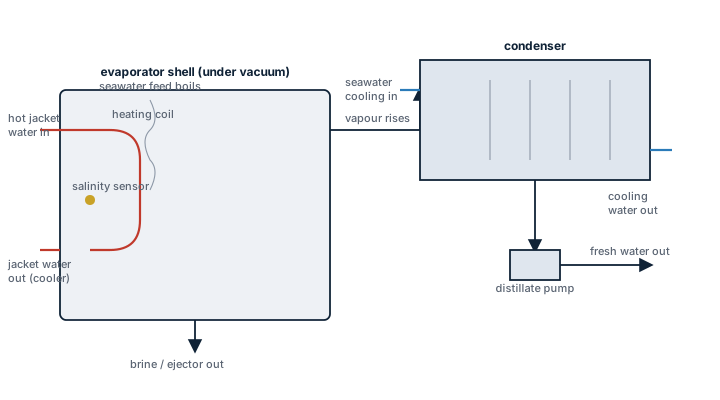
Legend
- condenser
- seawater feed boils
- evaporator shell (under vacuum)
- heating coil
- seawater cooling in
- hot jacket water in
- vapour rises
- cooling water out
- salinity sensor
- jacket water out (cooler)
- fresh water out
- distillate pump
- brine / ejector out
Main components
Evaporator shell
A vessel where feed seawater flows over a heating element carrying jacket cooling water and boils under the vacuum maintained inside the shell.
Heating element
A plate or tube bundle transferring heat from the jacket cooling water to the boiling seawater, without the two streams mixing.
Read the full guide
Demister and separator
A mesh or vane arrangement that strips entrained seawater droplets out of the rising vapour before it reaches the condenser, since carried-over droplets would salt-contaminate the product water.
Condenser
Cools the vapour back to liquid freshwater using a separate cooling seawater stream, and its outlet feeds the distillate pump that delivers product water to the tank.
Ejector or vacuum pump
Maintains the shell's vacuum, either a seawater-driven ejector or an electrically driven vacuum pump, and also extracts non-condensable gases that would otherwise reduce heat transfer efficiency.
Salinometer
Continuously monitors product water conductivity and automatically dumps the output to bilge or feed tank rather than the freshwater tank if salinity exceeds the set limit.
Selection and sizing
Capacity is set against the ship's daily freshwater consumption for the crew complement and any process use such as boiler make-up, with margin for the fact that output falls when jacket water temperature or engine load drops, for instance during manoeuvring or slow steaming. Single-effect units are simplest and match most cargo ships' needs; multi-effect or vapour-compression designs recover more heat per unit of seawater processed but add complexity that is only worth it where freshwater demand is high relative to available waste heat, such as on large passenger ships.
Regulations and class
Freshwater intended for drinking falls under the ship's potable water quality requirements, which in practice means the evaporator's salinometer alarm and automatic diversion function are checked at survey, along with the general condition of the pressure and vacuum parts as heat exchange equipment. There is no dedicated SOLAS chapter for evaporators as such; they are covered under the general machinery and potable water provisions the flag state applies.
Typical faults
| Fault | Cause | Consequence |
|---|---|---|
| Falling freshwater output | Scale build-up on the heating element from seawater minerals precipitating at the boiling surface | Reduced heat transfer and lower daily production, worsening progressively if not descaled |
| Product water intermittently salty | Demister fouled or damaged, allowing seawater carry-over into the vapour stream | Repeated automatic dumps of product water, reducing net output even when the salinometer is working correctly |
| Loss of vacuum | Air ingress through a worn gasket or a failing ejector/vacuum pump | Boiling point rises, and available jacket water heat may no longer be sufficient to sustain production |
| Sudden drop in output during manoeuvring | Reduced main engine load lowering jacket cooling water temperature | Expected behaviour rather than a fault, but often reported as one by crew unfamiliar with the dependency |
What to look for in a supplier
- Heating element material suited to the ship's typical seawater conditions, since scaling rates vary significantly with water temperature and salinity on the trading routes involved
- Rated output specified at a realistic jacket water temperature and engine load, not only at maximum continuous rating
- Salinometer and control system compatible with the ship's existing potable water monitoring, or supplied as a complete matched set
- Availability of gaskets, demister pads and ejector nozzles as consumable spares, since these wear faster than the shell or heating element itself
Track daily output against jacket water temperature, not against a fixed target — a genuine efficiency loss from scaling shows up as reduced output at the same jacket temperature, which a simple daily log makes obvious well before the unit fails to meet demand.
Models in this type.
The best-documented model of each manufacturer first, then the next — 10 of 10 models in Freshwater Generator (Evaporator). Every row links to full specifications, documents and service notes.
Manufacturers.
All 5 manufacturers with models of Freshwater Generator (Evaporator). Names with a manufacturer page open it; the others open a search across the full library.
All manufacturers in the libraryAlso in Heat Exchangers.
The other equipment types in this category.
Write to us about your machine — the answer comes by e-mail.
Name the make and the model and what the job is: a spare, a service call, a second opinion on a data sheet. We answer by e-mail.
No details at hand? A photo of the rating plate or the part is enough — simply attach it to the request.
Questions that come up with this equipment.
Is Freshwater Generator (Evaporator) data free?
Yes. Every model page, every guide and every datasheet for this type is readable without an account. An account adds saved searches and requests, nothing is taken away.
My model is missing — what now?
Send us the nameplate. We identify it by hand, add it to the library, and if you need a part or a service, the request is already on our desk.
Can you source a Freshwater Generator (Evaporator) part?
Yes. Tell us the manufacturer, the model and what you need — a person reads every request and replies by e-mail.