Conventional Fire Detection Panel
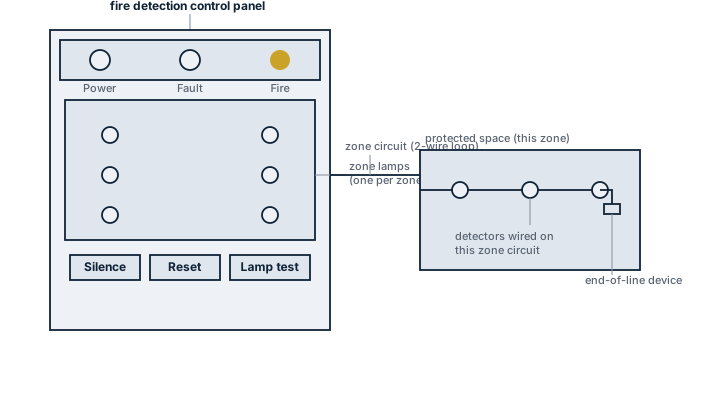
A conventional fire detection panel reports an alarm by zone, not by individual detector, so a triggered circuit tells the bridge which compartment group has a fire without saying which detector on that circuit tripped.
What to check on a Conventional Fire Detection Panel.
1 models from Tyco Fire & Security in Conventional Fire Detection Panel. Below: the full model list.
What sets a conventional panel apart from an addressable system
On an addressable fire detection system, every detector has its own electronic address and reports its identity individually to the panel. A conventional panel has none of that: detectors are wired in parallel groups onto a shared zone circuit, and the panel can only tell the crew that a device somewhere on that zone has activated, not which one. That simplicity is the whole point — conventional panels are cheaper to install, easier to wire, and remain common on smaller vessels and older tonnage where the number of zones is manageable enough that "somewhere in the engine room" or "somewhere on this accommodation deck" is enough information to send a crew member to investigate.
Main components
Zone circuits
Each zone is a two-wire loop, typically covering one compartment or a small group of adjacent spaces, with detectors and manual call points wired across the same pair of conductors.
End-of-line resistor
A fixed resistor at the far end of each zone loop lets the panel electronically distinguish a normal standby state from an open circuit fault or a short circuit, both of which are reported as faults distinct from an actual fire alarm.
Read the full guide
Zone indicator panel
A row of LEDs or a small annunciator, one per zone, lights to show which zone has alarmed; there is no display naming the specific detector or device.
Power supply and battery backup
A charger and standby battery keep the panel and connected sounders operating through a mains supply failure, sized to cover the required standby and alarm duration set by class.
Selection considerations
The main decision point is zone resolution against vessel size: a conventional panel with finely divided zones, one per small compartment, gives nearly the same practical response speed as an addressable system at lower installation cost, while a conventional panel with large zones covering multiple spaces forces crew to search a wider area on every alarm. Detector type per zone also needs matching to the space, since a zone mixing smoke and heat detectors on the same circuit still only reports "zone alarm" without telling responders which detection principle triggered.
Regulations and class
SOLAS Chapter II-2 sets requirements for fixed fire detection coverage, zone boundaries and the maximum floor area or number of spaces a single zone may cover, along with response and fault-indication requirements the panel has to meet regardless of whether it is conventional or addressable. Class surveys check zone identification labelling at the panel against the actual compartments served, since a mislabelled zone list defeats the entire purpose of a conventional system.
Typical faults
- Open zone circuit — from a corroded terminal or damaged cable, showing as a fault rather than an alarm but leaving that whole zone blind to fire.
- Ground fault on a zone — often from moisture ingress in a junction box, which can mask or falsely trigger alarms depending on where it sits on the circuit.
- Dust-contaminated detectors — give false alarms or, if contamination is severe enough to block the sensing chamber, fail to detect a real fire.
- Outdated zone labelling — after compartment changes or refits, leaving the panel's zone list out of step with the actual layout.
What to look for in a supplier
- Type approval for marine use and compatibility with the vessel's existing detector wiring if this is a panel replacement.
- Clear documentation matching each zone number to its physical coverage area.
- Battery capacity calculation showing it meets the required standby and alarm duration.
- Availability of end-of-line resistors and compatible detector types as ongoing spares.
Walk every zone physically against the panel's zone list at least once a year — an alarm that sends the crew to the wrong compartment is worse than no alarm at all.
Models in this type.
The best-documented model of each manufacturer first, then the next — 1 of 1 models in Conventional Fire Detection Panel. Every row links to full specifications, documents and service notes.
Manufacturers.
All 7 manufacturers with models of Conventional Fire Detection Panel. Names with a manufacturer page open it; the others open a search across the full library.
All manufacturersAlso in Fire Detection Systems.
The other equipment types in this category.
One request. A person reads it and replies by e-mail.
Tell us the manufacturer, the model and what you need — a part, a service call, a second opinion. A person reads every request and replies by e-mail.
No details at hand? A photo of the rating plate or the part is enough — simply attach it to the request.
Three things people ask first.
Is Conventional Fire Detection Panel data free?
Yes. Every model page, every guide and every datasheet for this type is readable without an account. An account adds saved searches and requests, nothing is taken away.
My model is missing — what now?
Send us the nameplate. We identify it by hand, add it to the library, and if you need a part or a service, the request is already on our desk.
Can you source a Conventional Fire Detection Panel part?
Yes. Tell us the manufacturer, the model and what you need — a person reads every request and replies by e-mail.