"> Fire Alarm Manual Call Point - Equipment Database

Fire Alarm Manual Call Point

medium 8 models total

A manual call point is the deliberately simple, break-glass link in an otherwise automatic detection system, a crew member's own eyes and nose raising the alarm the moment automatic detectors have not yet, or cannot.

Read more — Fire Alarm Manual Call Point explained

What sets a manual call point apart

Automatic detectors for smoke, heat or flame are built to catch a fire before anyone notices it, but they cannot see everything. A fire starting in a space without adequate detector coverage, or one first noticed by smell or sound rather than smoke density, still needs a way into the alarm system. A manual call point is that way in: a break-glass or push-button unit wired into the same addressable loop as the automatic detectors, reporting to the same panel, but requiring no automatic trigger at all, only a person. It is deliberately low-technology because the one thing it cannot be allowed to do is fail to work under stress.
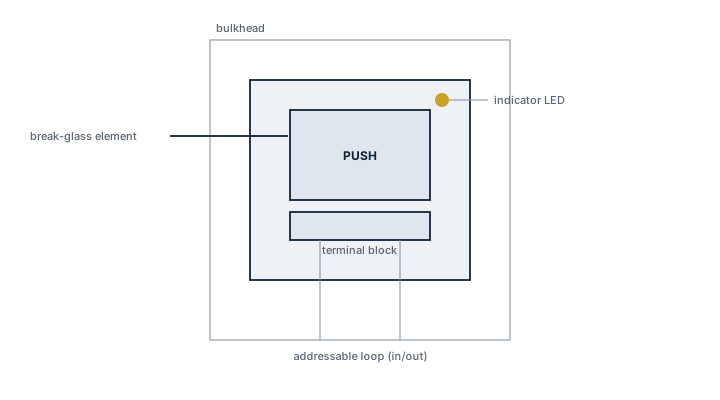
Fire alarm manual call point
Front view of a bulkhead-mounted manual call point showing the break-glass element, the indicator LED, the terminal block and the addressable loop cable running in and out through the bulkhead.

Main components

Frangible element

A glass or plastic element the operator breaks, or a resettable button they press, mechanically actuating a switch beneath. The physical action is intentionally obvious and hard to trigger by accident.

Switch and addressable module

On modern systems, an addressable module gives the panel the exact call point location, not just the zone, which matters when a fire team has to find the reporting point fast in a large accommodation block.

Indicator lamp

Confirms to the person who activated it, and to anyone passing, that the call point has registered on the panel.

Weatherproof enclosure

Call points in exposed deck locations or machinery spaces need an enclosure rated for the environment, covering moisture, vibration and temperature range, beyond the standard accommodation unit.

Placement and coverage

Placement is governed by escape route logic rather than fire risk logic: call points sit at every stairway landing, every exit from an enclosed space, and along corridors at intervals short enough that no one has to backtrack far to reach one. That is a different sizing question from automatic detector spacing, which follows ceiling height and airflow patterns. A space can be fully covered by automatic detection and still need call points simply because people pass through it on their way out.

Regulations and class

SOLAS II-2/7 requires manual call points as part of the fixed fire detection and fire alarm system, positioned at exits and stairway enclosures in accommodation, service and control spaces. FSS Code Chapter 9 sets the technical performance standard for the detection system as a whole, including manual call points, which must be capable of activation without requiring any tool and must be distinguishable from automatic-only zones on the panel. Testing is part of the periodic fire detection system survey; individual call points are function-tested on a rotating basis so that the whole installation is exercised across the survey cycle rather than only at the panel.

Typical faults

  • Frangible element already broken and not reported: the call point shows as activated or faulted on the panel, sometimes ignored as a known issue until it masks a real alarm.
  • Paint overspray sealing the glass or button during accommodation maintenance: the call point becomes inoperable without any panel fault shown.
  • Addressable module failure: the call point is present and apparently intact but not communicating with the panel, only found on function test.
  • Corrosion in exposed deck units: switch contacts fail intermittently, especially on older non-marine-rated housings retrofitted outdoors.
  • Coverage gap after a space reconfiguration: a new corridor or partition added without extending call point coverage to the new escape route.

What to look for in a supplier

  • Type approval under the FSS Code for the ship's installed detection system protocol, since call points are rarely interchangeable across different panel manufacturers' addressable loops.
  • Enclosure rating matched to the installation location, whether accommodation, open deck or machinery space.
  • Confirmed compatibility with the existing loop wiring and addressing scheme, to avoid a mixed-protocol installation.
  • Physical actuation force and reset method appropriate for the space; resettable push-button types are increasingly preferred over break-glass in accommodation areas to avoid injury and glass debris.

Rotate the function test across every call point over the survey cycle, not just the ones nearest the panel - a call point at the far end of a corridor is exactly the one most likely to be forgotten and exactly the one someone will need.

4 manufacturers · 8 models

Consilium Marine & Safety

4
Consilium Marine & Safety AB Manual Call Point CS-MCP
Manual Call Point CS-MCP
Coverage area per Hersteller-Datenblatt · Fire Suppression / Detection · Manual fire alarm call point
Common Failures & Inspection Points
  • Component wear due to operating hours and environmental conditions
  • Corrosion due to seawater/salt air exposure
  • Electronics/control failure due to moisture or vibration
  • Service interval overrun causes premature failure
Service: Maintenance per manufacturer manual and classification society requirements. Annual inspection at class survey. Stock spare parts per manufacturer specification.
Spare Parts: Consilium Marine & Safety AB: extinguishing agent and detector replacement from manufacturer. Lead time: 2-4 weeks.
Strengths
  • Robust stainless‑steel housing designed for marine corrosion resistance
  • Direct integration with Consilium fire detection/control systems (single‑wire loop operation)
  • Clear visual indicator and tactile feedback confirming activation
  • Meets EN 54‑2 and SOLAS requirements for manual call points on vessels
  • Low maintenance when inspected according to manufacturer’s schedule
Weaknesses
  • Requires regular inspection; missed maintenance can lead to failure in harsh sea‑water environments
  • Higher unit cost compared with generic, non‑marine‑rated MCPs
  • Only provides manual activation – no remote or automatic triggering capability
  • Installation requires compatible Consilium wiring and panel configuration
  • Potential for corrosion of internal contacts if sealing degrades over time
Typical Vessels: Passenger ferriesCruise shipsRo‑Ro vesselsOffshore supply vesselsOil & gas platform accommodation modules
Certifications: EN 54-2 (Manual call point)SOLAS compliance (IMO)DNV classification approval
Decision Guide: Choose if you need a marine‑rated manual fire alarm device that integrates seamlessly with Consilium fire panels, operates reliably in corrosive sea environments, and meets SOLAS/EN 54‑2 standards. Avoid if your vessel already uses a different fire‑alarm ecosystem, budget constraints preclude the higher unit price, or you require remote/automatic activation functions.
Use Cases: Installed at strategic manual alarm locations such as engine rooms, cargo holds, accommodation decks, and high‑risk zones on passenger and offshore vessels to provide crew members with an immediate means of signalling a fire event to the ship’s alarm system.
Manual Call Point CS-MCP WP
Coverage area per Hersteller-Datenblatt · Fire Suppression / Detection · Waterproof manual fire alarm activation point
Common Failures & Inspection Points
  • Component wear due to operating hours and environmental conditions
  • Corrosion due to seawater/salt air exposure
  • Electronics/control failure due to moisture or vibration
  • Service interval overrun causes premature failure
Service: Maintenance per manufacturer manual and classification society requirements. Annual inspection at class survey. Stock spare parts per manufacturer specification.
Spare Parts: Consilium Marine & Safety AB: extinguishing agent and detector replacement from manufacturer. Lead time: 2-4 weeks.
Strengths
  • Stainless‑steel construction provides high corrosion resistance in saltwater atmospheres
  • IP66/IK10 rating ensures protection against water ingress and mechanical impact
  • Fully compliant with EN 54‑2 and EN 54‑4, facilitating integration with most marine fire alarm panels
  • Simple pull‑type operation requires no power supply, reducing failure points
  • Low maintenance interval when inspected according to manufacturer’s handbook
Weaknesses
  • Provides only manual activation – no automatic detection capability
  • Requires regular visual inspection; missed inspections can lead to corrosion or mechanical sticking
  • Fixed mounting limits flexibility in layout changes
  • Potential for accidental activation if not properly guarded
  • Replacement parts must be sourced from the original manufacturer, which may affect lead time
Typical Vessels: Bulk CarrierContainer ShipTankerRo‑Ro VesselPassenger FerryOffshore Supply Vessel
Certifications: EN 54‑2EN 54‑4CE Marking
Decision Guide: Choose if you need a rugged, standards‑compliant manual activation point for engine rooms, cargo holds or accommodation spaces and can commit to the required annual inspection regime. Avoid if your fire safety strategy relies on automatic detection devices only, or if you prefer equipment with interchangeable parts from multiple suppliers.
Use Cases: Installed at strategic locations such as engine room entrances, cargo hold doors, stairwell landings, and near fire‑door assemblies; used to manually initiate the shipwide alarm and activate fire suppression systems when a fire is first observed.
Manual Call Point CS-MCP WP Ex, CD-MCP WP Ex ia, CD-MCP WP Ex ec and CD-MCP WP Ex ic
Coverage area per Hersteller-Datenblatt · Fire Suppression / Detection · Explosion‑protected manual fire alarm call point
Common Failures & Inspection Points
  • Component wear due to operating hours and environmental conditions
  • Corrosion due to seawater/salt air exposure
  • Electronics/control failure due to moisture or vibration
  • Service interval overrun causes premature failure
Service: Maintenance per manufacturer manual and classification society requirements. Annual inspection at class survey. Stock spare parts per manufacturer specification.
Spare Parts: Consilium Marine & Safety AB: extinguishing agent and detector replacement from manufacturer. Lead time: 2-4 weeks.
Strengths
  • ATEX and IECEx certified for use in hazardous zones (Ex ia, ic, ec)
  • Weather‑proof (WP) design suitable for marine environments with salt spray exposure
  • Multiple protection concepts allow selection to match vessel’s area classification
  • Robust mechanical lever provides reliable manual activation even after long service life
  • Meets IMO and class society requirements for fire alarm equipment in dangerous areas
Weaknesses
  • Manual operation only – no automatic detection capability
  • Requires strict maintenance schedule; corrosion or moisture ingress can cause failure
  • Higher initial cost compared with non‑Ex manual call points
  • Integration may need additional wiring or control modules to interface with ship’s fire alarm system
  • Physical size larger than some compact electronic alternatives
Typical Vessels: Oil tankerChemical carrierLNG/LPG carrierOffshore supply vesselPassenger ferryRo‑Ro vessel with hazardous cargo areas
Certifications: ATEXIECEx
Decision Guide: Choose if: the vessel has classified hazardous zones (Zone 0/1) where explosion‑proof equipment is mandatory, or when a weather‑proof manual activation point is required in engine rooms, fuel tanks or cargo pump stations. Avoid if: the ship already uses an integrated automatic fire detection system and budget constraints favor non‑Ex devices for non‑hazardous areas.
Use Cases: Installed at strategic locations such as engine rooms, fuel oil tanks, cargo pump stations, and other areas where a fire could develop in an explosive atmosphere; crew members can manually trigger the shipwide alarm to initiate fire suppression and evacuation procedures.
Consilium Marine & Safety AB Type A fire alarm sounder CD-S Buzzer
Type A fire alarm sounder CD-S Buzzer
Coverage area per Hersteller-Datenblatt · Fire Suppression / Detection · manual call point buzzer
Common Failures & Inspection Points
  • Component wear due to operating hours and environmental conditions
  • Corrosion due to seawater/salt air exposure
  • Electronics/control failure due to moisture or vibration
  • Service interval overrun causes premature failure
Service: Maintenance per manufacturer manual and classification society requirements. Annual inspection at class survey. Stock spare parts per manufacturer specification.
Spare Parts: Consilium Marine & Safety AB: extinguishing agent and detector replacement from manufacturer. Lead time: 2-4 weeks.
Strengths
  • Robust mechanical design suited for harsh marine environments
  • Clear, loud acoustic signal for rapid crew response
  • Simple operation – single‑push activation without need for external power
  • Manufacturer‑approved spare parts availability for quick replacement
  • Meets standard Class Society inspection requirements when maintained per handbook
Weaknesses
  • Susceptible to corrosion if sealing integrity is compromised by salt spray
  • Mechanical wear can reduce actuation force over many operating hours
  • No visual indicator; relies solely on sound which may be masked in noisy areas
  • Requires periodic manual inspection to verify functionality
  • Limited integration with advanced fire‑detection networks that use digital signalling
Typical Vessels: Bulk CarrierContainer ShipGeneral Cargo VesselOffshore Supply VesselPassenger Ferry
Decision Guide: Choose if: you need a proven, low‑complexity manual fire alarm point that can be installed quickly on vessels where electronic call points are not required and where routine class inspections are performed. Avoid if: the vessel relies heavily on integrated digital fire‑detection systems, operates in extremely corrosive environments without adequate protective enclosures, or requires visual alarm indications in addition to sound.
Use Cases: The CD‑S Buzzer is typically mounted in engine rooms, cargo holds, accommodation spaces and other high‑risk areas where crew members must be able to manually trigger an audible fire alarm instantly. It is used on vessels that follow IMO SOLAS requirements for manual call points and undergo annual class surveys.

Consilium Marine

2
Salwico MCP Marine
per point · Fire Suppression / Detection · addressable fire alarm manual call point
Type
manual_call_point
Solas
ja
Common Failures & Inspection Points
  • Glass element not resettable
  • Contact corrosion
  • Wiring fault
Service: Addressable type for Salwico loop. Test quarterly.
Spare Parts: Consilium: Extinguishing agent and detector replacement per manufacturer. Lead time: 2-4 weeks.
Strengths
  • Fully addressable – integrates with Salwico fire‑detection loops for precise zone identification
  • SOLAS compliant, meeting mandatory maritime fire safety regulations
  • Robust marine‑grade housing suitable for harsh shipboard environments
  • Simple single‑push operation; test function built in for quarterly verification
Weaknesses
  • Glass activation element is not resettable after actuation – must be replaced
  • Contact corrosion reported in high‑humidity installations, requiring regular inspection
  • Wiring faults can occur if loop termination is not performed to manufacturer specifications
  • Limited to Salwico system architecture; not interchangeable with other vendors' loops
Typical Vessels: TankerContainer shipBulk carrierPassenger ferryOffshore supply vessel
Decision Guide: Choose if you already operate a Salwico fire‑detection system, need an addressable manual call point that meets SOLAS requirements, and value straightforward testing. Avoid if you prefer a resettable glass element, are using a non‑Salwico alarm loop, or have experienced corrosion issues in similar devices on your fleet.
Use Cases: Installed at strategic fire zones such as engine rooms, cargo holds, accommodation decks, and machinery spaces to provide crew‑initiated alarm activation; commonly used where precise zone identification and compliance with SOLAS are mandatory.
Consilium Salwico Manual Call Point MCP unverified
Equipment Type
fire_detector
Salwico detector

Apollo Marine

1
Apollo Marine Discovery MCP Marine 55100-940
Discovery MCP Marine 55100-940
per point · Fire Suppression / Detection · Manual fire alarm call point
Type
manual_call_point
Ingress Protection (IP)
IP67
Solas
ja
Common Failures & Inspection Points
  • Glass element breakage
  • Contact failure
  • Water ingress
Service: IP67 rated for exposed locations. Quarterly test.
Spare Parts: Apollo Marine: Extinguishing agent and detector replacement per manufacturer. Lead time: 2-4 weeks.
Strengths
  • IP67 protection enables placement on decks and in wet locations
  • Meets SOLAS requirements for manual fire alarm initiation
  • Simple mechanical operation with no power supply needed
  • Low maintenance routine (quarterly functional test)
  • Robust housing suitable for typical shipboard conditions
Weaknesses
  • Glass activation element can fracture under impact
  • Potential contact wear leading to failure over time
  • Water ingress risk if seals degrade despite IP67 rating
  • Provides only manual activation – no automatic fire detection
  • Limited integration features compared with newer electronic panels
Typical Vessels: TankerContainer shipBulk carrierPassenger ferryOffshore supply vesselCruise ship
Certifications: SOLAS
Decision Guide: Choose if: you need a reliable, SOLAS‑compliant manual alarm point for exposed or wet locations and prefer a low‑maintenance mechanical device. Avoid if: the installation requires automatic detection, high‑impact resistance beyond glass, or advanced networking with fire panels.
Use Cases: Installed at deck level entry points, engine room doors, cargo hold accessways, near fire extinguishers, and other strategic locations where crew can quickly trigger a shipwide alarm in case of fire.

Autronica

1
Autronica Manual Call Point BG Detector unverified
Equipment Type
fire_detector
Autronica detector