What to check on a Manual Call Point.
Smoke and heat detectors react to a physical change in the air; a manual call point (MCP) reacts to a person. It exists for the case where someone spots flame, smells smoke, or sees an electrical fault sparking well before any detector head crosses its alarm threshold, and for spaces where automatic detection is impractical or where a false start needs a human override. Every MCP on the loop reports its own address to the fire panel, exactly like an automatic detector, so the location shows immediately on the mimic…
What a manual call point does that automatic detectors cannot
Smoke and heat detectors react to a physical change in the air; a manual call point (MCP) reacts to a person. It exists for the case where someone spots flame, smells smoke, or sees an electrical fault sparking well before any detector head crosses its alarm threshold, and for spaces where automatic detection is impractical or where a false start needs a human override. Every MCP on the loop reports its own address to the fire panel, exactly like an automatic detector, so the location shows immediately on the mimic display.
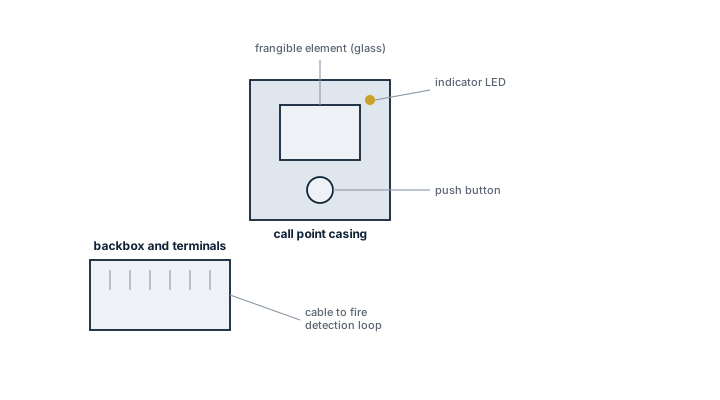
Main components
Break-glass / frangible element units
The traditional design uses a small glass or plastic element that must be broken to depress the operating element underneath. This deliberately makes activation a conscious, two-stage act — reducing accidental trips from a bumped enclosure — while still needing no key or tool.
Resettable (non-frangible) units
Increasingly common, these use a hinged or push-in element that can be reset with a key after a false alarm or drill, avoiding the cost and delay of replacing a glass element every time. Many yards now specify resettable units as standard on newbuilds precisely because drills happen often.
Addressable interface / base
On an addressable loop, the MCP body sits on a base that carries its own loop address, identical in principle to a smoke detector base, so the panel can distinguish an MCP activated in the engine room from a general zone alarm.
Selection considerations
- Compatibility with the existing loop protocol — MCPs are protocol-specific and cannot be freely mixed between panel manufacturers on an addressable system.
- Frangible versus resettable element, weighed against how often the space runs fire drills.
- Ingress protection rating for exposed deck or engine room locations against a dry accommodation corridor unit.
- Mounting height and colour, both fixed by class and flag requirements rather than left to preference.
Regulations and class
SOLAS Chapter II-2 and the FSS Code require manual call points at all exits from accommodation, service and control spaces, at each stairway landing, and along escape routes, in addition to automatic detection. They must be red, clearly marked, and positioned so no crew member has to travel far from any point in the space to reach one. Class surveys verify the call points activate the panel correctly and that the alarm reaches both the bridge and the fire control station, and periodic testing of a sample of call points is standard practice at each annual survey.
Typical faults
| Fault | Consequence |
|---|---|
| Paint applied over the unit during accommodation refurbishment | Frangible element no longer breaks under normal hand pressure, or the unit is no longer visibly red |
| Corroded terminal connections in weather-exposed mounting boxes | Loop reports intermittent fault or the call point drops off the addressable loop entirely |
| Cover glass replaced with the wrong element rating | Unit either triggers under vibration alone or requires excessive force to activate |
| Call point address not updated after panel software change | Alarm shows the wrong location on the mimic, sending the fire team to the wrong deck |
What to look for in a supplier
- Type approval certificate matching the specific fire panel manufacturer and protocol already fitted, not a generic addressable claim.
- Marine-rated housings (IP66 or better) for external and engine room locations.
- Spare frangible elements available separately from full replacement units.
- Documented compatibility with the vessel's existing loop wiring, since some manufacturers' addressable ranges are not backward compatible with older panel generations.
After any accommodation repainting, physically test every call point in the painted area — a coat of paint across the frangible element is one of the most common reasons a call point fails a survey.