OceanSphere
Engines

Smoke Detector (Optical)

medium 7 models total
Optical smoke detectors for marine fire detection loops

5 manufacturers · 7 models

Consilium

2
Consilium Salwico Optical Smoke Detector OSD
Salwico Optical Smoke Detector OSD
per point · Fire Suppression / Detection · Optical smoke detection
Type
optical_smoke
Solas
ja
Common Failures & Inspection Points
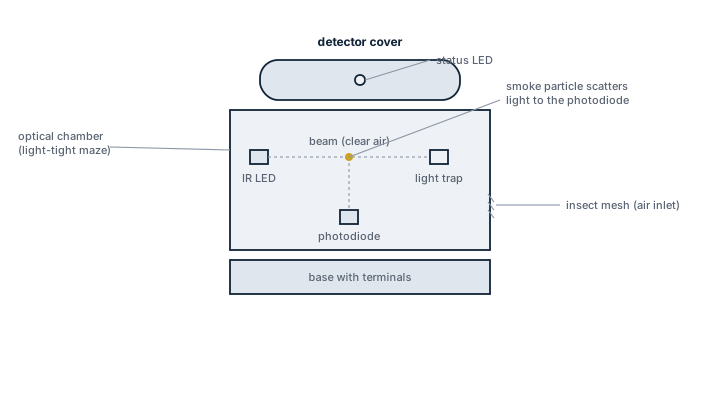
  • Sensor contamination from dust/insects
  • Base contact corrosion
  • LED source degradation
Service: Replace every 5-8 years. Clean annually. Use only with Salwico bases.
Spare Parts: Consilium: Löschmittel und Detektoren-Ersatz per Hersteller. Lead time: 2-4 Wochen.
Strengths
  • SOLAS‑approved for maritime use
  • High sensitivity to fine combustion particles
  • Designed to interface directly with Salwico base units
  • Rated service life of 5–8 years, reducing frequent replacements
Weaknesses
  • Sensor window can become contaminated by dust or insects, affecting reliability
  • Base contacts are prone to corrosion in humid marine environments
  • LED light source may degrade over time, requiring replacement at the end of service interval
  • Requires annual cleaning and strict maintenance discipline
Typical Vessels: Passenger shipsFerriesCruise vesselsRo‑Ro vesselsAny vessel with accommodation or public spaces subject to SOLAS fire detection rules
Decision Guide: Choose if you already use Salwico fire‑detection infrastructure, need a SOLAS‑compliant optical smoke sensor, and can commit to the required annual cleaning and replacement schedule. Avoid if you cannot guarantee regular maintenance, prefer multi‑sensor (heat + smoke) units, or operate in environments with high dust/insect exposure that would increase false alarms.
Use Cases: Typically installed in crew quarters, passenger cabins, galley areas, lounges and other enclosed spaces where early detection of smoldering fires is critical. The detector works best where a clear line‑of‑sight to the sensor window can be maintained and where routine inspection is feasible.
Consilium Salwico Optical Smoke Detector OSD unverified
Equipment Type
fire_detector
Salwico detector

Consilium Marine & Safety

2
Consilium Marine & Safety AB NS-DOS3 Optical Smoke Detector
NS-DOS3 Optical Smoke Detector
Coverage area per Hersteller-Datenblatt · Fire Suppression / Detection · Optical smoke detector
Common Failures & Inspection Points
  • Komponenten-Verschleiß durch Betriebsstunden und Umgebungsbedingungen
  • Korrosion durch Seewasser-/Salzluft-Exposition
  • Elektronik-/Steuerungsausfall durch Feuchtigkeit oder Vibration
  • Wartungsintervall-Überschreitung verursacht vorzeitigen Ausfall
Service: Wartung per Hersteller-Handbuch und Klassifikationsgesellschafts-Anforderungen. Jährliche Inspektion bei Class Survey. Ersatzteile per Herstellerangabe bevorraten.
Spare Parts: Consilium Marine & Safety AB: Löschmittel und Detektoren-Ersatz per Hersteller. Lead time: 2-4 Wochen.
Strengths
  • Fast response to smoldering fires typical in accommodation spaces
  • Sealed, corrosion‑resistant housing suitable for marine environments
  • Approved by DNV, facilitating class survey acceptance
  • Direct compatibility with Consilium fire alarm control panels
  • Simple annual inspection and cleaning procedures
Weaknesses
  • Performance can degrade if the optical lens becomes dirty or coated with salt deposits
  • Less effective in high‑dust or aerosol‑rich areas compared with ionisation detectors
  • Requires strict adherence to maintenance intervals; overdue service may cause premature failure
  • Sensitive to excessive humidity and vibration, which can lead to electronic faults
Typical Vessels: Passenger shipsFerriesCruise vesselsOffshore supply vesselsGeneral cargo vessels with enclosed accommodation areas
Certifications: DNV
Decision Guide: Choose the NS-DOS3 if you need a DNV‑approved optical smoke detector that integrates seamlessly with Consilium fire panels and will be installed in enclosed, low‑dust spaces such as cabins, galley or control rooms. Avoid it in highly dusty, aerosol‑laden environments or where budget constraints favour a simpler, non‑integrated detector.
Use Cases: Typically deployed in shipboard accommodation zones, crew quarters, galley areas, bridge and control rooms, and any enclosed compartments where early detection of smoldering fires is critical. The unit is mounted on ceilings or walls and linked to the vessel’s central fire alarm system for immediate alarm activation.
Consilium Marine & Safety AB Programmable Smoke and Heat detector with short circuit isolator CS-PH Ex, CD-PH Ex, ia. CD-PH Ex ic
Programmable Smoke and Heat detector with short circuit isolator CS-PH Ex, CD-PH Ex, ia. CD-PH Ex ic
Coverage area per Hersteller-Datenblatt · Fire Suppression / Detection · Programmable optical smoke/heat detector with Ex protection
Common Failures & Inspection Points
  • Komponenten-Verschleiß durch Betriebsstunden und Umgebungsbedingungen
  • Korrosion durch Seewasser-/Salzluft-Exposition
  • Elektronik-/Steuerungsausfall durch Feuchtigkeit oder Vibration
  • Wartungsintervall-Überschreitung verursacht vorzeitigen Ausfall
Service: Wartung per Hersteller-Handbuch und Klassifikationsgesellschafts-Anforderungen. Jährliche Inspektion bei Class Survey. Ersatzteile per Herstellerangabe bevorraten.
Spare Parts: Consilium Marine & Safety AB: Löschmittel und Detektoren-Ersatz per Hersteller. Lead time: 2-4 Wochen.
Strengths
  • Combined smoke and heat sensing in one unit reduces component count
  • Explosion‑proof housing (Ex) suitable for hazardous zones
  • Integrated short‑circuit isolator enhances system safety
  • Programmable thresholds allow tailoring to specific vessel areas
  • Compatible with standard fire detection control panels
Weaknesses
  • Sensitive to corrosion from sea‑water and salt‑laden air; requires robust sealing
  • Electronic components can fail if exposed to excessive moisture or vibration
  • Strict maintenance intervals; overdue service may cause premature failure
  • Higher initial cost compared with basic non‑Ex smoke detectors
  • Spare parts must be stocked as per manufacturer recommendation
Typical Vessels: TankerChemical tankerOffshore supply vesselLNG carrierPassenger ship
Decision Guide: Choose if you need a fire detector that meets explosion‑protection requirements, offers both smoke and heat detection, and includes a short‑circuit isolator for added safety. Avoid if the installation area is not classified as hazardous or if budget constraints make a non‑Ex detector sufficient.
Use Cases: Installed in engine rooms, cargo holds containing flammable liquids or gases, accommodation areas of passenger vessels, and any compartment where an explosion‑protected fire detection solution is mandated by classification societies.

Apollo Marine

1
Discovery Optical Smoke 58000-600
per point · Fire Suppression / Detection · Optical smoke detector
Type
optical_smoke
Solas
ja
Common Failures & Inspection Points
  • Chamber contamination
  • Base corrosion
  • LED degradation
Service: Apollo marine approved. Annual cleaning.
Spare Parts: Apollo Marine: Löschmittel und Detektoren-Ersatz per Hersteller. Lead time: 2-4 Wochen.
Strengths
  • Fast response to fine particulate smoke using light scattering principle
  • Meets SOLAS fire detection requirements for passenger and crew areas
  • Apollo Marine approved with straightforward annual cleaning procedure
  • Compact mounting suitable for confined accommodation compartments
Weaknesses
  • Chamber contamination can impair sensitivity if not cleaned regularly
  • Base corrosion reported in harsh marine environments, requiring inspection
  • LED light source may degrade over time, affecting long‑term reliability
  • Requires periodic calibration to maintain compliance
Typical Vessels: Passenger shipCruise linerRo‑Ro ferryOffshore support vesselYacht
Certifications: SOLAS
Decision Guide: Choose if you need a SOLAS‑compliant optical smoke detector with low installation complexity and an approved annual maintenance regime. Avoid if the vessel operates in extremely corrosive salt‑spray conditions without robust corrosion protection, or if long LED lifespan is a primary concern.
Use Cases: Installed in accommodation decks, galley areas, bridge and engine control rooms to provide early warning of smoldering fires where rapid detection can prevent fire spread.

Autronica

1
AutroSafe Optical Smoke BHH-500
per point · Fire Suppression / Detection · optical smoke detector
Type
optical_smoke
Solas
ja
Common Failures & Inspection Points
  • Sensor contamination
  • Base corrosion in humid areas
  • Sensitivity drift
Service: Part of Autronica loop. Annual cleaning.
Spare Parts: Autronica: Löschmittel und Detektoren-Ersatz per Hersteller. Lead time: 2-4 Wochen.
Strengths
  • SOLAS‑compliant, meeting mandatory safety regulations for passenger and crew spaces
  • Fast response to low‑temperature smouldering fires thanks to photoelectric sensing
  • Integrates directly into Autronica fire‑detection loops for centralized alarm handling
  • Marine‑grade housing resists vibration and salt spray when properly maintained
  • Low power consumption suitable for continuous operation on shipboard electrical systems
Weaknesses
  • Sensor window can become contaminated; requires annual cleaning to retain sensitivity
  • Base corrosion reported in high‑humidity installations if protective measures are lacking
  • Sensitivity may drift over time, necessitating periodic calibration checks
  • Provides smoke detection only – no heat or flame sensing for rapid fire growth scenarios
  • Installation tied to Autronica loop; retrofitting on non‑Autronica systems can be complex
Typical Vessels: Passenger shipCruise linerRo‑Ro ferryOffshore supply vesselGeneral cargo / container ship (accommodation areas)
Certifications: SOLAS
Decision Guide: Choose if: you need a SOLAS‑approved optical smoke detector, the vessel already uses an Autronica fire‑detection loop, and regular maintenance (cleaning, corrosion checks) can be performed. Avoid if: the installation environment is extremely humid without adequate anti‑corrosion measures, or if a multi‑parameter fire detection system (smoke + heat/ flame) is required.
Use Cases: Typically installed in accommodation spaces, galley areas, control rooms and other crew quarters where early detection of smouldering fires is critical. The detector’s fast optical response helps alert crews before a fire spreads, complementing heat detectors in engine rooms.

Hochiki

1
ESP Optical Smoke ALN-EN
per point · Fire Suppression / Detection · Optical (photoelectric) smoke detector
Type
optical_smoke
Solas
ja
Common Failures & Inspection Points
  • Chamber contamination
  • Address setting loss
  • Base corrosion
Service: Japanese manufacture, global marine approvals
Spare Parts: Hochiki: Löschmittel und Detektoren-Ersatz per Hersteller. Lead time: 2-4 Wochen.
Strengths
  • SOLAS‑compliant and accepted by major classification societies
  • Addressable design enables precise zone identification and integration with shipwide fire alarm panels
  • High sensitivity to smoldering fires while resisting rapid flame ignition sources
  • Compact mounting suitable for confined spaces such as engine rooms and cargo holds
Weaknesses
  • Performance can degrade if the optical chamber becomes contaminated by dust, oil mist or salt spray
  • Requires regular inspection and cleaning to maintain reliability in harsh marine environments
  • Corrosion of terminal bases reported in long‑term service if not protected properly
  • Limited temperature range compared with some multi‑criteria detectors
Typical Vessels: TankersContainer shipsBulk carriersCruise linersFerries
Certifications: SOLAS
Decision Guide: Choose if you need a proven, SOLAS‑approved optical smoke detector with addressable capability for early smoldering fire detection in engine rooms, accommodation areas or cargo spaces. Avoid if the installation environment is heavily contaminated with oil mist, dust or salt spray where a multi‑criteria (optical + CO) detector would be more robust.
Use Cases: Commonly installed in engine rooms, machinery spaces, crew accommodations, galley areas and certain cargo holds where early detection of slow‑burning fires is critical. Integrated into the vessel's fire alarm system for zone monitoring and automatic alarm activation.