Floodlight
A floodlight provides wide-area working light for deck operations and mooring stations, a separate function from the navigation and emergency lighting that shares this category and answers to different rules entirely.
What to check on a Floodlight.
42 models from WISKA in Floodlight. Below: the full model list.
What defines this type
A floodlight is a high-output, wide-beam fixture for illuminating a working area — deck, cargo hold, mooring station, gangway — and it is functionally distinct from the navigation lights that signal the ship's heading and status to other vessels, and from the emergency escape lighting that must run on the emergency switchboard. A floodlight failing does not create a collision-regulation problem the way a navigation light failing does; it creates a working-safety problem during cargo operations, mooring or a security watch.
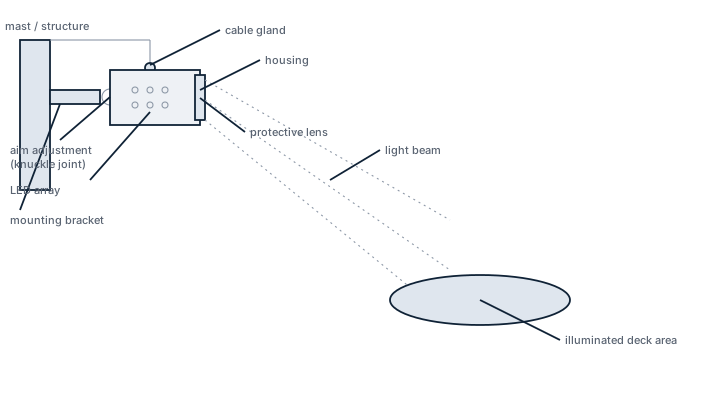
Legend
- Cable gland
- Housing
- Mounting bracket
- Aim adjustment (knuckle joint)
- Protective lens
- LED array
- Light beam
- Mast / structure
- Illuminated deck area
Main components
Housing
A sealed, corrosion-resistant enclosure — die-cast aluminium with a marine coating or stainless steel — rated to an ingress protection class that keeps out driving spray and washdown water at the mounting location.
Light source
LED arrays have largely replaced metal halide and high-pressure sodium floodlights on new-build and retrofit work, for instant-on operation, lower power draw for equivalent lumen output, and a service life measured in tens of thousands of hours rather than a few thousand.
Read the full guide
Driver
Converts ship's supply voltage to what the LED array needs and regulates current; it is usually the first component to fail under supply voltage spikes or heat, well before the LEDs themselves degrade.
Mounting bracket
A yoke or bracket allowing aim adjustment, built to resist the vibration of the mast or superstructure position it is fitted to without the fixture working loose or drifting off aim over months at sea.
Selection / Sizing
| Parameter | Why it matters |
|---|---|
| Lumen output | Matched to area size and working task, not maximised regardless of need |
| Beam angle | Narrow beam for long-throw deck lighting; wide beam for close work areas |
| IP rating | IP66 minimum for open deck exposure; higher for direct washdown areas |
| Supply voltage | Ship's distribution voltage (often 440V/230V or a 24V DC subsystem) |
| Colour temperature | Cooler colour temperatures give better perceived contrast for cargo work |
Mounting height and vibration exposure on masts versus superstructure walls also drive the choice between a heavier cast housing and a lighter fixture, since the same lumen output in a poorly damped high-mounted fixture shakes itself loose far faster than one mounted low and rigid.
Regulations / Class
Floodlights are not carriage-mandated equipment the way navigation lights are under COLREG and SOLAS; they fall instead under general electrical installation rules such as IEC 60092 for shipboard wiring and enclosure ratings, and class society requirements for fixtures in the specific area they are mounted. On tankers and other vessels with hazardous zones on deck, floodlights covering or adjacent to those zones require certified explosion-protected (ATEX or equivalent) fittings, and substituting a standard fixture in a hazardous area is a survey non-conformity, not a minor deviation.
Typical faults
- Seal failure and water ingress — gasket degradation from UV and salt exposure lets moisture into the housing, which then shows up as condensation fogging, corrosion on the driver board, or a nuisance earth fault.
- Driver failure — voltage transients on the ship's supply, especially near large motor starts, damage the driver electronics well before the LED array itself wears out.
- Mounting bracket corrosion — a fixture in fine working condition can still fail structurally at the bracket, dropping or misaiming the light, especially on masts exposed to constant spray.
- LED lumen depreciation — output drops gradually over years of operating hours, especially in poorly heat-sinked housings, and is rarely noticed until a side-by-side comparison with a new fixture.
- Vibration-loosened aim — brackets not properly torqued or lacking a lock feature drift out of aim over months, leaving a working area under-lit without any fault indication at all.
What to look for in a supplier
- A genuine IP66 or IP67 rating tested and certified, not a manufacturer's estimate.
- Marine-grade housing material with a stated salt-spray test duration (per a recognised standard) rather than a generic corrosion-resistance claim.
- Driver components rated for the ship's actual supply voltage tolerance and transient environment, with surge protection built in.
- Published lumen maintenance data (L70 or similar) so the expected useful service life can be planned against, not assumed.
- Certified hazardous-area variants available for any tanker or gas-carrier deck zones that require them.
Aim and re-torque floodlight brackets at each dry-dock, not only when a fixture is visibly drooping — vibration works the aim off target long before the mounting looks obviously loose.
Models in this type.
The best-documented model of each manufacturer first, then the next — 42 of 42 models in Floodlight. Every row links to full specifications, documents and service notes.
Manufacturers.
All 18 manufacturers with models of Floodlight. Names with a manufacturer page open it; the others open a search across the full library.
All manufacturers in the libraryAlso in Lighting.
The other equipment types in this category.
Write to us about this model — the answer comes by e-mail.
Name the make and the model and what the job is: a spare, a service call, a second opinion on a data sheet. We answer by e-mail.
No details at hand? A photo of the rating plate or the part is enough — simply attach it to the request.
Questions that come up with this equipment.
Is Floodlight data free?
Yes. Every model page, every guide and every datasheet for this type is readable without an account. An account adds saved searches and requests, nothing is taken away.
My model is missing — what now?
Send us the nameplate. We identify it by hand, add it to the library, and if you need a part or a service, the request is already on our desk.
Can you source a Floodlight part?
Yes. Tell us the manufacturer, the model and what you need — a person reads every request and replies by e-mail.