What to check on a Explosion-Proof Light.
An explosion-proof light is built to operate inside a hazardous area — a cargo pump room, a tank deck, a paint locker — where flammable gas or vapour may be present. It does not exclude the gas; it prevents the fitting from becoming the ignition source. Two protection concepts dominate on board: flameproof enclosure (Ex d), where any internal arc or spark is contained and the resulting flame is cooled below ignition temperature before it can reach the outside atmosphere, and increased safety (Ex e) or intrinsic safety (Ex ia/ib)…
What Makes This Type Different
An explosion-proof light is built to operate inside a hazardous area — a cargo pump room, a tank deck, a paint locker — where flammable gas or vapour may be present. It does not exclude the gas; it prevents the fitting from becoming the ignition source. Two protection concepts dominate on board: flameproof enclosure (Ex d), where any internal arc or spark is contained and the resulting flame is cooled below ignition temperature before it can reach the outside atmosphere, and increased safety (Ex e) or intrinsic safety (Ex ia/ib), where the internal energy is kept low enough that a spark simply cannot ignite the surrounding atmosphere. A standard cabin or engine room luminaire has neither property and must never be substituted, even temporarily.
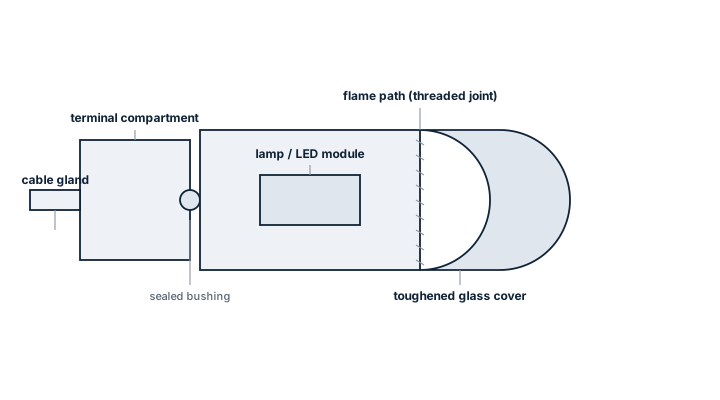
Main Components
Enclosure
Cast aluminium or stainless steel body, machined to tight tolerances at the joint faces so that any internal flame path is long and narrow enough to cool the gases before they exit — this is the flame path, and its clearance is fixed by certification, not by the yard fitting the light.
Glass and Gasket
Toughened borosilicate or polycarbonate glass, rated for both the thermal shock of a cold wash-down and the mechanical shock of green water on deck. The gasket seals the enclosure to at least IP66; a swollen or perished gasket is the single most common reason a certified fitting fails a re-inspection.
Terminal Compartment
Cable entry uses certified Ex d or Ex e glands matched to the cable outer diameter — an undersized gland is a documented cause of ingress and of certification voiding.
Light Source
Older stock still runs fluorescent or metal-halide tubes; current supply is almost entirely LED, which lowers heat inside the enclosure and extends the service interval, but the driver electronics must sit inside a compartment rated for the same zone as the lamp.
Selection and Sizing
- Zone: Zone 0, 1 or 2 per the hazardous area drawing — a Zone 1 fitting is not automatically suitable for Zone 0.
- Gas group: IIA, IIB or IIC — cargo vapour on a product tanker or gas carrier may demand IIC, a stricter group than IIA typical of many onshore applications.
- Temperature class: T3 to T6, based on the auto-ignition temperature of the specific cargo, not a generic assumption.
- Ambient range: engine room and deck fittings see different extremes; a driver rated for 40°C ambient will derate or fail early in a hot casing.
- Mounting: bulkhead, deckhead or pendant, with bracket material matched to the compartment's corrosion exposure.
Regulations and Class
SOLAS Ch. II-2 sets out which spaces require certified electrical equipment because of fire and explosion risk, and class societies apply IEC 60079 series certification to the fitting itself (marked as Ex d, Ex e, IIC, T-class and the certifying body's code on the nameplate). Surveys check that the nameplate matches the hazardous area drawing for that specific location, that gaskets and glass are intact, and that no unauthorised drilling or painting has damaged the flame path. A fitting moved from one location to another without re-checking its zone and gas group rating is a common survey finding.
Typical Faults
| Fault | Consequence |
|---|---|
| Gasket perished or missing after relamping | Loss of IP rating; moisture or gas ingress into a certified enclosure |
| Wrong replacement bulb or driver fitted | Certification voided even though the housing looks correct |
| Enclosure over-painted at the flame path joint | Flame path clearance altered, containment no longer guaranteed |
| Cable gland swapped for a standard type | Unrated entry point into a hazardous area, defeats the whole fitting |
| Bolts not fully torqued after maintenance | Flame path gap opens beyond certified tolerance |
What to Look for in a Supplier
- Valid Ex certificate for the exact model, not just a general product line datasheet.
- Gas group and temperature class stated explicitly, matched against the vessel's hazardous area drawing before ordering.
- Spare parts — glass, gasket, gland kit — sold as certified kits, not generic hardware store equivalents.
- Documented compatibility if replacing an existing fitting from a different manufacturer, since flame paths are not universally interchangeable.
Never relamp or open an Ex d fitting with anything other than the manufacturer's specified parts and torque values — a light that looks identical after a repair can be a completely different, uncertified device.