What to check on a Floodlights (Deck).
Deck floodlights exist to let people work safely and see what they are doing during cargo operations, mooring, anchoring or maintenance after dark. They are distinct from navigation lights, which signal the ship's status to others, and from emergency escape lighting, which is a statutory life-safety system with its own power supply and survey regime. A floodlight failure delays or complicates deck work; it does not, by itself, create a SOLAS non-conformity, though poor illumination on a working deck is still a safety and injury risk that class and flag…
What sets deck floodlights apart
Deck floodlights exist to let people work safely and see what they are doing during cargo operations, mooring, anchoring or maintenance after dark. They are distinct from navigation lights, which signal the ship's status to others, and from emergency escape lighting, which is a statutory life-safety system with its own power supply and survey regime. A floodlight failure delays or complicates deck work; it does not, by itself, create a SOLAS non-conformity, though poor illumination on a working deck is still a safety and injury risk that class and flag state inspectors will note.
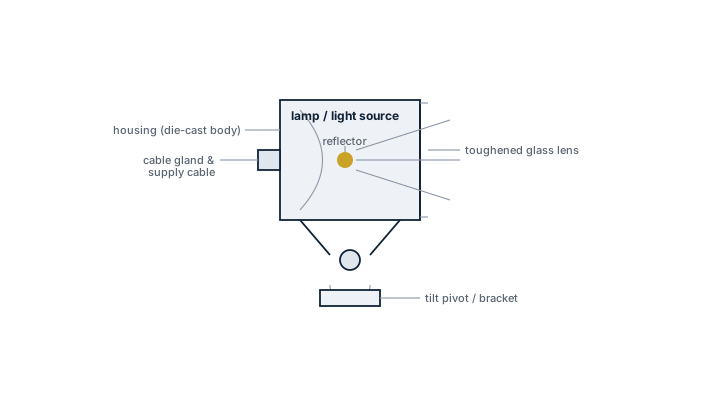
Main components
Luminaire and lamp
Modern deck floodlights are almost universally LED now, replacing older metal-halide and halogen fixtures, for lower power draw, longer service life and better cold-start performance.
Housing and glazing
Marine-rated housings are sealed to at least IP66 against driving rain and spray, built from corrosion-resistant aluminium alloy or stainless steel, with toughened glass or polycarbonate lenses able to take vibration without cracking.
Mounting bracket
Adjustable brackets let the beam be aimed at the working area and locked against vibration; on masts and kingposts they need to survive constant motion without the fixture working loose.
Switching and circuit protection
Floodlight circuits run from the ship's main lighting distribution with their own breakers, often grouped by deck zone so cargo lights and mooring station lights can be switched independently.
Selection and sizing
- Beam angle: narrow beams throw light further for mast-mounted units covering a large deck area; wide beams suit close-range work areas like mooring stations.
- Lumen output and colour temperature: enough lux at the working plane without glare that blinds the crew looking into the light from another position.
- Ingress protection rating: IP66 or better is standard for open deck exposure to green water and spray.
- Vibration rating: units on masts or near machinery need a rated resistance to sustained vibration, or the LED driver and lens seal fail early.
Regulations and class
Deck floodlights themselves are not directly regulated by SOLAS in the way navigation or emergency lighting is, but class societies check that working deck illumination is adequate for safe operation, and flag state port state control inspectors look for functioning deck lighting during night cargo operations. Electrical installation and cabling follow the ship's general electrical class rules for hazardous or open-deck areas.
Typical faults
| Fault | Consequence |
|---|---|
| Corroded housing seals letting in moisture | Internal short circuits, driver failure, or the fixture tripping its breaker |
| Bracket loosened by vibration | Beam drifts off the work area or the fixture swings and strikes the mast |
| Lens crazing or fogging from UV degradation | Reduced light output long before the LED itself fails |
| Undersized cable glands | Water tracking into the junction box along the cable |
What to look for in a supplier
- Marine type approval for the housing and IP rating, not an industrial fixture repackaged for shipboard sale.
- Stated vibration and shock test data, relevant for mast and kingpost mounting.
- LED driver rated for the ship's supply voltage tolerances, which are wider than shore power.
- Spares availability for lens gaskets and drivers separately from the whole fixture.
Aim floodlights during commissioning with the actual cargo or mooring party on deck, not from the bridge wing, since a beam that looks fine from above often leaves a working area in its own shadow.