What to check on a Fluorescent Light Fitting.
A fluorescent tube is a low-pressure mercury vapour discharge lamp: it needs a starting surge to strike an arc between its two electrodes and then a ballast to limit current once the arc is running, because the tube's resistance drops as it heats and would otherwise let current climb until the tube failed. This is fundamentally different from an incandescent lamp, which is a simple resistive filament, and from an LED fitting, which uses solid-state drivers with no arc to strike at all. On board, fluorescent fittings remain common in…
What makes a fluorescent fitting different from an incandescent or LED fitting
A fluorescent tube is a low-pressure mercury vapour discharge lamp: it needs a starting surge to strike an arc between its two electrodes and then a ballast to limit current once the arc is running, because the tube's resistance drops as it heats and would otherwise let current climb until the tube failed. This is fundamentally different from an incandescent lamp, which is a simple resistive filament, and from an LED fitting, which uses solid-state drivers with no arc to strike at all. On board, fluorescent fittings remain common in engine room, workshop and store lighting circuits where their lower running temperature and even light spread over a large fitting area still suit the space, even as LED replacement becomes more common on new-build and refit work.
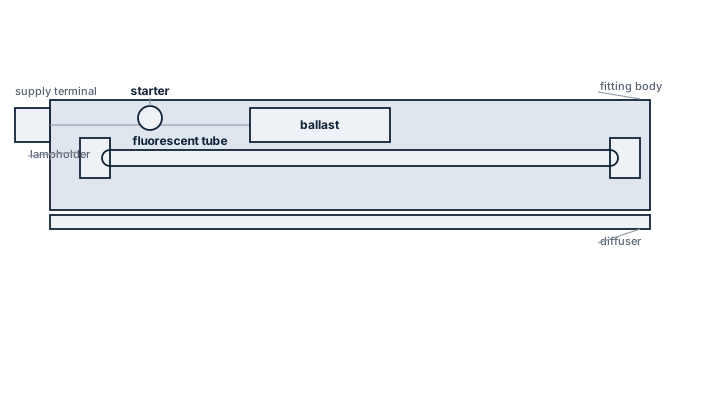
Main components
Tube
A sealed glass tube coated internally with phosphor, filled with a low-pressure argon and mercury vapour mix, with a heated electrode (cathode) at each end. Tube diameter and length are standardised, commonly designated by a T-number referring to the tube's diameter in eighths of an inch.
Ballast
Either a magnetic (choke and starter) ballast or an electronic ballast. The magnetic type uses an inductive choke plus a separate glow starter switch to produce the initial voltage spike; the electronic type generates a high-frequency starting and running current electronically, starts faster, runs cooler, and eliminates the visible flicker of a magnetic ballast running at line frequency.
Starter (magnetic ballast only)
A small glow-discharge switch that heats the tube's electrodes briefly, then opens to let the choke's collapsing magnetic field generate the striking voltage. A failed starter is one of the most common reasons a fluorescent fitting won't light even with a good tube and ballast.
Housing and diffuser
Enclosure rating matters more on board than ashore engine room and deck fittings need an ingress-protection rating suited to washdown, oil mist or a hazardous area classification, where fitted, and this rating is tied to the specific enclosure, not the lamp type inside it.
Selection and sizing
- Ingress protection rating must match the compartment: a general accommodation fitting has different requirements from one in an engine room bilge area or a paint locker.
- Ballast type electronic ballasts avoid the flicker and slower starting of magnetic ballasts and generally last longer, at the cost of being a sealed, non-repairable module rather than separate choke and starter parts.
- Tube colour temperature and length must match existing fittings on the same circuit if uniform lighting appearance matters in the space.
- Where a fitting is in a classified hazardous area, only a specifically certified explosion-protected fitting and tube combination is acceptable, not a standard fitting with an equivalent tube.
Regulations and class
General and emergency lighting arrangements fall under SOLAS Chapter II-1, which sets minimum illumination and emergency lighting duration requirements for escape routes and machinery spaces, though it does not mandate a specific lamp technology. Fittings in hazardous areas such as paint stores or tanker cargo spaces must carry certification appropriate to the area's zone classification, and any substitution of tube or ballast must preserve that certification fitting an uncertified replacement tube into a certified housing invalidates the approval even if it physically fits. Disposal of fluorescent tubes is subject to hazardous waste handling ashore because of the mercury content, and MARPOL Annex V garbage management procedures require them to be kept separate from general waste on board.
Typical faults
| Fault | Cause | Consequence |
|---|---|---|
| Tube flickers or won't fully strike | Worn electrodes near end of tube life, or failing starter | Reduced light output, eventual complete failure to start |
| Blackened ends on tube | Normal end-of-life electrode wear, or an incompatible ballast running the tube incorrectly | Tube approaching failure, replace before complete outage |
| Fitting hums or buzzes | Loose magnetic ballast laminations or a failing choke | Nuisance noise, possible ballast overheating |
| Repeated ballast failure on one fitting | Moisture ingress through a damaged seal or gasket | Recurring cost, and a compromised IP rating that keeps letting moisture back in |
What to look for in a supplier
- Certification matching the actual area classification for any fitting destined for a hazardous or classified space.
- Stock availability of the exact tube length, diameter and colour temperature already in use, to keep a compartment's lighting consistent.
- Electronic ballast options where flicker or restart time is a genuine issue, weighed against the sealed non-repairable nature of the ballast itself.
- Gasket and seal spares for the specific housing, since a degraded seal is what turns a routine tube change into a recurring ballast failure.
Never fit a tube of the wrong wattage rating to save a spare an electronic ballast run outside its rated tube wattage range overheats and fails early, and a magnetic ballast can do the same with a mismatched choke.