What to check on a Navigation Lights.
Navigation lights exist to tell another vessel, at a glance and at night, roughly what this ship is doing and which way it is heading, not to illuminate anything for the crew on board. Every characteristic that matters, arc of visibility, colour, minimum luminous range and mounting position relative to the ship's length, is fixed by the International Regulations for Preventing Collisions at Sea rather than by ship's electrical design practice, which is what sets this category apart from ordinary deck or navigation-area lighting.
What makes navigation lights different from other shipboard lighting
Navigation lights exist to tell another vessel, at a glance and at night, roughly what this ship is doing and which way it is heading, not to illuminate anything for the crew on board. Every characteristic that matters, arc of visibility, colour, minimum luminous range and mounting position relative to the ship's length, is fixed by the International Regulations for Preventing Collisions at Sea rather than by ship's electrical design practice, which is what sets this category apart from ordinary deck or navigation-area lighting.
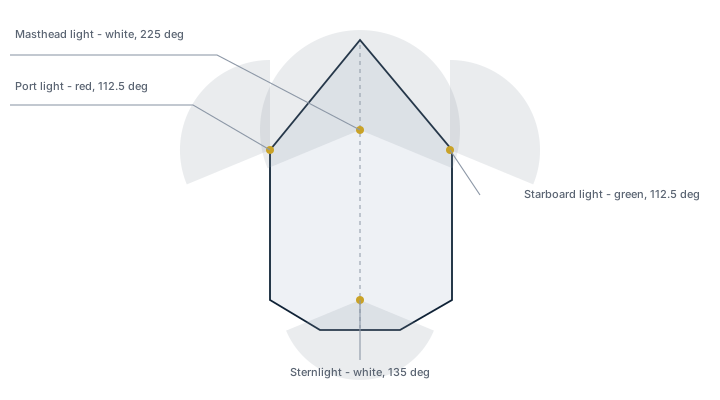
Main components
Light units: masthead, sidelights, sternlight
A masthead light shows white over an arc from dead ahead to just abaft the beam on each side; red and green sidelights show port and starboard over a narrower arc; a sternlight shows white astern. Together their combination, and which are switched on, tells an observer whether a vessel is underway, at anchor, towing, or restricted in her ability to manoeuvre.
Lens and colour filter
Coloured lenses or filters must meet defined chromaticity boundaries so that red and green are unambiguous at the required range, not just visually red or green to the eye up close.
Light source
LED sources have largely replaced incandescent lamps for their long service life and lower current draw, but the complete fitting, not just the LED module, must carry type approval; swapping in a brighter or differently coloured LED module without re-testing the fitting can put it outside the chromaticity and intensity limits even if it looks fine to the eye.
Navigation light monitoring panel
A panel on the bridge indicates each light's on/off status and, on many installations, alarms on lamp failure, since a light that fails unnoticed defeats the purpose of the whole system.
Selection and sizing
Required range and arc are set directly by the ship's length under COLREG Rule 22; longer vessels need lights visible from further away, and the rule gives specific minimum ranges in nautical miles for masthead, side and sternlights by length category. Selection is really a matter of choosing a type-approved fitting rated for the correct range class and confirming its mounting position on the ship meets the arc and screening requirements, since an otherwise compliant light mounted where a mast or funnel blocks part of its arc fails the installation even though the fitting itself is correct.
Regulations and class
- COLREG Rules 20-31 and Annex I set the technical requirements for colour, arc, range and positioning of every navigation light.
- SOLAS requires navigation lights to be fitted and maintained in an efficient condition, with a means of indicating failure available to the officer of the watch.
- Class and flag administration surveys check type approval marking on each fitting and verify the monitoring panel functions, typically at the periodic safety equipment survey.
Typical faults
| Fault | Consequence |
|---|---|
| LED module replaced with a non type-approved substitute | Light no longer meets required colour or intensity limits |
| Lens discoloured or crazed by UV exposure over years | Reduced luminous range without any electrical fault showing |
| Monitoring panel fuse blown and not noticed | Light failure at sea goes undetected until reported by another vessel |
| New mast-mounted equipment installed in the light's arc | Screened sector created, light no longer visible where required |
What to look for in a supplier
- Type approval certificate for the complete fitting at the specific range class required for the vessel's length, not just a generic marine LED light.
- Confirmed chromaticity test data for the colour lenses, since counterfeit or uncertified fittings are a known problem in this category.
- A monitoring panel compatible with the ship's existing indication and alarm wiring, to avoid a parallel retrofit system.
After any deck equipment addition near a masthead or sidelight, physically check the light's arc from a small boat or from key bearings rather than trusting the drawing; new radar scanners and antennas are a common, unplanned cause of a screened sector.
