What to check on a Floodlights & Deck Lights.
Navigation lights signal the ship's presence and heading to other vessels, and emergency lighting exists to get people out safely in a blackout; floodlights and deck lighting exist to let the crew work. That working purpose drives the whole specification: high lumen output aimed at cargo decks, mooring stations, hatch covers and gangways, mounted on masts, kingposts and superstructure at heights and angles chosen for glare-free coverage of the actual work area rather than for even ambient illumination. On tankers and gas carriers, deck lighting in cargo areas also has…
What sets floodlights and deck lights apart from other shipboard lighting
Navigation lights signal the ship's presence and heading to other vessels, and emergency lighting exists to get people out safely in a blackout; floodlights and deck lighting exist to let the crew work. That working purpose drives the whole specification: high lumen output aimed at cargo decks, mooring stations, hatch covers and gangways, mounted on masts, kingposts and superstructure at heights and angles chosen for glare-free coverage of the actual work area rather than for even ambient illumination. On tankers and gas carriers, deck lighting in cargo areas also has to meet explosion-protection requirements that ordinary deck lights elsewhere on the ship do not.
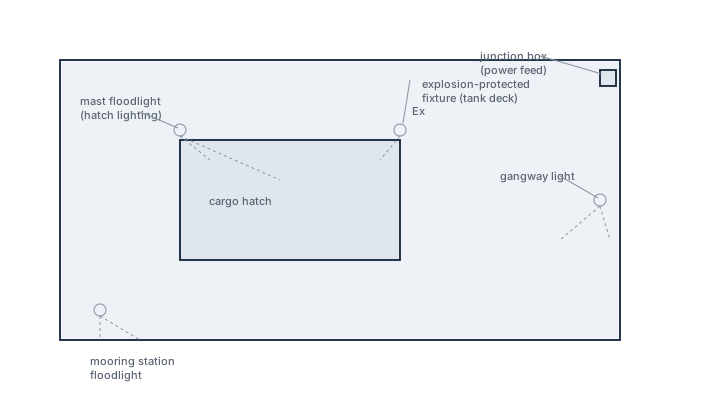
Main components
Luminaire and light source
Older installations use halogen or metal halide floodlights; current newbuildings and most retrofits use LED units for their lower power draw, longer service life and better tolerance of vibration, though LED driver electronics bring their own failure modes that halogen fixtures did not have.
Housing and glazing
Marine-grade aluminium or stainless steel housings with toughened glass or polycarbonate lenses, sealed to an IP rating suited to open deck exposure, since these fixtures see continuous salt spray and vibration that shore-based floodlights never experience.
Mounting and aiming
Adjustable brackets on masts, kingposts, crane structures and superstructure faces, positioned to cover cargo hatches, mooring decks and the gangway without throwing glare into the bridge or into a neighbouring vessel's line of sight during port operations.
Explosion-protected fixtures
On tankers and gas carriers, floodlights covering cargo tank decks and hazardous zones are certified explosion-proof, built so the fixture cannot become an ignition source even with an internal fault, and installed with cable glands and junction boxes rated to match.
Selection and sizing
Illumination levels are specified in lux for each working area, cargo deck, mooring station, gangway and accommodation ladder, driven partly by operational need and partly by port state and ILO requirements for safe working light at night. Fixture wattage and beam angle are chosen against mounting height and the area to be covered, aiming for the required lux level at deck without excessive fixture count or glare into navigation sightlines. On hazardous cargo vessels, zone classification of the deck area determines whether a standard or explosion-protected fixture is required, and that classification is not something to guess at when specifying replacements.
Regulations and class
SOLAS and ILO instruments set minimum lighting requirements for safe access and working areas, and class societies check that cargo deck and mooring station lighting meets those levels at survey. For tankers and gas carriers, IEC hazardous area standards govern which zones require explosion-protected fixtures, and class will check certification documents for any fixture installed within a classified zone.
Typical faults
- Corroded housings and cracked lenses from prolonged salt spray exposure, letting moisture into the fixture and shortening lamp or driver life
- LED driver failure, which can take out a fixture completely with no gradual dimming warning the way a failing halogen lamp gives
- Fixtures re-aimed informally over time until coverage no longer matches the original lighting plan, leaving dark patches at mooring stations or hatch corners
- Non-explosion-protected fixtures fitted as a quick replacement in a hazardous zone during a port call, creating a compliance gap that may not surface until the next survey
What to look for in a supplier
- Marine type approval and a documented IP and corrosion rating suited to open deck service, not an industrial floodlight adapted for shipboard use
- Explosion-protection certification for any fixture destined for a hazardous cargo zone, matched to the specific zone classification
- Photometric data for the actual beam angle and mounting height planned, so coverage can be checked against the required lux level before installation
- Availability of like-for-like replacement fixtures, since mixing housing types and mounting patterns across a lighting plan complicates future maintenance
Keep a record of which fixture is explosion-protected and which is standard before any deck lighting replacement job, because a fixture that looks identical from the deck can be the wrong type for its zone, and that mistake is easy to make and hard to spot afterwards.