Yacht/Boat DNV-Approved (Review)
This is the DNV-approved bucket for yacht and boat handling gear - davits, launching arms, boarding ladders - built to a yacht's smaller scale but tested against the same winching, load and proof-test principles as merchant ship survival craft equipment.
Read more — Yacht/Boat DNV-Approved (Review) explained ▾
What this grouping covers
Equipment here carries DNV type approval or class approval built for yachts and boats rather than for SOLAS merchant tonnage. It spans the same functional families as commercial davits and launching gear, meaning devices that lift a tender or small craft off its stowage and lower it to the water, and the ladders and platforms that let people board and leave it safely, scaled down to yacht proportions and duty cycles. Because much of a yacht's crew and guest safety case still follows survival craft engineering logic, a DNV-approved item in this group is usually built and tested to the same underlying principles as a SOLAS davit, even where the vessel itself is below the tonnage that SOLAS applies to.
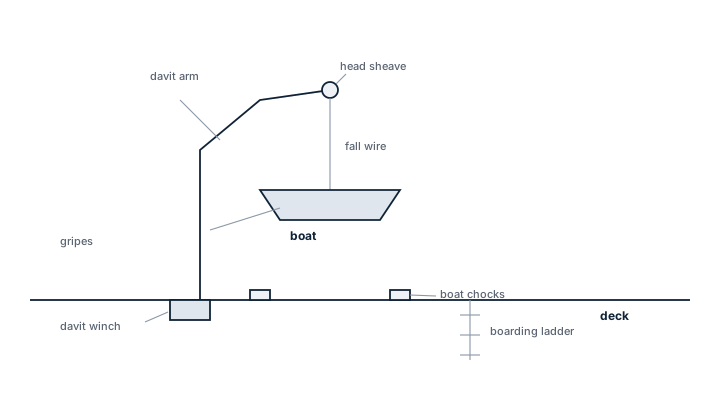
Main components across this equipment family
Davit arm and winch
A pivoting arm swings the tender out from its stowage position; an electric or hydraulic winch controls the lowering and raising speed, with a mechanical brake that holds the load if power is lost.
Wire falls or synthetic rope falls
Wire rope is still common for its predictable stretch and load rating, though synthetic rope falls are increasingly used on smaller yachts for their lighter weight and corrosion resistance, provided the fibre is rated for the UV and chafe exposure of permanent deck stowage.
Sheaves, blocks and load pins
Every point where the fall changes direction is a wear point; sheave bearing failure or a seized block is one of the more common reasons a davit will not run smoothly under load.
Boarding ladders and platforms
Fixed or telescopic ladders, and fold-out bathing or boarding platforms, rated for the static and dynamic load of people boarding from a tender or from the water, with anti-slip treads and secure stowage for use underway.
Selection
Safe working load is the first figure to check, and it has to cover the tender's fully loaded weight including fuel, gear and passengers, not just the empty hull weight on a specification sheet. Winch speed, davit reach and the deck space the stowed arm occupies matter as much on a yacht as load rating, since space is tighter than on a comparable commercial vessel.
- Safe working load with margin over the tender's actual loaded weight
- Corrosion protection suited to a yacht that may see far more time in tropical, high-salinity cruising grounds than a commercial ship on a fixed trade route
- Manual back-up recovery in case of a power or hydraulic failure
- Deck footprint and stowed height, particularly on flybridge or upper-deck installations
Regulations and class
DNV's rules for yachts set the approval basis for this equipment, drawing on the same load testing and proof testing logic used for SOLAS survival craft gear even though most private and charter yachts fall outside SOLAS tonnage limits. Class survey of the installed davit or ladder typically includes a proof load test at commissioning and periodic function checks thereafter, and the equipment's approval certificate should state the safe working load actually tested, not a theoretical design figure.
Typical faults
| Cause | Consequence |
|---|---|
| Sheave or block bearing seizure | Uneven or jerky lowering, increased load on the fall at the jammed point |
| Wire fall corrosion, especially inside the swaged end fitting | Hidden strength loss that a visual check from outside will not catch |
| Synthetic fall UV or chafe damage | Reduced breaking strength, failure without the visible necking a wire shows |
| Winch brake wear | Uncontrolled lowering speed or failure to hold the load stationary |
What to look for in a supplier
- DNV or equivalent class type approval certificate stating a tested safe working load, not a manufacturer's design estimate
- Proof load test documentation from commissioning, kept with the yacht's survey file
- Spare fall, sheave and brake parts available without a long lead time, since a yacht often cannot wait for a full replacement unit
- A manual recovery method built into the design, not added as an afterthought
Inspect wire falls at the swaged end fitting, not just along the visible length - that is where trapped moisture causes internal corrosion long before the outside of the wire shows any sign of it.
173 manufacturers · 1942 models
Marine-Care
280Boot Bremen GbR
275
Martin Haake, Boot Bremen
97
Bavaria Yachtbau
62ROTO Podjetje za predelavo in trzenje d.o.o
56HanseYachts
50
Weihai Sun Selections
46Uwe Johann Stiel
43Nimbus Boats Sweden
39
Inha Works
32
MS Watersports
32Cremo Produktions
31
Weihai Wavefun Outdoor
26
Plastimo S
24
Volvo Penta
23- Incorrect equipment identification causes the wrong maintenance or spare-parts procedure to be applied
- Missing or unverified approval documentation causes uncertainty during survey or vessel acceptance
- Corrosion, loose mounting or damaged connections cause visible deterioration regardless of the equipment's final classification
- Electrical or control defects cause failed operation or alarms if the item is powered
- Missing manufacturer documentation prevents reliable confirmation of limits, service intervals or compatible spares
- Compact footprint suitable for limited engine‑room space on yachts
- Volvo Penta brand reputation for durability and low‑maintenance operation
- DNV approval ensures compliance with marine classification standards
- Automatic start/stop and built‑in battery charger simplify emergency readiness
- Relatively low fuel consumption for an 80 kW unit
- Maximum output of 80 kW may be insufficient for larger vessels or high‑load scenarios
- Known field issues include starting battery failure, fuel solenoid sticking, coolant leaks and governor hunting, requiring vigilant maintenance
- Higher upfront cost compared with generic off‑the‑shelf gensets
- Noise level can be noticeable in small craft without additional acoustic insulation
- Incorrect equipment identification causes the wrong maintenance or spare-parts procedure to be applied
- Missing or unverified approval documentation causes uncertainty during survey or vessel acceptance
- Corrosion, loose mounting or damaged connections cause visible deterioration regardless of the equipment's final classification
- Electrical or control defects cause failed operation or alarms if the item is powered
- Missing manufacturer documentation prevents reliable confirmation of limits, service intervals or compatible spares
- High power density in a compact footprint suitable for limited engine‑room space
- Integrated electronic control panel with automatic start/stop and load management
- Low emissions design meeting modern marine environmental standards
- Proven brand reputation for reliability on luxury yachts
- DNV classification provides confidence for classed vessels
- Known failure modes include injector problems, turbocharger oil leaks, alternator bearing wear and auto‑start relay issues
- Maintenance intervals (injector service, turbo checks) can be demanding for remote operators
- Noise and vibration levels higher than some newer low‑speed or hybrid alternatives
- Initial purchase price is relatively high compared with basic marine gensets
- Limited after‑sales support in very remote regions
- Incorrect equipment identification causes the wrong maintenance or spare-parts procedure to be applied
- Missing or unverified approval documentation causes uncertainty during survey or vessel acceptance
- Corrosion, loose mounting or damaged connections cause visible deterioration regardless of the equipment's final classification
- Electrical or control defects cause failed operation or alarms if the item is powered
- Missing manufacturer documentation prevents reliable confirmation of limits, service intervals or compatible spares
- Compact footprint suitable for limited engine‑room space on yachts
- Fast auto‑start (under 10 s) to meet emergency power requirements
- Integrated control panel with remote monitoring capability
- Meets DNV marine certification for emergency generators
- Fuel‑efficient diesel operation with low specific fuel consumption
- Known reliability issues: EGR valve failure, injector drift, alternator AVR problems, thermostat sticking
- Requires regular weekly testing and annual load‑bank verification, increasing maintenance workload
- Injector calibration needed every 4 000–6 000 h, adding service cost
- Limited power output (315 kW) may be insufficient for larger vessels' hotel loads
- Spare parts inventory can be specific to Volvo Penta, affecting lead times
- Incorrect equipment identification causes the wrong maintenance or spare-parts procedure to be applied
- Missing or unverified approval documentation causes uncertainty during survey or vessel acceptance
- Corrosion, loose mounting or damaged connections cause visible deterioration regardless of the equipment's final classification
- Electrical or control defects cause failed operation or alarms if the item is powered
- Missing manufacturer documentation prevents reliable confirmation of limits, service intervals or compatible spares
- High power density – 440 kW in a relatively compact footprint suitable for yacht engine rooms
- Volvo Penta brand reputation for reliability and extensive service network
- Integrated electronic control system with fast start‑up for emergency power
- Meets DNV marine equipment standards, simplifying certification on new builds or refits
- Low emissions compared with older 2‑stroke gensets, complying with IMO Tier II requirements
- Documented failure modes: fuel system air lock, turbo wastegate, alternator winding and governor board issues
- Full service required every 500 hours – higher maintenance cadence than some low‑maintenance alternatives
- Primarily an emergency/standby unit; not intended for continuous primary power generation
- Initial purchase price is premium relative to generic OEM gensets of similar rating
- Component wear due to operating hours and environmental conditions
- Corrosion due to seawater/salt air exposure
- Electronics/control failure due to moisture or vibration
- Service interval overrun causes premature failure
- Proven reliability of Volvo Penta marine diesel engines
- Integrated joystick and electronic helm for precise maneuvering
- DNV class approval simplifies regulatory compliance
- Extensive global service network and spare‑part availability
- Optimised fuel management software reduces operating costs
- Higher initial cost compared with smaller outboard solutions
- Diesel emissions may not meet the strictest low‑emission zones without after‑treatment
- Engine compartment space requirements limit interior layout flexibility
- Maintenance intervals are longer but more expensive when due
- Sensitive to saltwater corrosion; requires diligent anti‑corrosion regimen
- Component wear due to operating hours and environmental conditions
- Corrosion due to seawater/salt air exposure
- Electronics/control failure due to moisture or vibration
- Service interval overrun causes premature failure
- High power‑to‑size ratio suitable for limited engine rooms
- Integrated electronic control provides precise fuel management and diagnostics
- DNV class approval simplifies certification for new builds or retrofits
- Broad Volvo Penta service network ensures parts availability in major ports
- Meets modern emission standards (typically IMO Tier II) for recreational vessels
- Higher upfront cost compared with legacy two‑stroke alternatives
- Electronic components can be vulnerable to moisture and vibration if not properly sealed
- Maintenance intervals must be strictly observed; overdue service accelerates wear
- Corrosion risk in harsh salt‑air environments requires diligent anti‑corrosion measures
- Spare‑parts inventory for older D11 variants may be limited
- Component wear due to operating hours and environmental conditions
- Corrosion due to seawater/salt air exposure
- Electronics/control failure due to moisture or vibration
- Service interval overrun causes premature failure
- High torque output suitable for large motor yachts
- Compact footprint allowing flexible installation in limited engine rooms
- Meets IMO Tier II emission standards (low exhaust emissions)
- DNV‑approved type certificate, facilitating class surveys
- Robust cast‑iron construction with proven durability
- Higher upfront cost compared with smaller outboard or gasoline options
- Fuel consumption can be relatively high at low load conditions
- Electronic control unit is sensitive to moisture and vibration, requiring careful sealing
- Spare parts may have longer lead times in remote ports
- Maintenance intervals must be strictly observed to avoid premature wear
- Component wear due to operating hours and environmental conditions
- Corrosion due to seawater/salt air exposure
- Electronics/control failure due to moisture or vibration
- Service interval overrun causes premature failure
- High power‑to‑weight ratio suitable for large yachts and fast craft
- Integrated electronic engine management for optimal fuel efficiency and emissions compliance
- Compact dimensions allow flexible installation in limited engine rooms
- DNV approval simplifies class survey documentation
- Broad service network and readily available spare parts
- Higher purchase price compared with smaller inline engines
- Requires premium marine diesel (low‑sulphur) to meet emissions limits
- Complex electronic systems increase diagnostic time and training needs
- Maintenance intervals are shorter than lower‑power models, raising operating costs
- Vibration levels can be higher if not properly mounted
- Component wear due to operating hours and environmental conditions
- Corrosion due to seawater/salt air exposure
- Electronics/control failure due to moisture or vibration
- Service interval overrun causes premature failure
- High power‑to‑size ratio – up to 1000 kW in a compact footprint
- Integrated electronic control system for precise throttle response and diagnostics
- Fuel efficient operation meeting IMO Tier II emission standards
- DNV‑approved classification, facilitating class surveys and insurance
- Strong global dealer and service network from Volvo Penta
- Higher purchase price compared with comparable four‑stroke engines of lower output
- Weight is greater than some high‑speed gasoline alternatives, affecting overall vessel displacement
- Service intervals (oil change, injector cleaning) are critical; missed maintenance can lead to premature wear
- Electronic control units are sensitive to moisture and vibration if not properly sealed
- Component wear due to operating hours and environmental conditions
- Corrosion due to seawater/salt air exposure
- Electronics/control failure due to moisture or vibration
- Service interval overrun causes premature failure
- High power density – delivers up to ~1,200 kW in a relatively small footprint
- Meets IMO Tier II/III emission standards without external after‑treatment (optional SCR available)
- Low vibration and noise levels thanks to balanced design and advanced mounting system
- Comprehensive dealer network and proven DNV class approval for yacht applications
- Flexible installation options (direct drive, reduction gear, hybrid integration)
- Higher upfront cost compared with older low‑tech diesel models
- Complex electronic control unit requires specialised diagnostic tools and training
- Premium fuel quality is recommended to avoid injector wear
- Spare‑parts inventory may be limited in remote regions without a Volvo Penta service centre
- Maintenance intervals are tighter than legacy engines, increasing operational planning
- Component wear due to operating hours and environmental conditions
- Corrosion due to seawater/salt air exposure
- Electronics/control failure due to moisture or vibration
- Service interval overrun causes premature failure
- High power‑to‑size ratio – delivers >1000 hp in a relatively compact footprint
- Low‑speed operation provides excellent fuel efficiency and torque for propeller‑driven vessels
- Broad global service network and OEM spare‑part support
- DNV‑approved marine propulsion certification ensures class compliance
- Proven reliability on luxury yachts and patrol craft
- Weight and dimensions limit installation in very small hulls
- Emissions compliance may require additional after‑treatment for IMO Tier III or US EPA Tier 3 markets
- Higher initial cost compared with smaller outboard or gasoline alternatives
- Maintenance intervals are longer than high‑speed engines, demanding disciplined service planning
- Vibration and noise levels higher than some modern four‑stroke low‑vibration designs
- Component wear due to operating hours and environmental conditions
- Corrosion due to seawater/salt air exposure
- Electronics/control failure due to moisture or vibration
- Service interval overrun causes premature failure
- High power‑to‑size ratio suitable for super‑yachts and patrol boats
- Electronic engine management provides precise throttling and lower emissions
- DNV class approval simplifies certification for new builds
- Robust construction with proven durability in harsh marine environments
- Broad service network and readily available OEM spare parts
- Higher initial purchase price compared with comparable straight‑six engines
- Complex electronic control system can be sensitive to moisture and vibration if not properly sealed
- Fuel consumption rises sharply at full throttle, impacting range on long passages
- Maintenance intervals are stricter than lower‑output models; missed service can accelerate wear
- Component wear due to operating hours and environmental conditions
- Corrosion due to seawater/salt air exposure
- Electronics/control failure due to moisture or vibration
- Service interval overrun causes premature failure
- High torque output at low engine speeds, ideal for propeller‑driven yachts
- Integrated electronic control unit (ECU) provides precise fuel management and diagnostics
- Meets IMO Tier II/III emission standards without requiring external after‑treatment in most configurations
- Compact footprint and lightweight design frees up valuable hull space
- Extensive global service network from Volvo Penta ensures parts availability and support
- Maximum power (≈800 hp for D6) may be insufficient for large superyachts or high‑speed craft
- Higher upfront cost compared with comparable gasoline engines of similar horsepower
- Vibration can become noticeable at certain RPM ranges, requiring careful mounting and isolation
- Requires fresh‑water cooling system; salt‑water exposure demands diligent corrosion protection
- Limited availability of some spare parts in remote regions without a Volvo Penta dealer
- Component wear due to operating hours and environmental conditions
- Corrosion due to seawater/salt air exposure
- Electronics/control failure due to moisture or vibration
- Service interval overrun causes premature failure
- High power‑to‑weight ratio suitable for limited engine rooms
- Integrated electronic control unit (ECU) enables precise fuel management and diagnostics
- Meets IMO Tier II emission standards, reducing environmental impact
- DNV class approval simplifies certification for new builds
- Extensive global service network and OEM spare‑part support
- Higher upfront cost compared with legacy two‑stroke or lower‑spec diesel options
- Requires premium marine diesel fuel to meet emission targets
- Maintenance intervals are critical; overruns can lead to premature wear
- Sensitive to salt‑water corrosion if protective measures are neglected
- Limited maximum output (≈ 800 kW) makes it unsuitable for large commercial vessels
- Component wear due to operating hours and environmental conditions
- Corrosion due to seawater/salt air exposure
- Electronics/control failure due to moisture or vibration
- Service interval overrun causes premature failure
- SOLAS‑approved, meeting mandatory safety requirements for passenger‑carrying vessels
- DNV class approval provides confidence in design and documentation
- Electronic control unit (ECU) optimises fuel consumption and reduces emissions
- Compact footprint and favourable power‑to‑weight ratio suited to limited engine rooms
- Global Volvo Penta service network simplifies maintenance and spare‑part logistics
- Higher purchase price compared with legacy mechanically‑controlled engines
- Electronic systems can be sensitive to moisture or excessive vibration if not properly sealed
- Power range (up to ~600 kW) may be insufficient for larger commercial vessels
- Specific fuel quality requirements; low‑sulphur diesel needed to meet emissions targets
- Spare‑part lead times can be longer in very remote ports without a local dealer
- Component wear due to operating hours and environmental conditions
- Corrosion due to seawater/salt air exposure
- Electronics/control failure due to moisture or vibration
- Service interval overrun causes premature failure
- High power‑to‑size ratio – delivers >1 000 hp in a compact footprint suitable for yachts and patrol vessels
- Integrated electronic control unit (ECU) provides precise fuel metering, diagnostics and reduced emissions (IMO Tier II compliant)
- DNV class approval simplifies certification for new builds and retrofits
- Proven reliability with long service intervals when maintained per Volvo Penta handbook
- Broad dealer network and readily available OEM spare parts
- Higher purchase price compared with lower‑output four‑stroke alternatives
- Requires premium marine diesel (low sulfur) to meet emissions limits, increasing operating cost
- Maintenance intervals (oil change ~500 h) can be demanding for vessels with continuous high load
- Weight and mounting requirements may limit installation on very small craft
- Electronic systems are sensitive to moisture and vibration; robust installation is essential
- Component wear due to operating hours and environmental conditions
- Corrosion due to seawater/salt air exposure
- Electronics/control failure due to moisture or vibration
- Service interval overrun causes premature failure
- High power‑to‑size ratio suitable for limited engine room space
- Integrated electronic engine management provides precise fuel metering and diagnostics
- Meets IMO Tier II emission standards, offering lower exhaust pollutants
- DNV class approval simplifies certification for luxury yachts
- Extensive Volvo Penta service network worldwide
- Higher specific fuel consumption at low loads compared to slower‑speed engines
- Complex electronic systems require specialised maintenance skills
- Premium marine diesel fuel often required, increasing operating cost
- Initial purchase price is higher than comparable older designs
- Spare‑part logistics can be challenging in remote regions
- Component wear due to operating hours and environmental conditions
- Corrosion due to seawater/salt air exposure
- Electronics/control failure due to moisture or vibration
- Service interval overrun causes premature failure
- High power‑to‑size ratio suitable for medium‑size motor yachts (up to ~30 m)
- Meets IMO Tier II emission standards, reducing environmental impact
- DNV‑approved construction provides class society acceptance
- Advanced electronic control unit enables precise fuel management and diagnostics
- Extensive global service network from Volvo Penta
- Higher initial purchase price compared with lower‑output alternatives
- Fuel consumption can be less efficient at low loads
- Requires strict adherence to maintenance intervals to avoid premature wear
- Sensitive to salt‑water corrosion; needs diligent cooling‑system upkeep
- Spare parts may be limited in very remote ports
- Diesel
- MGO
- Injector faults
- Turbocharger wear
- Heat exchanger fouling
- Electronic sensor faults
- Diesel
- MGO
- Injector wear
- Turbocharger fouling
- Seawater heat exchanger fouling
- Sensor faults
- Diesel
- MGO
- Seawater pump impeller failure
- Heat exchanger fouling
- Injector wear causing smoke and hard starting
- Diesel
- MGO
- Turbocharger fouling after low-load operation
- Raw-water pump leakage
- Heat exchanger scaling
- Diesel
- MGO
- Injector faults causing uneven exhaust temperatures
- Charge-air cooler fouling
- Electronic sensor faults causing derating
Windy Scandinavia
23Jet Power Hungary Kft
22Nimbus Group
22
Hallberg-Rassy Varvs
20Vikal International
20Viknes Båt og Service
20Cipax
19Höga Produkter
19Elan, d.o.o
18
Nimbus Boats
18Ryds Båtindustri
18- GRP gelcoat cracking, blistering or local laminate damage from age, impact or poor repairs, noticed as crazing, soft areas or moisture around the hull
- Hull-to-deck and deck-fitting sealant deterioration from weathering, noticed as water ingress into lockers or the cabin
- Steering cable or helm wear from corrosion and lack of lubrication, noticed as stiffness, backlash or uneven steering effort
- Outboard fuel or ignition faults after long lay-up, noticed as hard starting, unstable idle or loss of power
- Bilge pump, battery or charging faults from infrequent testing, noticed as low battery voltage or water remaining in the bilge
- Through-hull or drain fitting deterioration, noticed as seepage, staining or unexplained bilge water
Goldfish Boat
15
SPBI S
15ARGO NAVIS BESPOKE YACHTING d.o.o
14FPT Industrial
14
Oy Botnia Marin
14Sunbeam Yachts OG
14SVB-Spezialversand für Yacht- und Bootszubehör
14VSR Lab d.o.o
14AD Brodovi d.o.o
13Alltechnik technische Geräte Handelsgesellschaft m.b.H
13Man Ship Machinery & Hardware
13
Najadvarvet
13Brunswick Marine in EMEA
12Importaciones Nauticas
12
Marine Jet Power
12
AB Volvo Penta
11
Linder Aluminiumbåtar
10Sealine Yachts
10Yanmar
10Caterpillar
9
- Band brake lining wear during frequent port manoeuvres
- Wildcat pocket wear after 15,000+ operating hours
- Hydraulic motor seal leak in hydraulic variants
- Electric motor insulation fault due to deck load and moisture
Freizeit u. Sport R. u. J. Muhl
9Plastimo
9XO Boats
9
AM YACHT
8Dehler Yachts
8Knierim Yachtbau
8TUFNETS
8Maritime Partner
7
Plimsoll
7- Incorrect equipment identification causes the wrong maintenance or spare-parts procedure to be applied
- Missing or unverified approval documentation causes uncertainty during survey or vessel acceptance
- Corrosion, loose mounting or damaged connections cause visible deterioration regardless of the equipment's final classification
- Electrical or control defects cause failed operation or alarms if the item is powered
- Missing manufacturer documentation prevents reliable confirmation of limits, service intervals or compatible spares
- DNV‑approved design provides recognized safety and reliability for yacht applications
- Compact footprint suitable for limited deck space on pleasure vessels
- Integrated DC motor allows simple control and low installation cost
- Monthly bearing greasing schedule is straightforward, extending service life
- DC motor brushes wear and require periodic replacement, increasing maintenance
- Bearing warping can occur if lubrication is missed, leading to premature failure
- Foundation bolts have a known tendency to loosen under vibration, needing regular checks
- Pulling capacity limited compared with larger commercial‑grade capstans
- Incorrect equipment identification causes the wrong maintenance or spare-parts procedure to be applied
- Missing or unverified approval documentation causes uncertainty during survey or vessel acceptance
- Corrosion, loose mounting or damaged connections cause visible deterioration regardless of the equipment's final classification
- Electrical or control defects cause failed operation or alarms if the item is powered
- Missing manufacturer documentation prevents reliable confirmation of limits, service intervals or compatible spares
- High pulling capacity (120 kN) suitable for heavy anchors on super‑yachts
- Compact electric drive eliminates hydraulic fluid and reduces installation space
- DNV‑approved, giving confidence in compliance for yacht classification societies
- Fast chain retrieval speed of 9 m/min improves anchoring efficiency
- Simple control interface with optional remote operation
- Worm gear wear reported; requires monthly lubrication to maintain reliability
- Contactors can fail under heavy cycling, leading to occasional downtime
- Electrical cable damage is a known issue; annual inspection mandatory
- Limited to vessels with sufficient dedicated electrical supply (typically 24 V/400 A)
- Not ideal for large commercial ships where hydraulic windlasses dominate
- Incorrect equipment identification causes the wrong maintenance or spare-parts procedure to be applied
- Missing or unverified approval documentation causes uncertainty during survey or vessel acceptance
- Corrosion, loose mounting or damaged connections cause visible deterioration regardless of the equipment's final classification
- Electrical or control defects cause failed operation or alarms if the item is powered
- Missing manufacturer documentation prevents reliable confirmation of limits, service intervals or compatible spares
- High safe working load of 200 kN suitable for large yacht anchors
- Fast chain payout at 9 m/min reduces anchoring time
- Compact electric drive eliminates hydraulic fluid and associated maintenance
- DNV‑approved, meeting recognised classification standards
- Integrated brake system provides reliable holding power
- Motor overload can occur if the load exceeds design limits
- Brake linings are prone to contamination; must be kept dry
- Foundation bolts may loosen and require quarterly inspection
- Relies on vessel electrical supply – limited redundancy compared with hydraulic units
- Limited to vessels that can accommodate the required 200 kN pull without excessive structural reinforcement
- Incorrect equipment identification causes the wrong maintenance or spare-parts procedure to be applied
- Missing or unverified approval documentation causes uncertainty during survey or vessel acceptance
- Corrosion, loose mounting or damaged connections cause visible deterioration regardless of the equipment's final classification
- Electrical or control defects cause failed operation or alarms if the item is powered
- Missing manufacturer documentation prevents reliable confirmation of limits, service intervals or compatible spares
- High safe working load of 300 kN suitable for super‑yachts and heavy anchors
- Fast chain payout/retrieval at 9 m/min reduces anchoring time
- DNV‑approved design gives recognised class compliance
- Hydraulic drive provides smooth, high‑torque operation even in rough seas
- Simple maintenance regime (hose replacement every 5 yr, valve flush at 4 000 h)
- Hydraulic system requires regular hose inspection and replacement to avoid aging failures
- Valve block can become contaminated if flushing schedule is missed
- Generally heavier and bulkier than comparable electric windlasses
- Higher initial cost and need for a dedicated hydraulic power unit
- Bearing wear on the drum may require periodic overhaul
- Incorrect equipment identification causes the wrong maintenance or spare-parts procedure to be applied
- Missing or unverified approval documentation causes uncertainty during survey or vessel acceptance
- Corrosion, loose mounting or damaged connections cause visible deterioration regardless of the equipment's final classification
- Electrical or control defects cause failed operation or alarms if the item is powered
- Missing manufacturer documentation prevents reliable confirmation of limits, service intervals or compatible spares
- High safe working load (160 kN) suitable for heavy anchoring loads on super‑yachts
- Compact hydraulic drive provides smooth, controllable pay‑out and retrieval
- DNV‑approved design gives recognised class compliance for leisure vessels
- Fast chain handling speed of 9 m/min reduces anchoring time
- Standardised hydraulic interface simplifies integration with existing vessel systems
- Hydraulic pump wear rings require inspection at ~3000 h and can erode over time
- Solenoid valve may stick, leading to intermittent operation if not maintained
- Gypsy pocket wear is a known issue on high‑load cycles, requiring periodic replacement
- Requires dedicated hydraulic power unit, adding weight and space requirements compared with electric windlasses
- Higher initial cost and maintenance complexity versus basic electric models
- Incorrect equipment identification causes the wrong maintenance or spare-parts procedure to be applied
- Missing or unverified approval documentation causes uncertainty during survey or vessel acceptance
- Corrosion, loose mounting or damaged connections cause visible deterioration regardless of the equipment's final classification
- Electrical or control defects cause failed operation or alarms if the item is powered
- Missing manufacturer documentation prevents reliable confirmation of limits, service intervals or compatible spares
- High safe working load (350 kN) suitable for large sailing and motor yachts
- Precise speed control via VFD, enabling smooth anchor handling
- Compact electric installation eliminates the need for hydraulic lines
- DNV‑approved design provides recognised classification confidence
- VFD can overheat if ventilation in the equipment room is inadequate
- Chain cable may twist if alignment or chain guide geometry is not optimal
- Brake drum has a known cracking issue, requiring regular NDT inspection at dry‑dock
- Electric power demand may require dedicated generator capacity on smaller vessels
- Incorrect equipment identification causes the wrong maintenance or spare-parts procedure to be applied
- Missing or unverified approval documentation causes uncertainty during survey or vessel acceptance
- Corrosion, loose mounting or damaged connections cause visible deterioration regardless of the equipment's final classification
- Electrical or control defects cause failed operation or alarms if the item is powered
- Missing manufacturer documentation prevents reliable confirmation of limits, service intervals or compatible spares
- High pulling force of 10 tonnes for secure mooring and anchoring
- Electric drive for efficient and low-maintenance operation
- Compact design suitable for various vessel types
- Potential for worm gear wear, requiring regular maintenance
- Thermal relay tripping may cause operational disruptions
- Barrel cracking can lead to equipment failure if not addressed
Rutgerson Marin
7Yamaha Motor Europe
7Baltic Yachts
6Dusan Antic PR Inzenjerski Dizajn Argo Navis
6Mirage Boats W. Bychto i Wspolnicy Spolka Komandytowa
6SZTR Tri princeze
6Hansvik Poland
5INDUSTRIAS FERRI
5
Mirage Boats W. Bychto i Wspolnicy
5Moody Yachts
5NIDELV BÅTBYGGERI
5Qingdao Baoquan Yacht Manufacturing
5UtternBåtar
5- Gelcoat cracking, osmosis blistering or laminate damage from age, grounding or impact, noticed as crazing, blisters or soft areas
- Sterndrive, propeller or outdrive corrosion from inadequate anode protection or electrical leakage, noticed as pitting, coating loss or abnormal drive wear
- Steering and throttle-control wear from corrosion or cable deterioration, noticed as stiffness, backlash or poor response
- Bilge-pump or battery failure from infrequent use and charging problems, noticed as standing bilge water or unreliable starting
- Window, hatch or deck-fitting seal deterioration from weathering, noticed as cabin leaks and damp trim
- Fuel-system contamination after storage, noticed as hard starting, unstable running or loss of engine power
WallMax India Enterprises
5AM Yacht Daniel Margalski
4Angus Marine
4Axopar Boats
4Bura Brodovi d.o.o
4J Craft Boats
4MAILAM INDIA
4MAN Truck & Bus
4MARINAR TOMAŽ GORNIK S.P
4NewAge Fire Protection Industries
4OXE Marine
4Scania CV
4Sealine
4Yacht- und Bootswerft Josef Martin
4ALPHA YACHTS
3ASIS Boats
3Comfortbåtar i Arvika
3Dehler Deutschland
3Kewatec AluBoat
3Maruti Ropes India
3Najad
3Nidelv Båtbyggeri
3RAND Boats
3Rotostøp
3Ryds Båtar
3SAŠA SIMIĆ PR IZRADA ČAMACA ALU NAUTIKA UGRINOVCI
3Schöchl Yachtbau
3Selva
3Skjebergkilens Marina
3THR Marine
3- Incorrect equipment identification causes the wrong maintenance or spare-parts procedure to be applied
- Missing or unverified approval documentation causes uncertainty during survey or vessel acceptance
- Corrosion, loose mounting or damaged connections cause visible deterioration regardless of the equipment's final classification
- Electrical or control defects cause failed operation or alarms if the item is powered
- Missing manufacturer documentation prevents reliable confirmation of limits, service intervals or compatible spares
- High pulling capacity (100 kN) in a compact package suitable for limited deck space
- DNV‑approved design gives confidence for classed yachts
- Fast chain payout speed of 9 m/min for quick anchoring operations
- Integrated motor control allows precise slow‑speed heaving when needed
- Reported worm‑gear backlash can affect positioning accuracy under load
- Motor tends to overheat during prolonged low‑speed operation; requires temperature monitoring
- Deck seal deterioration observed in harsh marine environments, increasing maintenance intervals
- Limited to electric power supply – not suitable where hydraulic or diesel‑driven windlasses are required
- Incorrect equipment identification causes the wrong maintenance or spare-parts procedure to be applied
- Missing or unverified approval documentation causes uncertainty during survey or vessel acceptance
- Corrosion, loose mounting or damaged connections cause visible deterioration regardless of the equipment's final classification
- Electrical or control defects cause failed operation or alarms if the item is powered
- Missing manufacturer documentation prevents reliable confirmation of limits, service intervals or compatible spares
- High pull rating (200 kN) relative to its compact footprint
- Electric drive provides smooth, controllable chain speed up to 9 m/min
- DNV approval simplifies compliance for recreational vessels
- Integrated brake interlock enhances safety when operating the windlass
- Standard 68 mm chain size matches common anchoring gear on yachts
- Reported planetary‑gear pitting can lead to premature wear
- Brake interlock failures have been observed in field service
- Gypsy bushing wear requires scheduled replacement at ~8,000 h
- Maximum pull limited to 200 kN – may be insufficient for larger yachts or heavy anchors
- Electric‑only operation offers no hydraulic backup for redundancy
- Incorrect equipment identification causes the wrong maintenance or spare-parts procedure to be applied
- Missing or unverified approval documentation causes uncertainty during survey or vessel acceptance
- Corrosion, loose mounting or damaged connections cause visible deterioration regardless of the equipment's final classification
- Electrical or control defects cause failed operation or alarms if the item is powered
- Missing manufacturer documentation prevents reliable confirmation of limits, service intervals or compatible spares
- Very high pulling capacity (350 kN) suitable for heavy anchors on super‑yachts
- Fast chain payout speed of 9 m/min reduces anchoring time
- Hydraulic drive provides smooth, controllable torque and is less sensitive to voltage fluctuations than electric units
- DNV approval gives confidence in compliance with classification standards
- Proportional valve allows fine speed control when calibrated annually
- Requires a dedicated hydraulic power unit (HPU) and regular cooling‑fan maintenance
- Reported proportional‑valve drift can affect precise handling if not recalibrated each year
- Drum brake adjustment is needed periodically to maintain holding torque
- Higher initial cost and larger footprint compared with comparable electric windlasses
- Power consumption is greater, demanding a robust hydraulic system on board
Tufropes
3Walter Hering
3Aluminium Workboats d.o.o
2Azuro Plast d.o.o. Beograd
2Barracuda brodovi d.o.o
2Bootswerft Gerhard Bicker
2Cipax AS, Bjørkelangen
2Delta Powerboats
2Faeton Yachts
2Finn Yachts
2Günther Yacht
2Honavar Electrodes
2Krupa Yachting
2Lars-Göran Linder Aluminiumbåtar
2Marine Care USA
2More Brodovi d.o.o
2Pioner Boats
2Qingdao Beihai Boatbuilding
2Schiffswerft Laboe
2Strusshamn Båt & Servicesenter
2SUNBEAM Watersports
2Sweden Yachts
2Textron Motors
2Yacht- und Bootswerft Henningsen & Steckmest
2Zamil Ship Building & Repair
2"Mirage Boats" Zajac & Bychto Sp. j
1Alpha Ori India
1ARMACELL INDIA
1Asis Boats
1Balder Yachts d.o.o
1Bodo boats doo
1Brandkärsbåtar
1BRANISLAV ZIVKOVIC PR IZRADA CAMACA ZA SPORT I RAZONODU TANDEM NAUTIC BACKA PALANKA
1BRODOGRADILIŠTE I MARINA d.o.o
1Clubswan Yachts
1Coenen Yachts & Boats
1Dahls Båtbyggeri
1DELPHIA YACHTS KOT sp. j
1Deters Yacht- und Bootswerft
1FAD Flange Acciaio & Derivati
1Finngulf Yachts
1Flowmat Engineering
1Gem Engineering Industries India
1Golden Cut Yachts /Allybis
1Green Dream Boats
1Guangzhou Tornado Boats
1JOVAN MAJOROS PR IZRADA CAMACA ZA SPORT I RAZONODU MAJORPLAST GOSPODJINCI
1Mabi Yachts
1Marina Brodersby Service Center
1Mercury Marine (Plant 15)
1Mirage Boats W. Bychto i Wspolnicy Sp. K
1Monte Carlo Yachts
1MONTE MARINE YACHTING D.O.O
1
More boats
1Nautibus Yachting
1NOR STAR BOATS
1Nye Scand Boats
1Plastimo Distribution SASU
1Qingdao Hao Yun Boats Manufacture
1Redbridge Valves
1Solaris Yachts
1