Yacht/Boat DNV-Approved (Review)
This is the DNV-approved bucket for yacht and boat handling gear - davits, launching arms, boarding ladders - built to a yacht's smaller scale but tested against the same winching, load and proof-test principles as merchant ship survival craft equipment.
What to check on a Yacht/Boat DNV-Approved (Review).
7 models from Volvo Penta in Yacht/Boat DNV-Approved (Review). Below: the full model list.
What this grouping covers
Equipment here carries DNV type approval or class approval built for yachts and boats rather than for SOLAS merchant tonnage. It spans the same functional families as commercial davits and launching gear, meaning devices that lift a tender or small craft off its stowage and lower it to the water, and the ladders and platforms that let people board and leave it safely, scaled down to yacht proportions and duty cycles. Because much of a yacht's crew and guest safety case still follows survival craft engineering logic, a DNV-approved item in this group is usually built and tested to the same underlying principles as a SOLAS davit, even where the vessel itself is below the tonnage that SOLAS applies to.
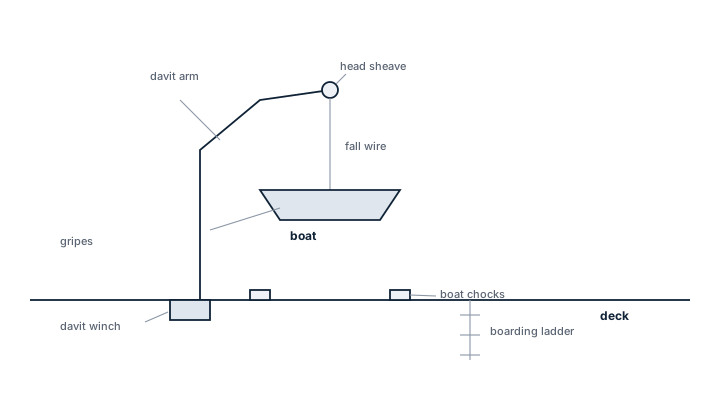
Legend
- Head sheave
- Davit arm
- Fall wire
- Boat in stowed position
- Davit winch
- Gripes (securing lashings)
- Boat chocks
- Deck
- Boarding ladder
Main components across this equipment family
Davit arm and winch
A pivoting arm swings the tender out from its stowage position; an electric or hydraulic winch controls the lowering and raising speed, with a mechanical brake that holds the load if power is lost.
Wire falls or synthetic rope falls
Wire rope is still common for its predictable stretch and load rating, though synthetic rope falls are increasingly used on smaller yachts for their lighter weight and corrosion resistance, provided the fibre is rated for the UV and chafe exposure of permanent deck stowage.
Read the full guide
Sheaves, blocks and load pins
Every point where the fall changes direction is a wear point; sheave bearing failure or a seized block is one of the more common reasons a davit will not run smoothly under load.
Boarding ladders and platforms
Fixed or telescopic ladders, and fold-out bathing or boarding platforms, rated for the static and dynamic load of people boarding from a tender or from the water, with anti-slip treads and secure stowage for use underway.
Selection
Safe working load is the first figure to check, and it has to cover the tender's fully loaded weight including fuel, gear and passengers, not just the empty hull weight on a specification sheet. Winch speed, davit reach and the deck space the stowed arm occupies matter as much on a yacht as load rating, since space is tighter than on a comparable commercial vessel.
- Safe working load with margin over the tender's actual loaded weight
- Corrosion protection suited to a yacht that may see far more time in tropical, high-salinity cruising grounds than a commercial ship on a fixed trade route
- Manual back-up recovery in case of a power or hydraulic failure
- Deck footprint and stowed height, particularly on flybridge or upper-deck installations
Regulations and class
DNV's rules for yachts set the approval basis for this equipment, drawing on the same load testing and proof testing logic used for SOLAS survival craft gear even though most private and charter yachts fall outside SOLAS tonnage limits. Class survey of the installed davit or ladder typically includes a proof load test at commissioning and periodic function checks thereafter, and the equipment's approval certificate should state the safe working load actually tested, not a theoretical design figure.
Typical faults
| Cause | Consequence |
|---|---|
| Sheave or block bearing seizure | Uneven or jerky lowering, increased load on the fall at the jammed point |
| Wire fall corrosion, especially inside the swaged end fitting | Hidden strength loss that a visual check from outside will not catch |
| Synthetic fall UV or chafe damage | Reduced breaking strength, failure without the visible necking a wire shows |
| Winch brake wear | Uncontrolled lowering speed or failure to hold the load stationary |
What to look for in a supplier
- DNV or equivalent class type approval certificate stating a tested safe working load, not a manufacturer's design estimate
- Proof load test documentation from commissioning, kept with the yacht's survey file
- Spare fall, sheave and brake parts available without a long lead time, since a yacht often cannot wait for a full replacement unit
- A manual recovery method built into the design, not added as an afterthought
Inspect wire falls at the swaged end fitting, not just along the visible length - that is where trapped moisture causes internal corrosion long before the outside of the wire shows any sign of it.
Models in this type.
The best-documented model of each manufacturer first, then the next — 7 of 7 models in Yacht/Boat DNV-Approved (Review). Every row links to full specifications, documents and service notes.
Manufacturers.
All 346 manufacturers with models of Yacht/Boat DNV-Approved (Review). Names with a manufacturer page open it; the others open a search across the full library.
All manufacturers- Ryds Båtindustri AB18
- Sealine GmbH14
- SPBI S.A.S.15
- Sunbeam Yachts OG14
- SVB-Spezialversand für Yacht- und Bootszubehör GmbH14
- Uwe Johann Stiel43
- Vikal International Pty Ltd.20
- Viknes Båt og Service AS20
- VSR Lab d.o.o.14
- Weihai Sun Selections Co., Ltd.46
- Weihai Wavefun Outdoor Co., Ltd.26
- Windy Scandinavia23
Show all 346 manufacturers
- "Mirage Boats" Zajac & Bychto Sp. j.1
- A.W. Niemeyer GmbH1
- AB OQS-Ocean Quality Systems OY2
- ABC Plovila d.o.o.1
- Ad Boats Ltd.2
- AD Brodovi d.o.o.10
- AD NAUTIC D.O.O.1
- Al Marakeb Boat Manufacturing Co Ltd.2
- Alpha Boat Manufacturing (Zhoushan) Co. Ltd.4
- ALPHA YACHTS3
- Aluminium Workboats d.o.o2
- AM Jacht Service1
- AM Yacht Daniel Margalski4
- AM YACHT Sp. z o.o.8
- Andrej Zajc1
- Angus Marine4
- AQWIA Kft.3
- Arba Nautika d.o.o.1
- Arna Kft1
- Arronet Teknik AB1
- Artemis Technologies Ltd1
- ASIS Boats LLC4
- Astilleros Astondoa, S.A.11
- Astilleros Sinergia1
- Astondoa Sport System, S.L.1
- Axopar Boats Oy4
- Azimut Benetti S.p.A. - Divisione Atlantis1
- Azuro Plast d.o.o. Beograd2
- B2 MARINE d.o.o.1
- Balder Yachts d.o.o.1
- Baltic Yachts Oy Ab Ltd.6
- Barracuda brodovi d.o.o.2
- BIMEX PROM d.o.o.1
- BNC d.o.o.1
- Bodo boats doo1
- Boote Kamper1
- Bootswerft Gerhard Bicker GmbH2
- Borneo Apparel Kft2
- Bourbon Mobility S.A.S.U1
- Brandkärsbåtar AB1
- BRANISLAV ZIVKOVIC PR IZRADA CAMACA ZA SPORT I RAZONODU TANDEM NAUTIC BACKA PALANKA1
- Breitengrad 541
- Brioni d.o.o.1
- BROBERG SWEDEN AB3
- BRODOGRADILIŠTE I MARINA d.o.o.1
- Bura Brodovi d.o.o.4
- BURA GUMENJACI d.o.o.1
- Candela Technology AB1
- Cantiere Se.Ri.Gi. Di Aquileia S.r.l.1
- Carbon Innovation Kft.1
- Caterpillar2
- Caterpillar Marine Power2
- Chantier Naval Couach CNC S.A.S.1
- Chongqing Jingsui Cruiser Manufacturing Co., Ltd.4
- Christian Spengler1
- Classic Hajógyár Kft.1
- Claudio Zappa1
- Clubswan Yachts S.R.L.1
- Coenen Yachts & Boats1
- Comfortbåtar i Arvika AB3
- Construcciones Navales Astondoa2
- Construcciones Navales de Mallorca S.A.1
- Csaba Mikesz1
- Dahls Båtbyggeri AS1
- Dalian Changmei Pleasure-Boat Manuf acture Co., Ltd.1
- Dalian Songliao F.R.P. Boat Co.,Ltd.2
- Dehler Deutschland GmbH3
- Dehler Yachts GmbH8
- DELPHIA YACHTS KOT sp. j.1
- Delta Powerboats AB2
- DEMCON unmanned systems B.V.1
- DK Composites Sdn Bhd1
- DLRG Ortsgruppe Stade e.V.1
- DNV GL Koper1
- Drágár Péter1
- Drassanes i Disseny, S.A.1
- DSB Deutsche Schlauchboot GmbH2
- Dusan Antic PR Inzenjerski Dizajn Argo Navis6
- EFINOR ALLAIS2
- EKO PLOVILA1
- ERTEC AS1
- F. Kersting & Co. KG2
- Faeton Yachts, S.L.2
- Finn Yachts Ltd2
- Finn-Marin Ltd3
- Finngulf Yachts Oy1
- FIT'N SAFE Racing Technology GmbH2
- Fjord d.o.o.3
- FlairEinrichtungsstudios GmbH1
- Flueraru Adrian-Mihail1
- FPT Industrial S.p.A.4
- Frei Benedikt1
- Freizeit u. Sport R. u. J. Muhl GmbH9
- Gerhard Damböck1
- Global Big Fishing, S.L.1
- Golden Cut Yachts /Allybis AB1
- GOLDFLAME INVESTMENTS Pty Ltd T/as IMAX MARINE2
- Green Dream Boats Sp. z o.o.1
- GROS INOX doo2
- Guangzhou Tornado Boats Co. Ltd1
- Gulyasne Barcsi Beatrix1
- Günther Yacht Sp. z o.o.2
- HANSVIK AS11
- Hansvik Poland Sp. z o.o.5
- Hatina Branislav1
- HELENA PAVLOVIĆ PR TRGOVINSKO KOMISIONA RADNJA HD NAUTIKA OBRENOVAC1
- HERA Warenhandels GmbH11
- Herbert Schulz1
- Huseklepp Modellverksted AS1
- HYUNDAI SEASALL CO., LTD.1
- ISSA d.o.o.1
- Istvan Kepes1
- Istvan Pölyhe1
- István Tóth1
- Ivanics Kft.2
- Iwona Marczak1
- J Craft Boats AB4
- JEMAR NORPOWER AS1
- Jens Leffler6
- JODA INDUSTRIER AS2
- JOVAN MAJOROS PR IZRADA CAMACA ZA SPORT I RAZONODU MAJORPLAST GOSPODJINCI1
- Kace AS1
- Karvel d.o.o.1
- Kewatec AluBoat Oy Ab3
- Kindlimann Naval Architecture GmbH2
- Knierim Yachtbau GmbH8
- Kökény Nóra2
- Kora Robert1
- Kordett KFT1
- Kóródi Imre1
- Krake Catamarane1
- Krupa Yachting1
- Kuhnle Werft GmbH2
- Lamiplast S.C.1
- Lars-Göran Linder Aluminiumbåtar AB2
- Laszlo Lauko1
- LEIDI3
- Leskau-Boote1
- LIBURNA JAHTE d.o.o.1
- Linder Aluminiumbåtar AB10
- Lovas János Attila1
- Lucky Wood doo1
- M Lana d.o.o1
- Mabi Yachts AB1
- Mahindra Ocean Blue Marine Pvt. Ltd.2
- Major Sandor2
- MAN Truck & Bus SE1
- Manikela d.o.o.2
- MARANA d.o.o. Pula1
- Marc-Oliver Stobbe1
- MAREX A/S3
- Marina Brodersby Service Center GmbH1
- MARINAR TOMAŽ GORNIK S.P.4
- Marine Alutech Oy Ab1
- Marine Care USA Inc.2
- Marine Sachverständigen Centrum6
- marinecare LLC.2
- Mariterm d.o.o.1
- Maritime Partner7
- Marius Sorin Dimachi1
- MASTPOL Osprzet Jachtowy S.C.1
- Mayland Boote1
- MD Prestige Spolka z o.o. Spolka Komandytowa2
- Mirage Boats W. Bychto i Wspolnicy12
- Monte Carlo Yachts S.p.A.1
- MONTE MARINE YACHTING D.O.O.1
- Moody Yachts GmbH5
- More boats Ltd1
- More Brodovi d.o.o.2
- MPM Engineering d.o.o.1
- Music Expo Festival Kft.1
- N. Sundin Dockstavarvet AB1
- Nagy Richárd1
- Najad AB3
- NAUTI2
- Nautibus Yachting GmbH & Co. KG1
- NAUTIKCENTAR1
- NAUTINOX di Bruno Spangaro1
- NAVALPORT YARDS-CONSTRUCAO NAVAL UNIPESSOAL LDA1
- NAVALTECNICA - COSTRUZIONI NAVALI - S.R.L.1
- Nave - obrt za servis brodova1
- Naya Design Kft.1
- Nelt d.o.o.2
- New Madera RIBs B.V.1
- NewAge Fire Protection Industries Private Limited2
- NIDELV BÅTBYGGERI A/S8
- NOR STAR BOAT AS2
- NOR STAR BOATS AS1
- North Wind Yard S.L.2
- Norway Marine Supply AS2
- Nye Scand Boats AS1
- Ocean tec d.o.o.2
- OKUS SOLI d.o.o.1
- Öregrund Marine Service AB1
- Origo Klip d.o.o.1
- ORKA, Janez Drinovec s.p.2
- OXE Marine AB1
- Oy Marino Ab10
- Oy Nautor Ab3
- PAKLENI OTOCI d.o.o.6
- Papp Levente1
- PAROBROD d.o.o.1
- PENSITO R d.o.o.1
- Péter Herman1
- Pioner Boats AS2
- Planet Marine d.o.o.1
- Plastimo Distribution SASU1
- PPH DEMEX2
- Premier Composite Technogies LLC4
- Pro Nautik AG1
- PUH POSEJDON JACEK SUDNIK1
- PUS PEGAZUS1
- Qingdao Baoquan Yacht Manufacturing Co.,Ltd5
- Qingdao Hao Yun Boats Manufacture Co., Ltd.1
- Qingdao Lian Ya Boat Co.,Ltd1
- Qingdao OSIC International Co., Ltd.1
- Qingdao WaterWish Boat Manufacturing Ltd.1
- RAND Boats A/S3
- RIS MARINE2
- Rolls-Royce Solutions GmbH1
- ROTO Podjetje za predelavo in trzenje d.o.o.20
- Rotostøp AS3
- Rutgerson Marin AB7
- Ryds Båtar AB3
- S.Z.R. Elko Vladimir Prisic PR Futog3
- Sachverständigen Büro Rainer Klotz1
- Sailart1
- SAILART Segelboote GmbH1
- Salona Grupa d.o.o2
- Salthouse Boatbuilders Ltd1
- SAMOSTALNA RADNJA NARVAL2
- SAŠA SIMIĆ PR IZRADA ČAMACA ALU NAUTIKA UGRINOVCI3
- Scania CV AB1
- Schiffswerft Laboe GmbH & Co. KG2
- Schöchl Yachtbau GmbH3
- Seamax d.o.o.1
- Seascape d.o.o.2
- Seaway Design d.o.o.2
- Seaway Group d.o.o.1
- Sebastian Krzeski1
- Selva S.p.A.3
- Skibsplast10
- Skipavik ehf.1
- Skjebergkilens Marina AS3
- Solaris Yachts S.r.l.1
- SolarWaterWorld AG1
- Somaker Altalanos Kereskedelmi es Szolgaltato Kft.1
- SPASOJEVIC ZORAN PR BOAT TEAM NOVI SAD1
- Srdjan Govedarica PR Izgradnja brodova i plovnih objekata TIAMAT BOATS Backa Palanka1
- Stanko Jurkovic1
- Stevan Mihajlov Preduzetnik SZR ZA Izradu Proizvoda OD PL1
- Storebro Boats AB1
- Storebro Bruks AB4
- Streit Marine FZ-LLC1
- Strusshamn Båt & Servicesenter2
- SUNBEAM Watersports GmbH2
- Sunseeker Shipyard AG1
- Suzhou Dehong Yachts Co., Ltd.1
- Sweden Yachts AB2
- SZR Blue1
- SZTR Tri princeze6
- Tamsen Maritim GmbH1
- TARSIS ASTILLEROS, S.L.1
- Tavros d.o.o.1
- Techno-Chemie Kessler & Co. GmbH1
- Technology Square Fiberglass Factory2
- TERITA EOOD1
- TERITA ET - Varna7
- Terra Nauta Yachts d.o.o.1
- Textron Motors GmbH2
- Tibor Hornyak1
- TO DELETE1
- Trend Marine Products Limited4
- TRIPLAST - Novak Anton s.p.1
- ULTRAMARIN, RAZVOJNO PODJETJE D.D.1
- UNIPLAST BK d.o.o. Struga1
- Universal Yachts, S.L1
- UtternBåtar AB5
- Vass Márk1
- Venture projektiranje Marko Papler s.p.1
- VICENTE BELLIURE C.N., S.L.3
- Viktor Posa1
- Viro d.o.o.1
- VK Yacht AB1
- Volvo Penta8
- Walter Hering1
- Walter Mitnacht1
- Willisits Mernökiroda Kft.2
- Windcat Workboats B.V.1
- Wiwa Robert Gzara2
- Wolfgang Wasserschaff1
- Xiamen Shipbuilding Industry Co., Ltd.1
- XO Boats OY9
- Yacht- und Bootswerft Henningsen & Steckmest GmbH2
- Yacht- und Bootswerft Josef Martin4
- Yachts & Boats Andrzej Kusmierek1
- Yamaha Motor Europe N.V.7
- Yamaha Motor Middle Europe B.V.1
- Yanmar Power Technology Co., Ltd. Tsukaguchi Factory1
- Yanti Leading Yacht International1
- Yinson Electric Pte. Ltd.1
- Yonca Onuk Adi Ortakligi1
- Zaklad Naprawczy Mechanizacji Rolnictwa w Ostrodzie Sp. z.o.o.3
- Zaklad Slusarski Piotr Rolewicz2
- Zamil Ship Building & Repair Co. Ltd.2
- Zegul AB1
- Zoltán AGÁRDI1
- ZR Djena Ship Branko Nikolic3
- ZR Mare Nostrum1
- Zvonko Buser1
Also in Yacht & Boat Equipment.
The other equipment types in this category.
One request. A person reads it and replies by e-mail.
Tell us the manufacturer, the model and what you need — a part, a service call, a second opinion. A person reads every request and replies by e-mail.
No details at hand? A photo of the rating plate or the part is enough — simply attach it to the request.
Three things people ask first.
Is Yacht/Boat DNV-Approved (Review) data free?
Yes. Every model page, every guide and every datasheet for this type is readable without an account. An account adds saved searches and requests, nothing is taken away.
My model is missing — what now?
Send us the nameplate. We identify it by hand, add it to the library, and if you need a part or a service, the request is already on our desk.
Can you source a Yacht/Boat DNV-Approved (Review) part?
Yes. Tell us the manufacturer, the model and what you need — a person reads every request and replies by e-mail.