Tunnel Thruster
A tunnel thruster is a fixed propeller in a transverse tunnel, distinct from azimuth or retractable units because it cannot steer - it only pushes sideways, port or starboard, at one fixed location in the hull.
What to check on a Tunnel Thruster.
51 models from Jastram in Tunnel Thruster. Below: the full model list.
What Defines a Tunnel Thruster
A tunnel thruster is a propeller mounted inside a straight transverse tunnel cut through the hull, close to the bow or stern. Unlike azimuth thrusters or retractable units, it cannot rotate or train; it only produces thrust along the tunnel's fixed axis, port or starboard, by reversing the propeller pitch or its direction of rotation. That simplicity is the whole point: a tunnel unit is cheaper to install, has no exposed steerable gearbox below the hull, and is the default choice wherever the vessel only needs lateral push for berthing rather than full manoeuvring or dynamic positioning capability.
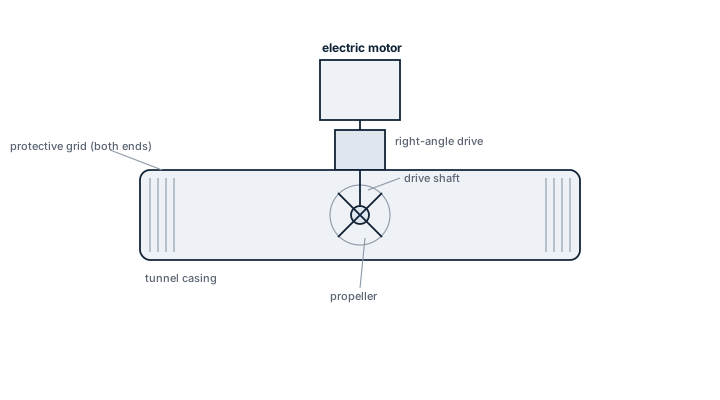
Legend
- electric motor
- right-angle drive
- protective grid (both ends)
- drive shaft
- propeller
- tunnel casing
Main components
Tunnel
A steel tube welded into the hull, sized and positioned per naval architecture calculations; a poorly located tunnel loses thrust to hull interaction and can generate noticeable vibration.
Propeller
Fixed-pitch or controllable-pitch, typically four or five bladed. Controllable-pitch units reverse thrust by changing blade angle at constant shaft speed, which is faster and gentler on the drivetrain than reversing a fixed-pitch propeller's rotation.
Read the full guide
Drive motor
Electric motor, hydraulic motor, or direct diesel drive through a right-angle gearbox. Electric drives dominate because they start and reverse quickly and integrate cleanly with the ship's power management system.
Gearbox and seals
A right-angle gearbox transmits drive from the motor shaft to the horizontal propeller shaft. Shaft seals keep sea water out of the gearbox and tunnel; seal failure is one of the most common causes of thruster downtime.
Selection and sizing
Thruster capacity is chosen from the manoeuvring requirement, not from engine room space:
- Bollard pull thrust in kN, derived from the vessel's windage area and the required transverse speed for berthing without tug assistance
- Motor power, typically a few hundred kW on coastal vessels up to several MW on large cruise ships and offshore vessels needing dynamic positioning capability
- Tunnel diameter and length-to-diameter ratio, which affects thrust efficiency and flow noise
- Fixed-pitch versus controllable-pitch, driven by how often the thruster starts and stops and whether soft manoeuvring is needed
Class and regulatory requirements
Classification societies require thruster tunnels to meet minimum submersion depth so the propeller does not draw air and cavitate in ballast condition, and they set structural requirements for the tunnel-to-hull connection. Where a thruster is counted toward a dynamic positioning notation, class rules require independent power feeds and redundancy appropriate to the DP class assigned. Periodic survey covers the drive motor, gearbox oil condition, seal integrity and, at dry-docking, the tunnel grid and propeller for damage or fouling.
Typical faults
- Seal leakage - worn shaft seals let sea water into the gearbox, contaminating the oil and accelerating bearing wear
- Cavitation erosion - operating in light ballast with insufficient submersion pits the propeller blades and reduces thrust over time
- Controllable-pitch hub hydraulic failure - loss of pitch control oil pressure leaves the blades stuck at an uncontrolled angle
- Debris strike - rope, fishing gear or ice entering the tunnel bends blades or jams the propeller
- Motor overheating - repeated short bursts during berthing without cooldown time trips thermal protection
What to look for in a supplier
- Documented bollard pull test results at the rated tunnel submersion, not just calculated figures
- Gearbox and seal spare parts held regionally, since a thruster failure often strands a vessel that depends on it for berthing
- Class approval of the tunnel structural design and drive train together, not as separate items
- Noise and vibration data if the tunnel sits near accommodation spaces
Log every thruster start with duration and current draw; a slow upward creep in running current over weeks, well before an alarm trips, is usually the first sign of a seal or bearing problem developing in the gearbox.
Models in this type.
The best-documented model of each manufacturer first, then the next — 51 of 51 models in Tunnel Thruster. Every row links to full specifications, documents and service notes.
Manufacturers.
All 30 manufacturers with models of Tunnel Thruster. Names with a manufacturer page open it; the others open a search across the full library.
All manufacturersAlso in Bow/Stern Thrusters.
The other equipment types in this category.
One request. A person reads it and replies by e-mail.
Tell us the manufacturer, the model and what you need — a part, a service call, a second opinion. A person reads every request and replies by e-mail.
No details at hand? A photo of the rating plate or the part is enough — simply attach it to the request.
Three things people ask first.
Is Tunnel Thruster data free?
Yes. Every model page, every guide and every datasheet for this type is readable without an account. An account adds saved searches and requests, nothing is taken away.
My model is missing — what now?
Send us the nameplate. We identify it by hand, add it to the library, and if you need a part or a service, the request is already on our desk.
Can you source a Tunnel Thruster part?
Yes. Tell us the manufacturer, the model and what you need — a person reads every request and replies by e-mail.