"> Tunnel Thruster - Equipment Database
Also listed under Bow/Stern Thrusters (720 models)

Tunnel Thruster

medium 4 models total

A tunnel thruster mounts a propeller inside a transverse tunnel built through the hull, giving pure athwartship thrust with no moving parts outside the tunnel - simpler and cheaper than an azimuth or retractable unit, but useless for propulsion and weaker as the vessel gains headway.

Read more — Tunnel Thruster explained

What sets the tunnel type apart

A tunnel thruster is a propeller fixed inside a transverse tunnel that passes straight through the hull below the waterline, near the bow or stern. Unlike an azimuth or retractable thruster, the propeller cannot rotate or be lifted clear of the water - it only pushes water out one side of the tunnel or the other, giving pure athwartship thrust and nothing else. That simplicity is the whole point: fewer moving parts below the waterline, a shorter drive train, and a lower unit cost than any steerable alternative. The trade-off is that a tunnel thruster contributes nothing to forward propulsion or course-keeping underway, and its thrust falls off sharply once the vessel picks up headway, because forward speed disturbs the flow through the tunnel.
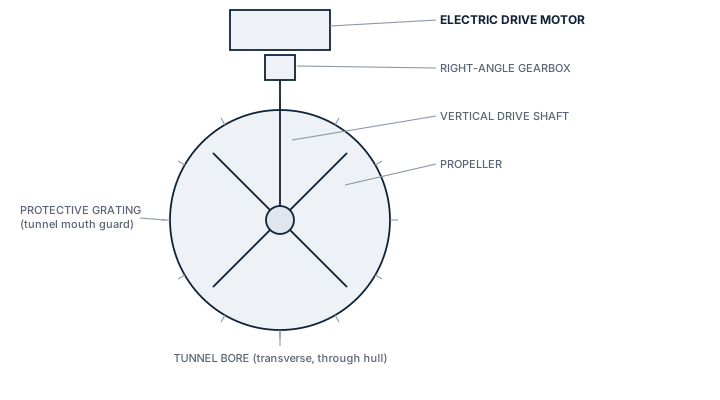
Tunnel thruster, end view
View into a transverse tunnel thruster bore showing the propeller and protective grating at the tunnel mouth, driven by a vertical shaft from a right-angle gearbox and an electric motor mounted in the hull above.

Main components

Propeller and tunnel

The propeller is usually a fixed-pitch design on smaller units and controllable-pitch (CPP) on larger ones, where reversing thrust direction without reversing the driver is worth the added complexity. The tunnel itself is a welded steel cylinder built into the hull structure, with grids or bar screens at both openings to keep debris out and to reduce cavitation noise at the tunnel mouth.

Drive train

Electric motor drive through a right-angle gearbox dominates on newer vessels with sufficient electrical capacity; hydraulic drive, fed from a dedicated power pack, is common as a retrofit or where deck space for a motor is tight. A right-angle bevel gearbox sits at the tunnel centreline and takes the drive from a vertical shaft down to the horizontal propeller shaft.

Control system

A joystick or lever at the bridge console commands thrust direction and, on CPP units, blade pitch; on fixed-pitch electric units, direction is set by reversing motor rotation. Local control is normally provided at the thruster room for maintenance and testing.

Selection and sizing

Sizing starts from the required lateral thrust in kN the naval architect specifies for the vessel's windage area and manoeuvring requirement, not from motor power alone. Key figures to check:

  • Thrust output (kN) at bollard condition, and how far it degrades at the ship's typical berthing speed
  • Motor or hydraulic power rating and duty cycle - most thrusters are short-time rated (10 or 30 minutes), not continuous
  • Tunnel diameter versus hull beam at the fitting location, since tunnel length-to-diameter ratio affects thrust efficiency
  • Immersion depth - insufficient submergence causes air draw and thrust loss in ballast condition

Regulations and class

Class societies require thruster installations to be assessed as part of the manoeuvring notation where one is sought, and the tunnel opening and local shell plating are subject to structural approval like any other hull penetration. Where the thruster is credited toward a dynamic positioning notation, IMO DP guidelines and the relevant class DP rules apply additional redundancy and testing requirements. Watertight integrity of the tunnel through any subdivided compartment is checked against SOLAS damage stability requirements for the vessel type.

Typical faults

FaultCauseConsequence
Loss of thrust in ballastInsufficient tunnel immersion, air drawn into propeller discCavitation, vibration, reduced manoeuvring control in light condition
Seal or bearing failureContaminated lubricant, infrequent running leading to seal drying outWater ingress into the thruster room, oil-in-water discharge issue
Overheating tripExceeding the rated duty cycle during prolonged berthing operationsThrust lost mid-manoeuvre, motor protection requires cool-down before restart
Grid blockageDebris, marine growth or ice fragments caught on the tunnel gridReduced flow, increased noise and vibration, possible propeller damage

What to look for in a supplier

  • Documented thrust curves at bollard and at typical approach speeds, not just a single headline figure
  • Spare parts availability for seals, bearings and control electronics matched to the vessel's trading pattern
  • Reference installations on similar hull forms and tunnel diameters
  • Clear duty-cycle rating and cooling requirements for the intended manoeuvring profile

Always confirm tunnel immersion at the lightest expected ballast condition before relying on the thruster during pilotage - a unit that performs well loaded can lose most of its thrust light.

4 manufacturers · 4 models

Brunvoll

1
Brunvoll Tunnel Thruster FU
Tunnel Thruster FU
300-3500 kW · 1500.0 kW · Seawater · Electric tunnel thruster
Power (kW)
1500
Type
Tunnel Thruster Electric
Common Failures & Inspection Points
  • Propeller blade tip erosion
  • Main bearing wear
  • Shaft seal leakage
  • Clutch engagement failure (if fitted)
Service: Brunvoll — strong in offshore/ferry segment. Fixed pitch — direction reversal via motor. Annual gear inspection.
Spare Parts: Brunvoll: Gear oil and seals on board. Lead time: 3-6 weeks.
Strengths
  • 1500 kW rating gives strong side thrust for large offshore and ferry vessels
  • Fixed‑pitch, direct‑drive design reduces hydraulic complexity and maintenance
  • Motor‑reversal provides instant change of thrust direction without clutch wear
  • Robust construction suited to harsh offshore environments (salt spray, vibration)
  • Annual gear inspection program supported by Brunvoll simplifies upkeep
Weaknesses
  • Large hull penetration required; installation is invasive and costly
  • Higher capital cost compared with conventional hydraulic thrusters of similar power
  • Fixed‑pitch propeller can suffer blade‑tip erosion in abrasive or sediment‑laden waters
  • Main bearing wear and shaft seal leakage are known wear items that need periodic overhaul
  • Thrust vector limited to transverse direction only; no 360° azimuth capability
Typical Vessels: Offshore supply vesselFerryPlatform support vesselAnchor handling tug supply (AHTS)
Decision Guide: Choose if you need high side thrust for large offshore or ferry vessels, value a low‑maintenance electric drive and rapid reversal, and can accommodate the hull penetration. Avoid if budget constraints favour cheaper hydraulic units, the vessel requires azimuthal thrusting, or operating in highly abrasive water where blade erosion would be excessive.
Use Cases: Commonly installed on ferries for dockside manoeuvring, offshore supply ships when approaching rigs or platforms, and platform support vessels that need precise lateral positioning during loading/offloading operations.

Kawasaki

1
Marine Bow Thruster
500-3000 kW · 1800.0 kW · Seawater · hydraulic tunnel thruster
Power (kW)
1800
Type
Tunnel Thruster
Common Failures & Inspection Points
  • Hydraulic motor leak (hydraulic type)
  • Tunnel grid damage
  • Shaft alignment issue
  • Control valve malfunction
Service: Standard on Japanese-built bulkers/tankers. Hydraulic version requires HPU maintenance. Test before each port call.
Spare Parts: Kawasaki: Gear oil and seals on board. Lead time: 3-6 weeks.
Strengths
  • Very high power rating (≈1800 kW) suitable for large tankers and bulk carriers
  • Proven reliability on Japanese‑built vessels, with extensive service history
  • Compact tunnel installation saves deck space compared to external azimuth units
  • Robust hydraulic motor design tolerates harsh marine environments
  • Straightforward integration with ship’s existing hydraulic power unit (HPU)
Weaknesses
  • Requires dedicated HPU and regular hydraulic maintenance; leaks are a known failure mode
  • Tunnel grid can suffer wear or damage, leading to reduced efficiency
  • Shaft alignment must be monitored closely during installation and service
  • Control‑valve malfunctions may affect response time in critical maneuvers
  • Heavier and bulkier than comparable electric thrusters, impacting hull design
Typical Vessels: TankerBulk Carrier
Decision Guide: Choose if the vessel needs high bow thrust for safe berthing of large deadweight ships and already has a hydraulic power system; the Kawasaki unit offers proven performance at a lower upfront cost than electric alternatives. Avoid if you prefer low‑maintenance electric drives, have limited hull space for a tunnel, or operate vessels where precise, rapid thrust modulation is critical.
Use Cases: Installed on Japanese‑built bulkers and tankers to provide reliable bow assistance during port entry/exit, emergency maneuvering, and as auxiliary thrust for dynamic positioning when docked in confined waterways.

Kongsberg

1
Rolls-Royce (Kongsberg) Kamewa TT Series
Kamewa TT Series
500-4000 kW · 2500.0 kW · Seawater · Electric tunnel thruster
Power (kW)
2500
Type
Tunnel Thruster Electric
Technical Specifications
Tunnelthrusters
Output 200–3,700 kW, propeller diameter 1,600–2,000 mm, thrust up to 229 kN, available in CP (Constant Pitch) and FP (Fixed Pitch)
Azimuth-thrusters
Leistung 330-6.500 kW (mechanical/hybrid), neun Baumgroessen, Zugkraft optimiert fuer Bollard-Pull, 360°-Schwenkung
Arctic Thruster (ARC)
Power from 3 MW to >10 MW, no oil-sea interfaces, adaptive seals, Polar-Class-2 and Icebreaker-7 to 9 MW
Permanent Magnet (PM) Thrusters
TT-PM 1000 kW (146 kN), TT-PM 1600 kW (229 kN), Effizienzsteigerung 7-13% gegenueber Diesel-Elektrik
Hydraulik-standard
Double gear hydraulics for control/ventilation/lubricant, double cylinder with pressure pipe safety, seal tank with refueling capacity
Lagerung
Rollenlager fuer Schubwelle, Schmierung mit Fett, Dichtung an Lagergehausen, Toleranz-Freispiele typisch 0,5-2,0 mm
Product Lines
  • US Azimuth Thruster
  • Arctic Thruster (ARC)
  • TCNS/C Azimuth Thruster (Swing-up/Retractable)
  • Rim Drive Azimuth Thruster (RD-AZ)
  • Tunnel Thruster Type TT/TTH
  • Permanent Magnet Tunnel Thruster (TT-PM)
  • Rim Drive Tunnel Thruster (RD-TT)
  • Underwater Mountable Azimuth Thruster (UUC/UUC-PM)
  • Retractable Azimuth Thruster (UL/ULE)
  • Azipull Thruster (Integrated PM Motor)
Common Failures & Inspection Points
  • Area: Propellerblaetter: Verschleiss, Risse, Verformung, Seewuchsbewuchs
    Check: Sichtpruefung auf Schaedigungen, Freispiel, Blattoberflaeche glatt ohne Kratzer/Dellen. Blattwurzel-O-Ringe auf Verschleiss checken, Spitzzenspiel messen. Bei Zweifeln: 1,5 bar Luftdruck auf VT-Nippel, Seifenblasen-Test auf Oellecks.
  • Area: Propellerwellen-Dichtung: Durchfeuchtuung, Oelaustrittsverlust, Verschleiss
    Check: Visual inspection for leaks around shaft seal, check sealing cavity (monitored automatically via ARC). Observe seal clip pressure (e.g. via sensor output). At 5-year overhaul: renew seal. Check adaptive pressure regulation.
  • Area: Lagerfreispiel/Lagerverschleiss: Axiales/Radiales Play ueber Norm, Bohrlochabtrag
    Check: Calipers/counter gauges: measure shaft diameter and bores (target value via manufacturer data sheet). Document caliper readings. If exceeded: replace bearing journal/bearing shells. Observe vibration/noise during operation.
  • Area: Hydraulikfluid: Verschmutzung, Feuchtigkeit, Alterung, Farb-/Geruechsveraenderung
    Check: Check fluid level in tank (target level). Color test: light/yellowish OK, cloudy/dark = change required. Particle count (if available). Change filter per manufacturer interval. Perform pressure test on hydraulic line.
  • Area: Hydraulik-Leitungen/Verbindungen: Risse, Lecks, Verformung, korrosive Belaege
    Check: Visual inspection of all hoses, pipes, connections for defects. Check for dryness, corrosion (rust spots), kink marks. High-frequency leak test if necessary. Observe operating pressure during voyage.
  • Area: Elastomer-Bauteile (O-Ringe, Dichtlippen, Gummistuecke): Hartung, Risse, Quellungserscheinungen
    Check: Visual inspection of all O-rings/seals for wear, hardening, deformation. Test with finger pressure (elasticity). Clean O-ring grooves/lubricate with gearbox oil (at 5-year overhaul). Replace damaged parts.

Type-universal inspection/service points for bow/stern thrusters (Kongsberg, Mega-Swarm 2026-06). Per-model specs not auto-populated.

Service: Kamewa TT series. VFD enables soft start and speed control. Annual gear oil change. Propeller inspection at drydock.
Spare Parts: Rolls-Royce (Kongsberg): gearbox oil and seals on board. Lead time: 3-6 weeks.
Strengths
  • High power rating (up to 2 500 kW) delivering up to ~229 kN thrust in a compact tunnel layout
  • Integrated variable frequency drive enables soft start, fine speed regulation and energy‑efficient operation
  • Available with constant‑pitch or fixed‑pitch propellers for optimisation of bollard‑pull performance
  • Robust double‑gear hydraulic control system and roll‑bearing shaft design reduce wear and extend service intervals
  • Proven class‑approved design widely installed on DP‑equipped tankers, container ships and offshore vessels
Weaknesses
  • Tunnel geometry occupies significant hull volume; not suitable for vessels with limited beam or shallow draft
  • Thrust is fixed in a single direction – no 360° azimuth capability, limiting manoeuvre flexibility compared with azimuth thrusters
  • High‑power electric drive and hydraulic control increase initial cost and require specialised maintenance (seal, bearing, propeller inspections)
  • Potential for cavitation at very high thrust settings, especially on low‑speed vessels
  • Maintenance of shaft seals and roll bearings is critical; failure can lead to costly dry‑dock repairs
Typical Vessels: Crude oil tankerProduct tankerContainer ship (≥8 000 TEU)Bulk carrier (≥150 000 dwt)LNG/LPG carrierOffshore supply vesselCruise ship
Certifications: DNV GL Type Approval
Decision Guide: Choose if: you need high static thrust for low‑speed manoeuvring or DP support, have sufficient hull space for a tunnel installation, and prefer an electric drive with proven reliability. Avoid if: vessel geometry limits tunnel size, you require full 360° thrust vectoring, or budget constraints favour lower‑cost azimuth units.
Use Cases: The TT series is typically installed on large tankers and container ships to provide bow‑ and stern‑thruster assistance during docking, undocking and low‑speed manoeuvres. It is also used as a DP‑auxiliary thruster on offshore supply vessels and cruise ships where high bollard pull and precise speed control are required.

Wärtsilä

1
Tunnel Thruster CT/FT
500-5000 kW · 2000.0 kW · Seawater · Electric steerable tunnel thruster
Power (kW)
2000
Type
Tunnel Thruster Electric
Technical Specifications
Leistungsbereich WST
700 kW bis 4900 kW
Leistungsbereich WTT
400 kW bis 5500 kW
Leistungsbereich WST-R
750 kW bis 6500 kW
Neigungswinkel (WST-R)
8-Grad Propeller-Getriebe-Neigung für 15-20% höheren Schub
Drehbereich
360° kontinuierliche Lenkung in horizontaler Ebene
Wartungsintervalle
5-year inspections, 10-year overhauls or after 40,000–56,000 operating hours
Dichtungstechnologie
Sternguard In-Water Serviceable Seal (IWSS) - vollständig unter Wasser wartbar
Ölsystem
Integrierte Hydraulik mit Feinfiltration zur Lagerverlängerung
Product Lines
  • WST - Steerable Thrusters (700-4900 kW)
  • WTT - Transverse/Tunnel Thrusters (400-5500 kW)
  • WST-R - Retractable Steerable Thrusters (750-6500 kW)
  • WST-E - Electric Steerable Thrusters (WST-18E embedded electric)
  • Underwater-Mountable Steerable Thrusters
Common Failures & Inspection Points
  • Area: Propeller-Blätter: Erosion, Korrosion, Kantenschäden, Verschleißmuster
    Check: Perform visual inspection and NDT (non-destructive testing) according to OEM and classification society standards. Polishing in combination with edge damage repair increases operating efficiency by 2-5%. Check for pitting, erosion patterns and corrosion spots; document severe pitting areas.
  • Area: Propeller blade foot seals: wear, leakage, water ingress
    Check: 5-year overhaul: Disassemble and inspect all seals. 10-year overhaul: Complete replacement of blade foot O-rings. Check for water penetration in jet thruster assembly. Seals are critical for system protection.
  • Area: Wellendichtungen (Shaft Seals): Abnutzung, Leckage, Austauschbedarf
    Check: Measure propeller shaft wear with poker gauge (between last two stern tube seals). Perform complete inspection of tooth clearance, tooth pattern and shaft seals. 5-year overhaul: seal replacement. 10-year overhaul: comprehensive replacement.
  • Area: Bearings (Roller Bearings): wear, bearing clearance, preload, failure symptoms
    Check: 5-year overhaul: Check bearing clearance and wear. 10-year overhaul: Complete bearing replacement, reset preload, perform NDT inspection. Check main bearing axial clearance wear with feeler gauge (0.1 mm); maximum wear limit 2 mm. Use Wärtsilä bearing wear measurement system for remote monitoring of propeller shaft shoulder.
  • Area: Hydrauliksystem: Öl-Verschmutzung (Wasser, Partikel), Filtration, Ölqualität
    Check: Check gear oil regularly. At critical wear limits: partial change (bleed-and-feed) or complete oil change. Monitor water content in oil (critical >1000 ppm). Check fine filtration system and redundant filter options. Continuously filter out water ingress. Use all Wärtsilä-approved spare parts. 5-10-year overhaul: Perform oil change and filter maintenance.
  • Area: Sternguard In-Water Serviceable Seal (IWSS): seal integrity, maintenance possible underwater
    Check: Check for oil leakage at outer seal. Inspect inflatable emergency seal and inner rope guard. Fully serviceable underwater without habitat or discharge. Measure seal gap and wear. Check retrofit compatibility with other seal types. Confirm compatibility with EAL and mineral oils.

Type-universal inspection/service points for Bow/Stern Thrusters (Wärtsilä, Mega-Schwarm 2026-06). Per-model specs not auto-filled.

Service: Inspect propeller at drydock. Gear oil analysis annually. Motor insulation test annually. Test before arrival at every port.
Spare Parts: Wärtsilä (Lips): gearbox oil and seals on board. Lead time: 3-6 weeks.
Strengths
  • Continuous 360° thrust vectoring provides superior low‑speed manoeuvring and dynamic positioning capability.
  • Sternguard In‑Water Serviceable Seal allows underwater inspection and minor repairs without dry‑docking, reducing maintenance downtime.
  • Integrated hydraulic system with fine filtration extends bearing life and reduces oil contamination risk.
  • Modular power range (400 kW – 5.5 MW) covers a wide variety of vessel sizes while maintaining high thrust efficiency.
  • Standardised control interface compatible with most DP‑2/DP‑3 systems.
Weaknesses
  • Higher capital cost compared with fixed, non‑steerable tunnel thrusters.
  • Larger tunnel cross‑section can affect hull structural layout and internal volume.
  • Complex control and monitoring electronics require specialised training for crew and shore support.
  • Spare parts (e.g., IWSS components) are proprietary, potentially increasing inventory costs.
  • Installation requires precise alignment; retrofits on existing vessels may be labour intensive.
Typical Vessels: Very Large Crude Carriers (VLCC)Ultra‑Large Container ShipsBulk carriers >150 ktCruise shipsOffshore supply and anchor handling tug supply (AHTS) vessels
Certifications: DNV GL – Approved Marine EquipmentABS – Classification Society ApprovalLloyd's Register – Type Approval
Decision Guide: Choose if you need high thrust for large vessels, require rapid turnaround on thruster maintenance, or operate in ports with tight manoeuvring constraints. Avoid if vessel size and power demand are modest, budget is limited, or hull space cannot accommodate the larger tunnel geometry.
Use Cases: The CT/FT thruster is typically installed on deep‑draft tankers, mega‑container ships and cruise liners to provide precise bow‑and‑stern thrust during docking, undocking and dynamic positioning. It is also favoured on offshore support vessels that need quick directional changes while maintaining station‑keeping in harsh sea states.