Provision Cooling Compressor
A provision cooling compressor is a dedicated refrigeration compressor serving only the chill and freeze rooms for meat, vegetables and dairy, kept separate from the starting air and control air compressors covered elsewhere in this category because the working medium and duty are entirely different.
What to check on a Provision Cooling Compressor.
1 models from Carrier Marine in Provision Cooling Compressor. Below: the full model list.
What sets this type apart
The compressors elsewhere in this category move air. A provision cooling compressor moves refrigerant vapour, compressing it as part of a closed vapour-compression refrigeration circuit rather than filling a receiver with compressed air for starting or control duty. It runs far more of the time than a starting air compressor - often cycling on and off continuously for the length of the voyage - and its failure has a much shorter consequence timeline: food spoils in hours to a day or two, not whenever the next start is needed.
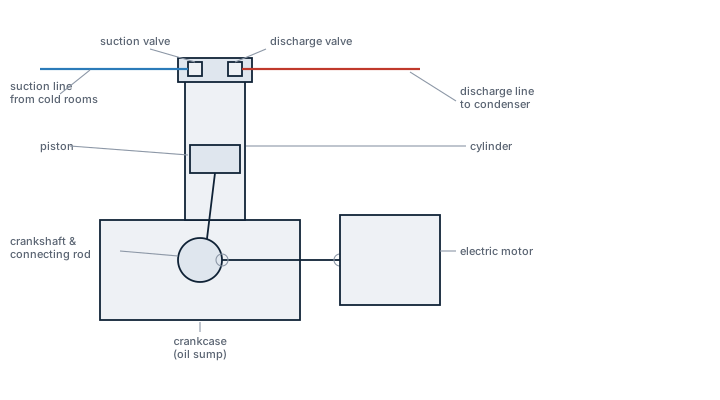
Legend
- suction valve
- discharge valve
- suction line from cold rooms
- discharge line to condenser
- piston
- cylinder
- crankshaft & connecting rod
- electric motor
- crankcase (oil sump)
Main components
Compressor unit
Typically a reciprocating or, on larger installations, a semi-hermetic or open-drive compressor sized for the combined chill and freeze room heat load, drawing low-pressure refrigerant vapour from the evaporators and discharging it at condensing pressure.
Condenser
Rejects the heat picked up in the rooms plus the heat of compression to seawater or to air, condensing the refrigerant back to liquid before it goes to the receiver.
Read the full guide
Receiver and expansion device
The receiver holds liquid refrigerant ready for use; a thermostatic or electronic expansion valve meters it into each evaporator coil, dropping its pressure so it can absorb heat in the room at a low evaporating temperature.
Room evaporators and controls
Each chill and freeze room has its own evaporator coil and thermostat, so a single compressor plant typically serves several rooms in sequence or in parallel through solenoid valves, each room independently held at its own setpoint.
Selection and sizing
Capacity is set by the combined heat load of every provision room served - chill rooms typically held around zero to plus four degrees Celsius, freeze rooms around minus eighteen to minus twenty degrees Celsius - plus a margin for door openings, product loading and ambient heat gain, not simply the room volume. Redundancy matters more here than raw capacity: most vessels carry at least two compressor units so that one machine can be serviced or can fail without losing refrigeration entirely, since there is no quick alternative once food starts to spoil. Refrigerant type is chosen against the vessel's flag and international phase-down schedules for high global-warming-potential refrigerants, which increasingly steers new installations toward lower-GWP alternatives.
Regulations and class
Refrigerant handling and leak prevention fall under the ship's compliance with the Montreal Protocol phase-out of ozone-depleting substances and, for newer refrigerants, applicable greenhouse gas regulations affecting the type and quantity of refrigerant carried. Class societies survey the plant periodically for pressure vessel and piping condition, safety valve testing, and confirmation that the refrigerant log records charge, top-ups and any recovery are kept current, since undocumented refrigerant loss is treated as a compliance issue, not just a maintenance one.
Typical faults
- Refrigerant leak at a fitting or seal - caused by vibration fatigue or a degraded gasket; leads to falling capacity, rising room temperature, and a compliance record entry once detected.
- Condenser fouling - caused by seawater scale or marine growth on a seawater-cooled condenser; leads to high discharge pressure and reduced cooling capacity.
- Expansion valve hunting - caused by an incorrectly set or faulty thermostatic element; leads to unstable room temperature and compressor short-cycling.
- Compressor short-cycling - caused by a low refrigerant charge or a faulty pressure control; leads to accelerated wear on the compressor motor and contacts.
What to look for in a supplier
- Compressor and refrigerant type compatible with the vessel's flag state phase-down schedule, so the installation is not obsolete within a few years.
- Spare parts availability for the expansion valves and solenoid valves specific to each room, which are the components most often replaced.
- Documented capacity data against actual room volumes and setpoints, not a generic catalogue figure.
- Support for refrigerant recovery and leak-testing equipment compatible with the charge on board.
Check the freeze room temperature log daily, not just when someone complains about the food - a slow refrigerant leak shows up as a gradual upward creep long before the compressor alarms, and by the time it alarms the product may already be compromised.
Models in this type.
The best-documented model of each manufacturer first, then the next — 1 of 1 models in Provision Cooling Compressor. Every row links to full specifications, documents and service notes.
Manufacturers.
All 3 manufacturers with models of Provision Cooling Compressor. Names with a manufacturer page open it; the others open a search across the full library.
All manufacturers in the libraryAlso in Compressors.
The other equipment types in this category.
Write to us about this model — the answer comes by e-mail.
Name the make and the model and what the job is: a spare, a service call, a second opinion on a data sheet. We answer by e-mail.
No details at hand? A photo of the rating plate or the part is enough — simply attach it to the request.
Questions that come up with this equipment.
Is Provision Cooling Compressor data free?
Yes. Every model page, every guide and every datasheet for this type is readable without an account. An account adds saved searches and requests, nothing is taken away.
My model is missing — what now?
Send us the nameplate. We identify it by hand, add it to the library, and if you need a part or a service, the request is already on our desk.
Can you source a Provision Cooling Compressor part?
Yes. Tell us the manufacturer, the model and what you need — a person reads every request and replies by e-mail.