"> Provision Cooling Compressor - Equipment Database

Provision Cooling Compressor

medium 3 models total

A provision cooling compressor is a dedicated refrigeration compressor serving only the chill and freeze rooms for meat, vegetables and dairy, kept separate from the starting air and control air compressors covered elsewhere in this category because the working medium and duty are entirely different.

Read more — Provision Cooling Compressor explained

What sets this type apart

The compressors elsewhere in this category move air. A provision cooling compressor moves refrigerant vapour, compressing it as part of a closed vapour-compression refrigeration circuit rather than filling a receiver with compressed air for starting or control duty. It runs far more of the time than a starting air compressor - often cycling on and off continuously for the length of the voyage - and its failure has a much shorter consequence timeline: food spoils in hours to a day or two, not whenever the next start is needed.
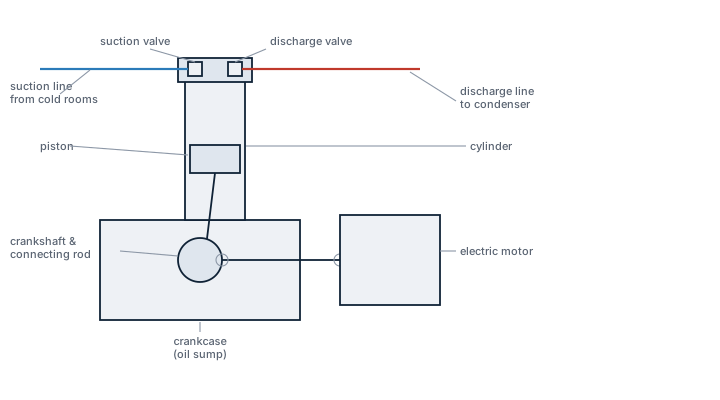
Provision cooling compressor, cross-section
Cross-section of a reciprocating provision cooling compressor: crankcase, crankshaft and connecting rod driving the piston in its cylinder, suction and discharge valves in the head, direct-coupled electric motor, and the suction and discharge refrigerant lines.

Main components

Compressor unit

Typically a reciprocating or, on larger installations, a semi-hermetic or open-drive compressor sized for the combined chill and freeze room heat load, drawing low-pressure refrigerant vapour from the evaporators and discharging it at condensing pressure.

Condenser

Rejects the heat picked up in the rooms plus the heat of compression to seawater or to air, condensing the refrigerant back to liquid before it goes to the receiver.

Receiver and expansion device

The receiver holds liquid refrigerant ready for use; a thermostatic or electronic expansion valve meters it into each evaporator coil, dropping its pressure so it can absorb heat in the room at a low evaporating temperature.

Room evaporators and controls

Each chill and freeze room has its own evaporator coil and thermostat, so a single compressor plant typically serves several rooms in sequence or in parallel through solenoid valves, each room independently held at its own setpoint.

Selection and sizing

Capacity is set by the combined heat load of every provision room served - chill rooms typically held around zero to plus four degrees Celsius, freeze rooms around minus eighteen to minus twenty degrees Celsius - plus a margin for door openings, product loading and ambient heat gain, not simply the room volume. Redundancy matters more here than raw capacity: most vessels carry at least two compressor units so that one machine can be serviced or can fail without losing refrigeration entirely, since there is no quick alternative once food starts to spoil. Refrigerant type is chosen against the vessel's flag and international phase-down schedules for high global-warming-potential refrigerants, which increasingly steers new installations toward lower-GWP alternatives.

Regulations and class

Refrigerant handling and leak prevention fall under the ship's compliance with the Montreal Protocol phase-out of ozone-depleting substances and, for newer refrigerants, applicable greenhouse gas regulations affecting the type and quantity of refrigerant carried. Class societies survey the plant periodically for pressure vessel and piping condition, safety valve testing, and confirmation that the refrigerant log records charge, top-ups and any recovery are kept current, since undocumented refrigerant loss is treated as a compliance issue, not just a maintenance one.

Typical faults

  • Refrigerant leak at a fitting or seal - caused by vibration fatigue or a degraded gasket; leads to falling capacity, rising room temperature, and a compliance record entry once detected.
  • Condenser fouling - caused by seawater scale or marine growth on a seawater-cooled condenser; leads to high discharge pressure and reduced cooling capacity.
  • Expansion valve hunting - caused by an incorrectly set or faulty thermostatic element; leads to unstable room temperature and compressor short-cycling.
  • Compressor short-cycling - caused by a low refrigerant charge or a faulty pressure control; leads to accelerated wear on the compressor motor and contacts.

What to look for in a supplier

  • Compressor and refrigerant type compatible with the vessel's flag state phase-down schedule, so the installation is not obsolete within a few years.
  • Spare parts availability for the expansion valves and solenoid valves specific to each room, which are the components most often replaced.
  • Documented capacity data against actual room volumes and setpoints, not a generic catalogue figure.
  • Support for refrigerant recovery and leak-testing equipment compatible with the charge on board.

Check the freeze room temperature log daily, not just when someone complains about the food - a slow refrigerant leak shows up as a gradual upward creep long before the compressor alarms, and by the time it alarms the product may already be compromised.

8000h
Service Interval
20 yr
Typical Lifetime

Typical Manufacturers

Bitzer Bock Carrier

3 manufacturers · 3 models

Bitzer Marine

1
Bitzer 4FES-3Y
4FES-3Y
8 kW cooling · 3.0 kW · Refrigerant R134a · semi-hermetic reciprocating compressor
Common Failures & Inspection Points
  • Evaporator icing
  • Thermostat drift
  • Compressor short-cycling
Service: Small semi-hermetic; defrost timer must be set correctly.
Spare Parts: Bitzer: Keep valve sets and piston rings on board. Lead time: 2–6 weeks. Oil filters and gasket sets as standard ship's stores.
Strengths
  • Compact footprint – fits in limited engine room spaces
  • Robust construction suitable for marine vibration and motion
  • Built‑in defrost timer simplifies operation when set correctly
  • Good efficiency for low to medium cooling loads
  • Relatively simple maintenance and oil change procedures
Weaknesses
  • Sensitive to evaporator icing if control logic is not tuned
  • Thermostat drift can lead to temperature excursions
  • Short‑cycling may occur under low load or improper charge
  • Limited capacity compared with larger screw compressors
  • Semi‑hermetic design requires periodic oil replacement
Typical Vessels: Crew Transfer VesselOffshore Supply ShipCoastal FerryPatrol BoatYacht with galley refrigeration
Decision Guide: Choose if: you need a compact, reliable provision‑cooling compressor for low to medium capacity on a vessel with limited engine‑room space and can manage the defrost timer settings. Avoid if: high cooling capacity is required, oil‑free operation is mandatory, or the installation cannot accommodate regular maintenance of semi‑hermetic units.
Use Cases: Commonly installed in crew mess freezers, galley refrigeration loops, medical stores coolers, and small cargo hold chillers on offshore support vessels and coastal ferries where space and weight are at a premium.

Bock

1
Bock HGX4/555-4S
HGX4/555-4S
12 kW cooling · 5.5 kW · Refrigerant R134a · Oil-free screw compressor
Common Failures & Inspection Points
  • Low refrigerant charge
  • Condenser fouling
  • Oil return issues
Service: Open-type; check belt tension if belt-driven condenser fan.
Spare Parts: Bock: Keep valve sets and piston rings on board. Lead time: 2–6 weeks. Oil filters and gasket sets as standard ship's stores.
Strengths
  • High efficiency and reliability due to oil-free operation
  • Compact design suitable for various vessel types
  • Easy maintenance with accessible components
Weaknesses
  • Potential issues with low refrigerant charge, condenser fouling, or oil return problems if not properly maintained
  • May require frequent belt tension checks for optimal performance
Typical Vessels: Cruise shipsFerriesOffshore supply vessels
Certifications: IMO D-2DNV GL Type Approval
Decision Guide: Choose if: You need a reliable and efficient provision cooling compressor for a medium-sized vessel. Avoid if: You require a high-capacity compressor or have limited space constraints.
Use Cases: Typically deployed on vessels with large provisions stores, such as cruise ships, ferries, or offshore supply vessels, where precise temperature control is essential to maintain food quality and safety.

Carrier Marine

1
06CC665
15 kW cooling · 7.5 kW · Refrigerant R134a · semi‑hermetic compressor
Common Failures & Inspection Points
  • Unloader failure
  • HP cutout
  • Suction pressure low
Service: Semi-hermetic; suitable for dual-temperature provision systems.
Spare Parts: Carrier: Keep valve sets and piston rings on board. Lead time: 2–6 weeks. Oil filters and gasket sets as standard ship's stores.
Strengths
  • Dual‑temperature capability in a single unit reduces space and installation cost.
  • Robust semi‑hermetic construction tolerates marine vibration and harsh environments.
  • Compatible with Carrier control panels and existing shipboard HVAC/refrigeration systems.
  • Proven track record on passenger vessels and offshore supply ships.
  • Relatively straightforward maintenance – head can be removed for service.
Weaknesses
  • Known failure modes include unloader valve issues, high‑pressure cutout, and low suction pressure, requiring vigilant monitoring.
  • Oil‑lubricated design necessitates regular oil analysis and replacement.
  • Heavier and bulkier than oil‑free screw alternatives, impacting weight‑critical installations.
  • May require dedicated ventilation space to dissipate heat from the semi‑hermetic housing.
Typical Vessels: Cruise shipFerryOffshore supply vesselContainer ship with crew accommodationProduct tanker
Decision Guide: Choose if you need a reliable dual‑temperature provision cooling solution that integrates with existing Carrier HVAC/refrigeration gear and can tolerate marine vibration. Avoid if oil‑free operation, minimal maintenance, or the smallest possible footprint are top priorities.
Use Cases: Commonly installed to supply chilled water for galley freezers and air‑conditioned fresh‑water systems on passenger vessels, as well as providing cooler water loops for crew accommodation HVAC on offshore support ships.