What to check on a Deck Air Compressor.
A deck air compressor supplies compressed air for pneumatic tools, general service blow-down, and sometimes control air to deck machinery, as distinct from the starting air compressor whose sole job is charging the main and auxiliary engine starting air receivers to a much higher pressure. Deck service air typically runs at 7 to 10 bar, well below the 25 to 30 bar range of starting air systems, and the duty is intermittent rather than the periodic high-pressure charging cycle a starting air compressor follows. Because the two systems serve different…
What defines a deck air compressor
A deck air compressor supplies compressed air for pneumatic tools, general service blow-down, and sometimes control air to deck machinery, as distinct from the starting air compressor whose sole job is charging the main and auxiliary engine starting air receivers to a much higher pressure. Deck service air typically runs at 7 to 10 bar, well below the 25 to 30 bar range of starting air systems, and the duty is intermittent rather than the periodic high-pressure charging cycle a starting air compressor follows. Because the two systems serve different pressures and different criticality, they are normally kept on separate compressors and separate receivers rather than sharing one machine reduced through a pressure regulator, though small vessels sometimes make that compromise.
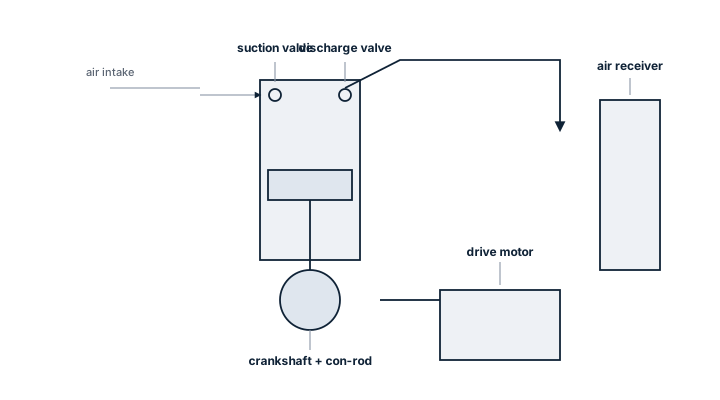
Main components
Compression stage
Reciprocating piston compressors are the traditional choice for this duty and pressure range; screw compressors are increasingly used where continuous or near-continuous service air demand justifies their smoother output and lower vibration.
Intercooler and aftercooler
On multi-stage reciprocating units, an intercooler between stages reduces the work of the second stage and controls discharge temperature; an aftercooler condenses moisture out of the air before it reaches the receiver.
Air receiver
A pressure vessel that smooths out the compressor's pulsed output and provides a reserve of air for a tool's peak demand without the compressor cycling constantly; fitted with a safety valve, drain, and pressure gauge.
Automatic control
A pressure switch or unloader that starts and stops the compressor, or unloads it to idle running, based on receiver pressure, so the compressor is not run continuously against a closed system.
Selection and sizing
- Simultaneous tool demand expected on deck -- grinders, chipping hammers, paint spray equipment -- added up rather than sized on the single largest tool alone.
- Discharge pressure required by the tools actually carried aboard, since running the whole system at a higher pressure than needed wastes power.
- Duty cycle: continuous service air demand favours a screw compressor, occasional demand favours a simpler reciprocating unit.
- Receiver size against the compressor's cycling frequency, balancing installed compressor capacity against how large a receiver the space allows.
- Moisture control needed for the trade -- humid tropical air loads the aftercooler and drain system harder than a cold-water trade.
Regulations and class
Deck service air compressors carry lighter class requirements than starting air compressors, since they are not classed as essential for propulsion. The air receiver, however, is a pressure vessel and is surveyed under the same pressure vessel rules as any other receiver aboard -- periodic internal or hydrostatic testing and a valid safety valve setting are checked at survey regardless of which air system the receiver belongs to. Where deck air is cross-connected to a control air or safety system, class reviews that arrangement for the same segregation reasons applied to instrumentation cabling.
Typical faults
| Fault | Cause | Consequence |
|---|---|---|
| Excessive moisture in the air line | Aftercooler fouled or drain valve blocked or not opened on schedule | Water in pneumatic tools and paint spray equipment, corrosion in the distribution piping |
| Compressor short-cycling | Receiver too small for the demand pattern, or a leak in the distribution system keeping pressure from holding | Excessive start-stop wear on the motor and compressor, shortened service life |
| Falling discharge pressure under load | Worn piston rings or valve plates on a reciprocating unit, or worn rotors on a screw unit | Tools starved of pressure at the point of use even though the compressor is running |
| Safety valve lifting prematurely | Valve set point drifted low, or receiver pressure switch failing to cut out the compressor at the correct point | Air loss and, if ignored, a sign the pressure control has failed rather than just the valve |
What to look for in a supplier
- Free air delivery rating, not just piston displacement, matched to actual simultaneous tool demand.
- Receiver sized and certified to the pressure vessel code applicable to the flag or class, with an accessible manway or plug for internal inspection.
- Spares availability for wear parts -- piston rings, valve plates, or screw element service kits -- specific to the model installed.
- Noise and vibration data if the compressor is located near accommodation, since deck compressors are often sited closer to living spaces than the main engine room machinery.
A compressor that keeps starting and stopping every few seconds is telling you about a leak in the distribution system or an undersized receiver, not about a fault in the compressor itself -- chasing the leak first is quicker than chasing the machine.