What to check on a Fire Detection System.
A conventional fire detection system wires detectors into zones and only tells the panel which zone has activated, leaving the crew to search every space on that zone or loop. An addressable system gives each detector and manual call point its own identity on a common data loop, so the panel reports the exact device, and therefore the exact space, that triggered. This matters most on larger vessels where a zone can cover several cabins or a whole deck of machinery spaces, and the minutes saved locating the actual fire…
What sets an addressable system apart from a conventional one
A conventional fire detection system wires detectors into zones and only tells the panel which zone has activated, leaving the crew to search every space on that zone or loop. An addressable system gives each detector and manual call point its own identity on a common data loop, so the panel reports the exact device, and therefore the exact space, that triggered. This matters most on larger vessels where a zone can cover several cabins or a whole deck of machinery spaces, and the minutes saved locating the actual fire can decide whether it is caught early or not.
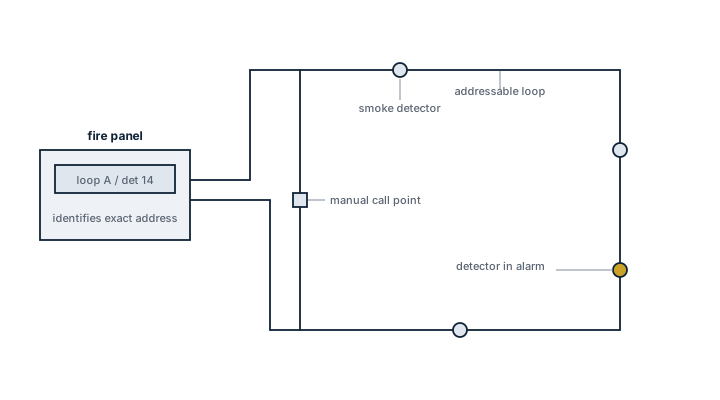
Main components
Detectors
Smoke (optical or ionisation), heat, and in machinery spaces flame or multi-sensor detectors are selected by space type: optical smoke detectors suit accommodation, heat detectors suit galleys and laundries where smoke detectors would false-trigger, and flame or multi-sensor types suit engine rooms with oil mist and high background temperature.
Manual call points
Break-glass call points are positioned along escape routes and at exits so crew can raise an alarm directly, independent of automatic detection.
Loop wiring and control panel
Detectors and call points connect on a two-wire addressable loop back to the control panel, which can usually survive a single open or short circuit on the loop without losing the whole line, a key resilience feature over simple zone wiring.
Panel and repeater displays
The main panel, typically on the bridge or in the fire control station, shows the exact device in alarm; repeater panels elsewhere on board mirror that information so the alarm is visible wherever it is needed.
Selection and sizing
Detector type and spacing follow the space being protected, not a single standard density applied everywhere on the ship.
- Detector type matched to the space (smoke, heat, flame, multi-sensor) to minimise false alarms while catching real ones early.
- Loop capacity and topology, since a single loop fault should not disable detection across multiple fire zones.
- Panel location and repeater coverage matching the ship's manning and watchkeeping arrangement.
- Integration with the ship's fire door release, ventilation shutdown and general alarm systems.
Regulations and class requirements
SOLAS Ch. II-2/7 sets out which spaces require fixed fire detection, the response time and coverage the system must achieve, and requires the system to be independently powered so it remains operational during a general power failure. Class rules for fire detection reference IMO performance standards, resolution A.800 and successors, and the FSS Code, for detector sensitivity and system architecture. Periodic survey includes functional testing of a sample of detectors, verification of panel battery backup, and confirmation that the detector layout still matches the as-fitted general arrangement after any accommodation modification.
Typical faults
| Fault | Cause | Consequence |
|---|---|---|
| False alarms from galley or laundry detectors | Smoke-type detector fitted where heat-type is needed | Crew desensitised to alarms, delayed response to a genuine fire |
| Detector contamination | Dust, oil mist or paint overspray coating the sensor chamber | Reduced sensitivity or failure to trigger |
| Loop fault | Chafed cable or a corroded connection at a detector base | Section of the loop isolated or reporting fault instead of alarm |
| Detector layout outdated | Cabin or space reconfiguration without updating the detection design | Coverage gap in a modified space |
What to look for in a supplier
- Type approval matching IMO performance standards and the flag/class combination of the vessel.
- Detector range covering all the space types on board, not just standard smoke detectors sold as a one-size solution.
- Loop architecture that isolates faults to a short section rather than disabling detection over a wide area.
- Local access to replacement detector heads, since these are consumable items with a finite service life recommended by the maker.
Repainting or refitting a space without notifying whoever maintains the fire detection drawings is how coverage gaps happen; the detector layout has to be treated as a living document, not a one-time installation record.