What to check on a Water Mist System (Hi-Fog).
A conventional sprinkler or deluge system knocks a fire down mainly by drenching the fuel surface with a large volume of water. A water mist system, commonly known by the Hi-Fog brand name used on many ships, does the opposite: it atomises water at pressures typically in the 70-140 bar range into droplets small enough to absorb heat rapidly, flash to steam near the flame and starve it of oxygen, while wetting far less of the surrounding structure. The result is comparable fire suppression performance with a small fraction of…
What sets a water mist system apart
A conventional sprinkler or deluge system knocks a fire down mainly by drenching the fuel surface with a large volume of water. A water mist system, commonly known by the Hi-Fog brand name used on many ships, does the opposite: it atomises water at pressures typically in the 70-140 bar range into droplets small enough to absorb heat rapidly, flash to steam near the flame and starve it of oxygen, while wetting far less of the surrounding structure. The result is comparable fire suppression performance with a small fraction of the water storage and pump capacity a low-pressure system would need — a real advantage on a ship where tank space, pipe weight and the risk of free surface effect from firefighting water all matter. Water mist is used in machinery spaces, accommodation, and increasingly in galleys and ro-ro cargo spaces, but it is not a substitute for fixed gas flooding in spaces where a fuel spray fire needs immediate total flooding.
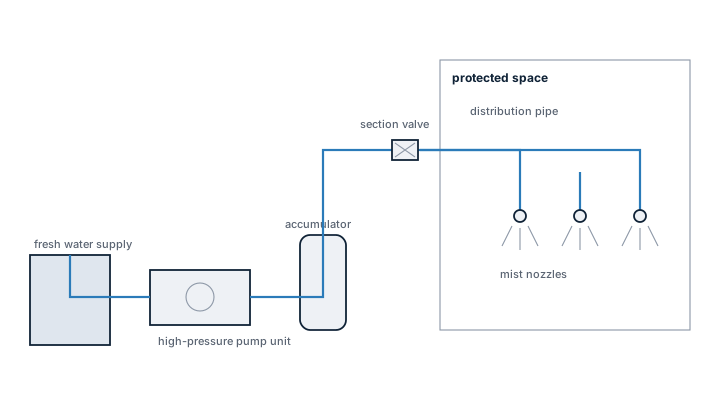
Main components
Pump unit
A high-pressure pump set, usually with duty and standby pumps, pressurises fresh water or seawater to the operating pressure the nozzles need to atomise properly.
Distribution piping and section valves
Small-bore stainless steel piping, rated for the system's high pressure, runs to zone section valves so a single protected space can be released without discharging the whole system.
Nozzles
Open or closed (heat-activated) nozzles, selected by protected space type, produce the atomised spray pattern the space's hazard class requires.
Detection and release
Heat or smoke detection triggers automatic release in unmanned spaces; manual release stations back this up wherever the system protects an occupied or periodically unmanned space.
Selection and sizing
- Hazard class of the protected space (machinery space, galley deep-fat fryer, accommodation cabin), which sets nozzle type and density
- Design duration of discharge the approval for that space type requires
- Number of zones needing simultaneous protection versus pump and tank capacity
- Fresh water versus seawater supply, affecting nozzle fouling and corrosion of fine bore piping
Regulations and class
SOLAS Chapter II-2 sets performance requirements for fixed fire-extinguishing systems by space type, and water mist systems used as an equivalent to a traditional sprinkler or CO2 system must carry approval testing to the relevant IMO fire test procedures for the specific application (machinery space, accommodation, or ro-ro deck). Class surveys check pump capacity, pressure at the remotest nozzle, and periodic function testing of section valves and detection.
Typical faults
| Fault | Cause | Consequence |
|---|---|---|
| Nozzle blockage | Fine bore nozzles clogged by scale or biological growth in stagnant seawater fill | Reduced or absent spray from affected nozzles in a real fire |
| Section valve fails to open | Corrosion or lack of periodic exercising | No water reaches the fire zone despite the pump running correctly |
| Pump fails to reach rated pressure | Worn high-pressure pump internals or air in the system | Poor atomisation, spray reverts closer to a coarse jet, reduced cooling effect |
| Undetected small leaks in fine bore piping | Vibration fatigue at pipe joints over time | Pressure loss at the far end of long runs when the system is called on |
What to look for in a supplier
- Approval certificates matching the exact space types the ship needs to protect, not a generic system approval
- Documented pressure at the hydraulically remotest nozzle, not only at the pump
- Materials suited to the water source actually used (fresh versus seawater) to limit nozzle fouling
- Spare nozzle and section valve availability, since fine bore components are not always interchangeable between makers
Flush and function-test seawater-fed sections regularly even when the system has never fired — stagnant seawater in fine bore piping fouls nozzles silently, and the first sign is often a dry nozzle during an actual fire.