What to check on a Open Path Gas Detector.
An open path (line-of-sight) gas detector projects an infrared beam from a transmitter to a receiver, sometimes tens or over a hundred metres apart, and measures how much of that beam is absorbed by combustible gas crossing the line. It reports a path-integrated reading in LEL-metres rather than a concentration at a single spot, which is the fundamental difference from a point detector or a catalytic bead sensor sitting at one location. Where a point detector can miss a leak that never reaches its inlet, an open path unit covers…
What makes this type
An open path (line-of-sight) gas detector projects an infrared beam from a transmitter to a receiver, sometimes tens or over a hundred metres apart, and measures how much of that beam is absorbed by combustible gas crossing the line. It reports a path-integrated reading in LEL-metres rather than a concentration at a single spot, which is the fundamental difference from a point detector or a catalytic bead sensor sitting at one location. Where a point detector can miss a leak that never reaches its inlet, an open path unit covers the whole line between transmitter and receiver, making it suited to large open areas such as offshore platform decks, LNG carrier cargo areas, and engine room roof spaces where a grid of point detectors would be impractical.
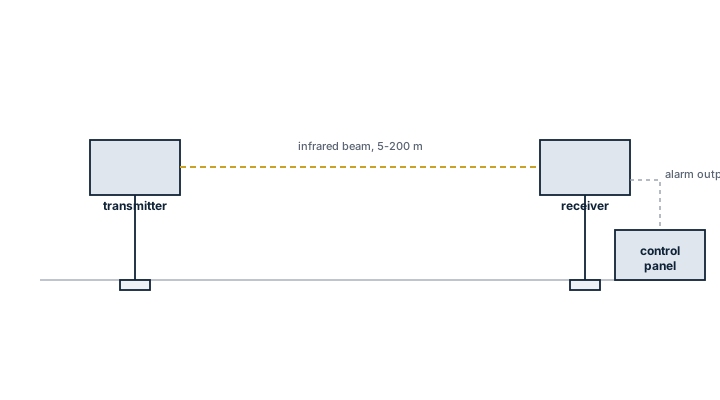
Main components
Transmitter
Houses the infrared source, usually a xenon flash lamp or tunable diode laser, pulsed at a fixed rate so the receiver can distinguish the signal from sunlight or reflections.
Receiver
Contains the optical filter and detector element tuned to the absorption band of the target gas (commonly around 3.3 micrometres for hydrocarbons), plus the electronics that convert absorption into a path-averaged concentration.
Alignment mounts
Adjustable brackets that keep transmitter and receiver in line despite vibration and thermal movement of the structure; misalignment is the single most common open path fault.
Controller / output stage
Converts the path reading into a 4-20 mA signal or digital bus output to the fire and gas system, and drives local alarm indication.
Selection / Sizing
- Path length: longer paths reduce the number of units needed but lower sensitivity to a small local leak diluted over distance.
- Target gas and absorption band: hydrocarbon (methane/general HC), or dedicated bands for specific gases.
- Beam obstruction risk: cranes, scaffolding, and cargo operations must not routinely cross the line.
- Housing rating: Ex d or Ex ia certification matching the hazardous area zone, plus a marine environmental rating for salt spray and vibration.
- Alarm thresholds set in LEL-metres, coordinated with the fire and gas system logic rather than a single point percentage.
Regulations / Class
Fixed gas detection in hazardous areas falls under SOLAS Ch. II-2 fire safety requirements and, on gas carriers, the IGC Code provisions for cargo area gas detection. Classification societies require the detector's hazardous area certificate to match the zone it is mounted in, and periodic functional testing is part of the survey regime for the fire and gas detection system as a whole. There is no dedicated open-path-specific class rule beyond what applies to fixed gas detection generally, but alignment and calibration checks are commonly written into the planned maintenance system because a misaligned unit can fail silently.
Typical faults
| Fault | Consequence |
|---|---|
| Beam misalignment from vibration or structural movement | Signal drops below the receiver threshold, unit goes to fault rather than alarm, and coverage of that line is lost until re-aligned |
| Optical window fouling by salt deposit, exhaust soot or paint overspray | Reduced signal strength causes false low readings or nuisance fault trips |
| Beam blocked by temporary staging, cargo, or a parked container | Complete loss of coverage on that path, often unnoticed until the next functional test |
| Xenon lamp degradation with age | Signal-to-noise ratio falls, increasing both missed detections and false alarms |
| Water ingress at cable glands | Intermittent signal loss or controller lockup, hard to reproduce during troubleshooting |
What to look for in a supplier
- Marine type approval (not just an industrial Ex certificate) covering vibration, humidity and temperature cycling to the relevant class society's rules.
- Documented cross-sensitivity data for the target gas versus common shipboard interferents such as water vapour and diesel exhaust.
- Local support for alignment tools and spare xenon lamps or laser modules, since a beam realignment after yard work is routine, not exceptional.
- Clear guidance on maximum practical path length for the gas and environment in question, not just the theoretical maximum range.
Log every open path unit's baseline signal strength at commissioning; a slow decline over months is the earliest warning of window fouling or lamp wear, long before the unit trips into fault.