OceanSphereEnginesPartsWorkServiceNetworkAdditiveFree accountLog inDEENPL
OceanSphereENGINES
Library Safety & LSA Gas Detection Fixed Gas Detection System
Gas Detection

Fixed Gas Detection System

A fixed gas detection system watches defined spaces around the clock and can trigger automatic interlocks, unlike a portable detector that only reports what it measures the moment someone carries it into a space and switches it on.

286models 9manufacturers
Models

Models in this type.

The 100 models with the most complete data of 286 in Fixed Gas Detection System. Every row links to full specifications, documents and service notes.

DrägerDrager CalGas H2S/SO2 Dual-C DrägerDrager CalGas LEL/O2/CO/H2S Quad-C DrägerDrager CalGas O2/CO Dual-C DrägerDrager CalGas Span Gas Kit-C DrägerDrager CalGas Zero Air Kit-C DrägerDrager Fixed System Accommodation-C DrägerDrager Fixed System Battery Room-C DrägerDrager Fixed System Cargo Hold-C DrägerDrager Fixed System Engine Room-C DrägerDrager Fixed System Galley-C DrägerDrager Fixed System Paint Locker-C DrägerDrager Fixed System Pump Room-C DrägerDrager Fixed System Void Space-C DrägerDrager Polytron 5000 CO DrägerDrager Polytron 5000 Cl2 DrägerDrager Polytron 5000 H2S DrägerDrager Polytron 5000 HCN DrägerDrager Polytron 5000 LEL DrägerDrager Polytron 5000 NH3 DrägerDrager Polytron 5000 NO2 DrägerDrager Polytron 5000 O2 DrägerDrager Polytron 5000 SO2 DrägerDrager Polytron 7000 CO DrägerDrager Polytron 7000 Cl2 DrägerDrager Polytron 7000 H2S DrägerDrager Polytron 7000 HCN DrägerDrager Polytron 7000 LEL DrägerDrager Polytron 7000 NH3 DrägerDrager Polytron 7000 NO2 DrägerDrager Polytron 7000 O2 DrägerDrager Polytron 7000 SO2 DrägerDrager Polytron 8000 CO DrägerDrager Polytron 8000 Cl2 DrägerDrager Polytron 8000 H2S DrägerDrager Polytron 8000 HCN DrägerDrager Polytron 8000 LEL DrägerDrager Polytron 8000 NH3 DrägerDrager Polytron 8000 NO2 DrägerDrager Polytron 8000 O2 DrägerDrager Polytron 8000 SO2 DrägerPolytron CH4/LEL-B DrägerPolytron CO-B DrägerPolytron COCl2-B DrägerPolytron Cl2-B DrägerPolytron ETO-B DrägerPolytron H2-B DrägerPolytron H2S-B DrägerPolytron HCN-B DrägerPolytron HF-B DrägerPolytron NH3-B DrägerPolytron NO2-B DrägerPolytron O2-B DrägerPolytron PH3-B DrägerPolytron SO2-B DrägerPolytron VOC-B DrägerRegard 7000 Riken KeikiGD-70D CH4/LEL-B Riken KeikiGD-70D CO-B Riken KeikiGD-70D COCl2-B Riken KeikiGD-70D Cl2-B Riken KeikiGD-70D ETO-B Riken KeikiGD-70D H2-B Riken KeikiGD-70D H2S-B Riken KeikiGD-70D HCN-B Riken KeikiGD-70D HF-B Riken KeikiGD-70D NH3-B Riken KeikiGD-70D NO2-B Riken KeikiGD-70D O2-B Riken KeikiGD-70D PH3-B Riken KeikiGD-70D SO2-B Riken KeikiGD-70D VOC-B Riken KeikiRM-5000 Riken KeikiRM-6000 Riken KeikiRiken EC-600 CO Riken KeikiRiken EC-600 H2S Riken KeikiRiken EC-600 LEL Riken KeikiRiken EC-600 NH3 Riken KeikiRiken EC-600 O2 Riken KeikiRiken GD-70D CO Riken KeikiRiken GD-70D H2S Riken KeikiRiken GD-70D LEL Riken KeikiRiken GD-70D NH3 Riken KeikiRiken GD-70D O2 Riken KeikiRiken GD-70D+ CO Riken KeikiRiken GD-70D+ H2S Riken KeikiRiken GD-70D+ LEL Riken KeikiRiken GD-70D+ NH3 Riken KeikiRiken GD-70D+ O2 Riken KeikiCalGas H2S/SO2 Dual-C Riken KeikiCalGas LEL/O2/CO/H2S Quad-C Riken KeikiCalGas O2/CO Dual-C Riken KeikiCalGas Span Gas Kit-C Riken KeikiCalGas Zero Air Kit-C Riken KeikiFixed System Accommodation-C Riken KeikiFixed System Battery Room-C Riken KeikiFixed System Cargo Hold-C Riken KeikiFixed System Engine Room-C Riken KeikiFixed System Galley-C Riken KeikiFixed System Paint Locker-C Riken KeikiFixed System Pump Room-C
By manufacturer

Manufacturers.

All 9 manufacturers with models of Fixed Gas Detection System. Every name opens a search across the full library.

Related types

Also in Gas Detection.

The other equipment types in this category.

Fixed Gas DetectorGas Detection Control PanelOpen Path Gas DetectorPortable Multi-Gas DetectorSingle Gas Detector
Knowledge

What to check on a Fixed Gas Detection System.

A fixed gas detection system monitors defined spaces continuously and automatically, without anyone carrying an instrument into the space first. Sensor heads are hard-wired (or increasingly wireless) to a central control panel that raises an alarm the moment a gas concentration crosses a set threshold, whereas a portable detector only reports what it measures at the moment someone switches it on and carries it in. The two are complementary rather than interchangeable: fixed detection covers a space around the clock and can trigger interlocks such as shutting a ventilation fan…

What sets a fixed system apart from portable gas detection

A fixed gas detection system monitors defined spaces continuously and automatically, without anyone carrying an instrument into the space first. Sensor heads are hard-wired (or increasingly wireless) to a central control panel that raises an alarm the moment a gas concentration crosses a set threshold, whereas a portable detector only reports what it measures at the moment someone switches it on and carries it in. The two are complementary rather than interchangeable: fixed detection covers a space around the clock and can trigger interlocks such as shutting a ventilation fan or closing a fuel valve, while portable detection is what confirms a space is actually safe before entry, sensor by sensor, at head height and floor level.
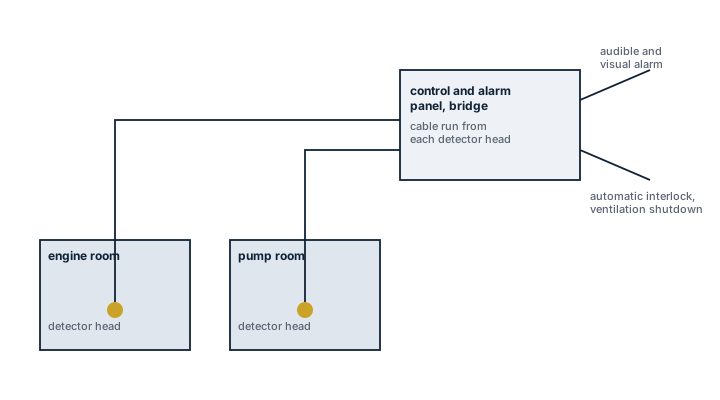
Fixed gas detection system, arrangement
Arrangement of a fixed gas detection system with detector heads in monitored spaces wired back to a bridge control and alarm panel that can trigger automatic interlocks.

Main components

Sensor heads

Catalytic bead sensors for flammable gas, electrochemical cells for toxic gas such as H2S or CO, and infrared point or open-path sensors increasingly used for flammable gas where catalytic sensors would be poisoned by silicones or lead compounds.

Control panel

Receives signals from every sensor loop, displays gas concentration per point, and drives the visual and audible alarm outputs at pre-alarm and high-alarm thresholds.

Cabling and junction boxes

Intrinsically safe wiring runs through hazardous areas, terminated in explosion-protected junction boxes, since the wiring itself must not become an ignition source.

Interlock outputs

Relay contacts wired to ventilation fans, fuel valves, or electrical equipment shutdown, so a confirmed high-gas alarm can automatically remove an ignition source or stop the leak's source.

Selection and sizing

  • Gas types actually present in the space — flammable hydrocarbon vapour in a pump room is a different sensor technology from H2S in a sewage tank or CO2 in a fixed firefighting system space.
  • Number and location of sensor points, following the gas dispersion pattern of the specific space (heavier-than-air gas collects low, lighter-than-air gas collects at deckhead) rather than an arbitrary grid.
  • Response time and sensor drift characteristics, since catalytic sensors typically need more frequent calibration than electrochemical or infrared types.
  • Certification for the hazardous area zone the sensor sits in (Zone 0, 1, or 2), matched against the ship's hazardous area plan.

Regulations and class

SOLAS Chapter II-2 requires fixed gas detection in specific spaces on certain ship types, most notably in cargo areas of gas carriers and tankers and in enclosed spaces where flammable or toxic gas can accumulate. The IGC Code and IGF Code set out detailed detection requirements for gas carriers and gas-fuelled ships respectively, including sensor placement, alarm set points, and required interlocks with ventilation and fuel systems. Class surveys check calibration records, functional testing of the alarm and interlock chain, and physical condition of sensor heads at each periodic survey.

Typical faults

FaultCauseConsequence
Sensor reads zero permanentlyCatalytic bead poisoning from silicone vapour, common near paint or sealant useSpace appears safe on the panel while actually being unmonitored — the most dangerous failure mode of this equipment
Frequent nuisance alarmsSensor drift beyond calibration tolerance, or condensation on an electrochemical cellCrew begins to distrust and eventually ignore alarms, defeating the purpose of the system
Loss of signal from one zoneCable damage or a failed junction box seal allowing moisture ingressLoop fault alarm, and that zone effectively has no fixed detection until repaired
Interlock fails to activate on alarmRelay contact fault or a bypass switch left in the test position after maintenanceVentilation does not stop or fuel valve does not close automatically, leaving manual response as the only safeguard

What to look for in a supplier

  • Sensor technology matched to the actual gas hazard, not a generic flammable-gas-only package sold for every space.
  • Hazardous area certification documentation for every sensor and junction box in the loop.
  • Calibration gas availability and interval, since catalytic sensors in particular need routine bump testing and calibration to stay trustworthy.
  • Panel compatibility with the ship's existing alarm and monitoring system, to avoid a standalone panel nobody on watch actually looks at.

A gas detector reading zero is not proof of a safe space until someone has confirmed the sensor itself is still alive — bump-test fixed sensors on the calibration schedule, not only when something already seems wrong.

Search by manufacturer AFRISOWISKASwagelokAlfa Laval S.p.A.MAN Energy SolutionsWärtsiläEndress+HauserABB MarineAlfa LavalMacGregorNovenco MarineCarrier MarineSiemens MarineHeinen & HopmanDaikin Marine
Would you like to know more?

One request. A person answers within 24 hours on working days.

Tell us the manufacturer, the model and what you need — a part, a service call, a second opinion. Our desk asks the right suppliers from a network of over 114,000 companies and comes back with a quote or a sourcing plan, not a search page.

Frequently asked

Three things people ask first.

Is Fixed Gas Detection System data free?

Yes. Every model page, every guide and every datasheet for this type is readable without an account. An account adds saved searches and requests, nothing is taken away.

My model is missing — what now?

Send us the nameplate. We identify it by hand, add it to the library, and if you need a part or a service, the request is already on our desk.

Can you source a Fixed Gas Detection System part?

Yes. Tell us the manufacturer, the model and what you need — our desk asks the right suppliers from a network of over 114,000 companies and comes back with a quote or a sourcing plan.