Hoistable Car Deck
A hoistable car deck is a movable intermediate deck within a single hold that raises or lowers on hydraulic lifts to trade cargo height for cargo density, letting the same hold carry two tiers of cars one voyage and a single tier of high-and-heavy trailers the next.
What to check on a Hoistable Car Deck.
4 models from ALMAC Marine in Hoistable Car Deck. Below: the full model list.
What sets a hoistable car deck apart
Fixed tween decks split a hold into permanent tiers; a hoistable car deck instead hangs from lifting points or stands on hydraulic pillars that can move the deck panel up, down or fold it flush against the deckhead. This turns clear height into a variable the cargo planner controls voyage by voyage - lower the deck for two rows of passenger cars, raise it clear of the tank top for high-and-heavy cargo, or stow it against the deckhead when the hold is needed for a single tall consignment such as yachts or construction machinery.
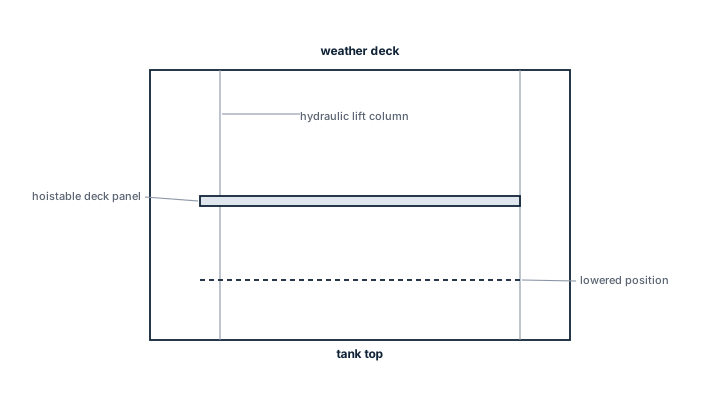
Legend
- weather deck
- hydraulic lift column
- hoistable deck panel
- lowered position
- tank top
Main components
Deck panels
Steel or aluminium panels, usually built in sections that pin together across the hold width, rated for the axle loads of the vehicle mix the ship is designed to carry.
Lifting mechanism
Either wire-rope hoists running on chain blocks or built-in hydraulic cylinders at each corner, synchronised so the panel travels level. Cylinder-type systems are more common on newer purpose-built car carriers because they need no separate chain store.
Read the full guide
Locking pins and stanchions
Once positioned, the deck is pinned into fixed sockets in the ship's structure at set height increments; the hydraulics only move the deck, they do not carry the working load once it is loaded and locked.
Hydraulic power pack
A dedicated pump station, often shared between several decks in the same hold, with pressure relief and load-holding valves so a hose failure cannot let a loaded deck fall.
Selection and sizing
| Parameter | Relevance |
|---|---|
| Uniform load rating (t/m2) | Sets whether the deck can take passenger cars only or also light trucks and heavy cargo |
| Number of height positions | More positions give finer control over clear height versus tier count |
| Lifting speed and synchronisation tolerance | Slow or uneven travel extends port time and risks panel jamming |
| Panel span and support spacing | Longer unsupported spans need thicker or stiffened panels, adding weight |
Regulations and class
Hoistable decks are assessed as lifting appliances as well as cargo structure: class rules require the lifting mechanism, wires or hydraulic cylinders and locking pins to be proof-tested and periodically surveyed, similar to other shipboard lifting gear, in addition to the normal structural fatigue assessment of the deck panels themselves. SOLAS Chapter II-1 requirements on RoRo space subdivision and damage stability apply to the hold as a whole and constrain how much load the deck may carry in each position without affecting the vessel's stability calculations.
Typical faults
- Uneven cylinder synchronisation - one corner lags, racking the panel and jamming it against the guide rails; usually traced to a worn synchronising valve or air in one hydraulic line.
- Locking pin wear - elongated pin holes let the deck settle slightly under load, transferring dynamic shock into the hydraulics instead of the fixed structure.
- Corrosion at panel hinges - sections that fold or hinge collect salt water in the joint and seize if not greased on a set schedule.
- Hydraulic seal failure - a slow cylinder drift under load, discovered only when the deck is found lower than its locked position at the next use.
What to look for in a supplier
- Proof-load and survey certificates for the lifting mechanism, not just a structural drawing of the panel
- Clear load-holding valve design so a hydraulic hose failure cannot drop a loaded deck
- Spare panel sections and pins held to the original tolerances, since mismatched sections bind on the guide rails
- Documented maintenance intervals for synchronisation calibration
Log every height position change with load and date - a deck that has spent years mostly in one position and is suddenly run through its full range for an unusual cargo mix is exactly when synchronisation and locking pin problems surface.
Models in this type.
The best-documented model of each manufacturer first, then the next — 4 of 4 models in Hoistable Car Deck. Every row links to full specifications, documents and service notes.
Manufacturers.
All 3 manufacturers with models of Hoistable Car Deck. Names with a manufacturer page open it; the others open a search across the full library.
All manufacturers in the libraryAlso in RoRo Equipment.
The other equipment types in this category.
Write to us about this model — the answer comes by e-mail.
Name the make and the model and what the job is: a spare, a service call, a second opinion on a data sheet. We answer by e-mail.
No details at hand? A photo of the rating plate or the part is enough — simply attach it to the request.
Questions that come up with this equipment.
Is Hoistable Car Deck data free?
Yes. Every model page, every guide and every datasheet for this type is readable without an account. An account adds saved searches and requests, nothing is taken away.
My model is missing — what now?
Send us the nameplate. We identify it by hand, add it to the library, and if you need a part or a service, the request is already on our desk.
Can you source a Hoistable Car Deck part?
Yes. Tell us the manufacturer, the model and what you need — a person reads every request and replies by e-mail.