Life Raft (Inflatable, SOLAS)
A SOLAS inflatable life raft is a self-contained survival craft stowed in a rigid canister or valise, designed to inflate automatically or on release and support a fixed number of survivors until rescue. Its safety depends entirely on service intervals being kept, not on the raft's apparent condition.
What to check on a Life Raft (Inflatable, SOLAS).
10 models from VIKING Life-Saving in Life Raft (Inflatable, SOLAS). Below: the full model list.
What sets the inflatable life raft apart
Unlike a rigid lifeboat, an inflatable life raft carries no engine and no steering; it is a compact, stowed survival platform that only becomes usable at the moment of inflation, either by manual painter pull, automatic hydrostatic release, or davit launch depending on the installation. Its entire safety case rests on components the crew cannot inspect visually once the canister is sealed, which is why the service regime exists in the first place.
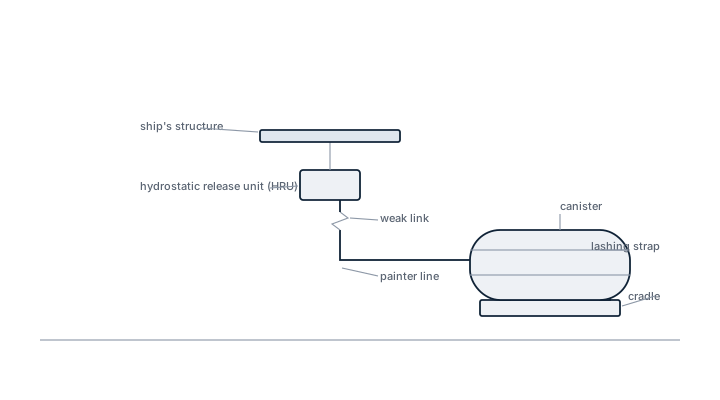
Legend
- ship's structure
- hydrostatic release unit (HRU)
- weak link
- canister
- painter line
- lashing strap
- cradle
Main components
Container
A rigid fibreglass canister for deck-stowed rafts, or a soft valise for rafts stowed in a purpose-built cradle, protecting the folded raft from weather and UV.
Inflation system
A CO2 or CO2/nitrogen gas cylinder connected through an inflation valve, triggered by pulling the painter line, which fills the buoyancy tubes and erects the canopy in well under a minute.
Read the full guide
Painter line and hydrostatic release unit (HRU)
The painter connects the raft to the ship and triggers inflation; the HRU releases the raft automatically if the ship sinks before the raft can be launched manually, a critical function with its own separate expiry date.
Canopy, sea anchor and equipment pack
The canopy protects survivors from exposure; the sea anchor limits drift; the SOLAS A or B equipment pack carries rations, water, flares, first aid and signalling equipment scaled to the raft's capacity.
Selection and sizing
Capacity is chosen to match or exceed the vessel's maximum complement, in whole-raft increments since a raft cannot be partially rated. Davit-launched rafts allow controlled boarding from deck height; throw-over rafts are simpler but require survivors to enter the water or board from a lower freeboard. Equipment pack type (A for unrestricted service, B for near-coastal) is set by the vessel's trading area, not by preference.
Regulations and class requirements
SOLAS Chapter III and the LSA Code set construction, capacity and equipment standards. Rafts require annual service at a manufacturer-approved shore station, where the canister is opened, the raft inflated, checked and repacked. The HRU has its own fixed service life, commonly two years, after which it must be replaced regardless of apparent condition, and periodic hydrostatic pressure testing of the raft fabric itself is required on a longer cycle, typically around five years or per manufacturer schedule.
Typical faults
- Expired hydrostatic release unit, which either fails to release the raft in an emergency or, worse, releases it prematurely in heavy weather.
- Canister corrosion or cracking allowing water ingress, which can damage the folded raft fabric or the inflation mechanism unnoticed between services.
- Painter line chafe or incorrect securing at the weak link, risking the raft being lost before boarding or dragged under with a sinking ship.
- CO2 cylinder pressure loss from a slow valve leak, discovered only at the annual service when the raft under-inflates.
- Missed service intervals, which invalidate the raft's certification even if nothing is physically wrong with it.
What to look for in a supplier
- Service performed only at a station approved by the raft's original manufacturer, not a generic life-saving equipment shop.
- Correct SOLAS pack type supplied for the vessel's actual trading area.
- Traceable service records and replacement part certificates retained for the survey file.
- Stock availability of HRUs and CO2 cylinders matched to the exact raft model, since substitutes are not always compatible.
A raft's canister looking clean tells you nothing about the HRU date stamped inside; check the expiry tag before assuming the raft is in date.
Models in this type.
The best-documented model of each manufacturer first, then the next — 10 of 10 models in Life Raft (Inflatable, SOLAS). Every row links to full specifications, documents and service notes.
Manufacturers.
All 11 manufacturers with models of Life Raft (Inflatable, SOLAS). Names with a manufacturer page open it; the others open a search across the full library.
All manufacturers in the libraryAlso in Lifesaving Appliances (LSA).
The other equipment types in this category.
Write to us about this model — the answer comes by e-mail.
Name the make and the model and what the job is: a spare, a service call, a second opinion on a data sheet. We answer by e-mail.
No details at hand? A photo of the rating plate or the part is enough — simply attach it to the request.
Questions that come up with this equipment.
Is Life Raft (Inflatable, SOLAS) data free?
Yes. Every model page, every guide and every datasheet for this type is readable without an account. An account adds saved searches and requests, nothing is taken away.
My model is missing — what now?
Send us the nameplate. We identify it by hand, add it to the library, and if you need a part or a service, the request is already on our desk.
Can you source a Life Raft (Inflatable, SOLAS) part?
Yes. Tell us the manufacturer, the model and what you need — a person reads every request and replies by e-mail.