Autopilot System
An autopilot drives the steering gear from a heading or track error signal supplied by the gyrocompass, and on track control systems by the ECDIS route, holding a ship on course without a helmsman; it does not replace the lookout duty required whenever collision risk exists.
What to check on an Autopilot System.
32 models from Sperry Marine in Autopilot System. Below: the full model list.
What sets an autopilot apart
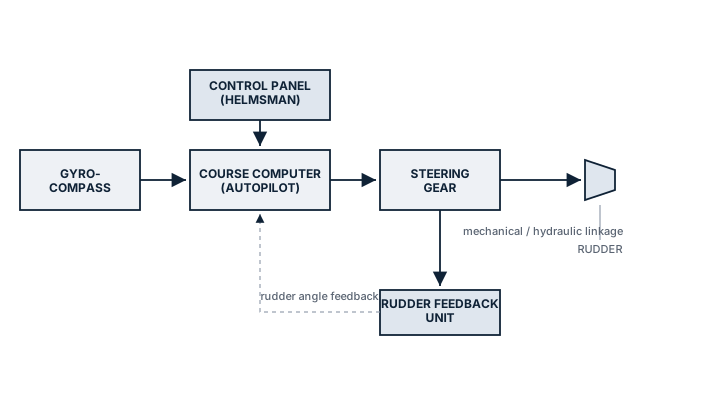
An autopilot is a closed-loop control system: it compares the ship's actual heading against a set heading, or the ship's position against a planned track on a track control system, and sends a correcting order to the steering gear. This is different from manual steering, where a helmsman applies rudder directly, and from a simple gyro repeater, which only displays heading without acting on it. A basic heading autopilot corrects drift and yaw; a track control system additionally corrects cross-track error against a route loaded from the ECDIS.
Main components
Control unit and gain settings
The control unit compares heading error and rate of turn against operator-set gain, counter-rudder and weather adjustments. Poorly tuned gain either lets the ship wander in a seaway or hunts constantly, both of which waste rudder movement and fuel.
Sensors
Heading comes from the gyrocompass, rate of turn from a dedicated sensor or derived from heading change, and on track control systems, position from the GNSS receiver feeding the ECDIS. A degraded or failed gyro is the single most common cause of an autopilot fault, since the system has no independent way to know it is being fed bad heading data.
Read the full guide
Interface to the steering gear
Correcting signals pass to the steering gear's follow-up or non-follow-up control circuit, ultimately moving the same rudder actuator used in manual and emergency steering.
Selection and sizing
Selection depends on the vessel's steering gear interface, whether track control is required for the trade (needed for some restricted or ECA passage planning), redundancy expected by the bridge procedures, and integration with the existing gyrocompass and ECDIS suppliers, since cross-manufacturer integration is not always straightforward.
Regulations and class requirements
SOLAS Chapter V sets carriage and performance requirements for heading and track control systems, including a requirement that steering can be reverted to manual control within a defined time. Track control systems used to satisfy watchkeeping arrangements must meet IMO performance standards for automatic steering, and the officer of the watch remains responsible for monitoring the vessel's progress and lookout at all times regardless of autopilot mode, a duty set out under the STCW Code.
Typical faults
- Gyrocompass drift feeding false heading — ship steers a course that is steadily off the intended track without an alarm
- Gain set too aggressive for sea state — constant rudder hunting increases wear on the steering gear and fuel burn
- Loss of GNSS signal on a track control system — reversion to heading mode or an alarm, depending on the system's fallback logic
- Sticking changeover switch between manual and auto — delay reverting to manual steering when needed quickly
- Software or interface fault after a gyrocompass or ECDIS upgrade — track control data not accepted or misread
What to look for in a supplier
- Confirmed interface compatibility with the vessel's existing gyrocompass, GNSS and ECDIS
- Type approval covering both heading control and, if required, track control performance standards
- Clear changeover procedure and alarm behaviour on sensor loss
- Training or documentation for gain tuning appropriate to the vessel's typical sea states
- Service support reachable for software updates tied to chart or ECDIS system changes
Re-check gain settings after any change in loading condition or draft, not just after rough weather; a lightly laden ship with a shallow draft can hunt on settings that were fine fully loaded.
Models in this type.
The best-documented model of each manufacturer first, then the next — 32 of 32 models in Autopilot System. Every row links to full specifications, documents and service notes.
Manufacturers.
All 28 manufacturers with models of Autopilot System. Names with a manufacturer page open it; the others open a search across the full library.
All manufacturersAlso in Autopilot & Bridge Systems.
The other equipment types in this category.
One request. A person reads it and replies by e-mail.
Tell us the manufacturer, the model and what you need — a part, a service call, a second opinion. A person reads every request and replies by e-mail.
No details at hand? A photo of the rating plate or the part is enough — simply attach it to the request.
Three things people ask first.
Is Autopilot System data free?
Yes. Every model page, every guide and every datasheet for this type is readable without an account. An account adds saved searches and requests, nothing is taken away.
My model is missing — what now?
Send us the nameplate. We identify it by hand, add it to the library, and if you need a part or a service, the request is already on our desk.
Can you source a Autopilot System part?
Yes. Tell us the manufacturer, the model and what you need — a person reads every request and replies by e-mail.