"> BNWAS (Bridge Navigational Watch Alarm) - Equipment Database

BNWAS (Bridge Navigational Watch Alarm)

critical IMO Required 4 models total

BNWAS escalates through dormant, bridge, cabin and, if needed, backup officer alarm stages whenever no watchkeeping activity is detected within a set interval, and has been mandatory on most SOLAS ships since 2011.

Read more — BNWAS (Bridge Navigational Watch Alarm) explained

What sets BNWAS apart

A Bridge Navigational Watch Alarm System does not monitor the ship's course or track; it monitors the presence of an alert human on the bridge. It works from an assumption that a watchkeeper interacts with bridge controls, resets buttons or motion sensors on a regular basis, and treats a long enough silence as a sign the officer of the watch may be incapacitated, asleep, or has left the bridge. That distinguishes it from an autopilot off-course alarm or a track control alarm, which detect a navigational deviation rather than the absence of the watchkeeper who would normally have corrected it.
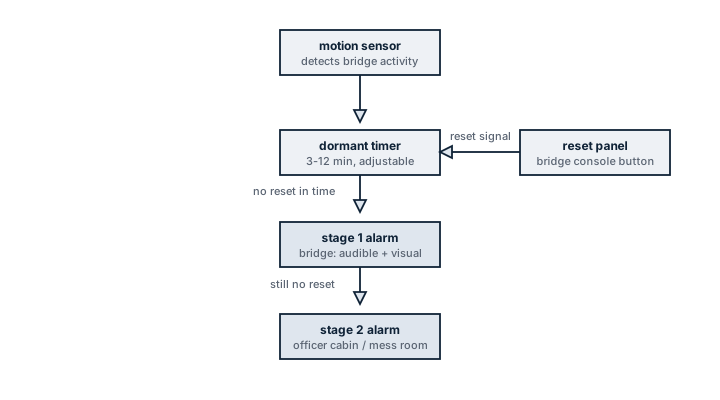
BNWAS alarm escalation
Flow diagram of a bridge navigational watch alarm system: motion sensor feeds a dormant timer, escalating to a stage one bridge alarm and a stage two backup officer alarm if the reset panel is not pressed in time.

Main components

Motion or activity sensors

Passive infrared sensors, or reset buttons distributed around the bridge, that register watchkeeper presence and activity.

Dormant period timer

A configurable interval, commonly adjustable between around 3 and 12 minutes, after which the system moves from dormant to first-stage alarm if no activity has been registered.

First and second stage alarm units

Audible and visual alarms on the bridge itself, followed if unacknowledged by alarms extended to the master's or backup officer's cabin and other crew locations defined in the ship's procedures.

Central control unit

Manages the escalation logic, interfaces with the ship's alarm system, and typically logs alarm events for review.

Selection and configuration

Selection is less about competing designs and more about correct configuration: dormant period length, which sensors count as valid activity, and the escalation chain of cabins and locations alerted at each stage must all be set to match the ship's actual watchkeeping arrangements and manning. A system configured with too short a dormant period generates nuisance alarms that crews learn to silence reflexively, which defeats the entire purpose.

Regulations and class

IMO adopted BNWAS as mandatory under SOLAS Chapter V, Regulation 19, with a phased implementation completed by 2011 across new and, on a schedule, existing ships above defined size thresholds. The regulation sets the minimum functional requirements — dormant period range, escalation stages, and backup alerting — while allowing flag states and class societies to specify installation and testing detail through type approval and survey.

Typical faults

  • Dormant period set too long — undermines the safety intent, since a watchkeeper could be incapacitated for an extended period before any alarm triggers.
  • Reset button used reflexively without genuine watchkeeping — an officer can silence the system out of habit while not actually maintaining a proper lookout, a training and procedure issue rather than an equipment fault.
  • Escalation chain not tested to actual cabins — the second-stage alarm is wired to a cabin no longer occupied by the backup officer after a crew change, leaving no effective backup.
  • Motion sensor blocked or miscounted — a sensor obstructed by equipment or paperwork stops registering activity, causing nuisance first-stage alarms even with an alert watch present.

What to look for in a supplier

  • Type approval confirming compliance with the applicable performance standard for BNWAS.
  • Flexible sensor and reset button placement options matching the specific bridge layout.
  • Straightforward reconfiguration of dormant period and escalation chain without a service engineer visit for routine crew changes.
  • Alarm logging that supports audit and, where relevant, incident investigation.

Review the escalation chain contact list at every crew change, not just at the annual survey — a BNWAS alarm routed to an empty cabin gives a false sense of backup coverage.

5 yr
Class Survey
15 yr
Typical Lifetime

Typical Manufacturers

Consilium JRC Netwave

2 manufacturers · 4 models

Kongsberg

3
K-Bridge BNWAS
Heading/Track Control per IMO · Ship Steering Control · Integrated bridge watch alarm system
Common Failures & Inspection Points
  • Komponenten-Verschleiß durch Betriebsstunden und Umgebungsbedingungen
  • Korrosion durch Seewasser-/Salzluft-Exposition
  • Elektronik-/Steuerungsausfall durch Feuchtigkeit oder Vibration
  • Wartungsintervall-Überschreitung verursacht vorzeitigen Ausfall
Service: Wartung per Hersteller-Handbuch und Klassifikationsgesellschafts-Anforderungen. Jährliche Inspektion bei Class Survey. Ersatzteile per Herstellerangabe bevorraten.
Spare Parts: Ersatzteile über Kongsberg Maritime AS oder zugelassene Vertriebspartner. Lead time: 2-6 Wochen.
Strengths
  • Seamless integration with Kongsberg's K-Bridge navigation suite
  • Highly configurable alarm intervals and response actions
  • Built‑in self‑test and redundancy for increased reliability
  • User‑friendly graphical interface on existing bridge displays
  • Meets IMO SOLAS watch‑keeping regulations out of the box
Weaknesses
  • Higher upfront cost compared with standalone BNWAS units
  • Requires K-Bridge hardware/software environment, limiting retrofit flexibility
  • Specialized training needed for configuration and troubleshooting
  • Limited compatibility with non‑Kongsberg bridge equipment
  • Complexity of settings may lead to misconfiguration if not properly managed
Typical Vessels: Container shipBulk carrierTankerCruise passenger vesselOffshore support vessel
Certifications: DNV
Decision Guide: Choose if: you already operate a K‑Bridge system or plan a newbuild with integrated bridge electronics, need full compliance with IMO watch‑keeping rules, and value advanced configurability and redundancy. Avoid if: budget constraints preclude the higher cost, your vessel uses a different bridge suite, or you only require a basic standalone BNWAS.
Use Cases: Typically installed on modern merchant vessels and passenger ships during construction or major retrofits to provide continuous watch‑keeping monitoring, remote alarm logging, and integration with other bridge sensors such as radar and autopilot. It is also used in offshore platforms where bridge crew safety is critical.
Kongsberg Maritime AS K-Bridge BNWAS MK2
K-Bridge BNWAS MK2
Heading/Track Control per IMO · Ship Steering Control · Bridge Navigational Watch Alarm System
Common Failures & Inspection Points
  • Komponenten-Verschleiß durch Betriebsstunden und Umgebungsbedingungen
  • Korrosion durch Seewasser-/Salzluft-Exposition
  • Elektronik-/Steuerungsausfall durch Feuchtigkeit oder Vibration
  • Wartungsintervall-Überschreitung verursacht vorzeitigen Ausfall
Service: Wartung per Hersteller-Handbuch und Klassifikationsgesellschafts-Anforderungen. Jährliche Inspektion bei Class Survey. Ersatzteile per Herstellerangabe bevorraten.
Spare Parts: Ersatzteile über Kongsberg Maritime AS oder zugelassene Vertriebspartner. Lead time: 2-6 Wochen.
Strengths
  • Fully integrated with Kongsberg K‑Bridge suite for seamless data exchange with autopilot, radar and ECDIS
  • Automatic multi‑level escalation (visual, audible, remote) reduces risk of unattended bridge
  • Robust marine‑grade hardware designed for vibration, moisture and salt‑air environments
  • Self‑test diagnostics and configurable response times simplify commissioning and maintenance
  • Meets IMO SOLAS BNWAS mandatory requirements out‑of‑the‑box
Weaknesses
  • Higher purchase price compared with basic standalone BNWAS units
  • Requires a Kongsberg bridge network; limited compatibility with non‑Kongsberg systems
  • Software updates and configuration need qualified personnel, adding to lifecycle cost
  • Complexity may be unnecessary for small vessels with simple bridge layouts
  • Spare‑part logistics tied to Kongsberg distribution channels
Typical Vessels: Passenger shipFerry / RoPaxCruise vesselOffshore supply vesselPlatform support vesselContainer ship (SOLAS‑compliant)Tanker (SOLAS‑compliant)
Certifications: DNVIMO SOLAS
Decision Guide: Choose if you already operate Kongsberg bridge equipment or need a highly integrated BNWAS with automatic escalation and remote monitoring. Avoid if the vessel uses a different bridge vendor, budget constraints preclude the higher cost, or the operational profile does not require the advanced integration features.
Use Cases: The system is typically installed on new builds of passenger‑carrying vessels to satisfy SOLAS watch‑keeping regulations, as well as on retrofits where existing K‑Bridge hardware is present. It is also favored for offshore support ships that operate in harsh environments and benefit from the rugged design and remote alarm capabilities.
Kongsberg Maritime AS Avd Skonnertvegen ShaPoLi Bridge Panel, MetaPower Cabinet, MetaPower Quad Shaft Torque Meter
ShaPoLi Bridge Panel, MetaPower Cabinet, MetaPower Quad Shaft Torque Meter
Heading/Track Control per IMO · Ship Steering Control · Integrated BNWAS & shaft‑torque monitoring system
Common Failures & Inspection Points
  • Komponenten-Verschleiß durch Betriebsstunden und Umgebungsbedingungen
  • Korrosion durch Seewasser-/Salzluft-Exposition
  • Elektronik-/Steuerungsausfall durch Feuchtigkeit oder Vibration
  • Wartungsintervall-Überschreitung verursacht vorzeitigen Ausfall
Service: Wartung per Hersteller-Handbuch und Klassifikationsgesellschafts-Anforderungen. Jährliche Inspektion bei Class Survey. Ersatzteile per Herstellerangabe bevorraten.
Spare Parts: Ersatzteile über Kongsberg Maritime AS Avd Skonnertvegen oder zugelassene Vertriebspartner. Lead time: 2-6 Wochen.
Strengths
  • Seamless integration of BNWAS functionality into the ShaPoLi bridge display, reducing cockpit clutter
  • MetaPower cabinet delivers continuous shaft torque and power data for condition monitoring and fuel optimisation
  • Class‑approved (DNV) and meets IMO SOLAS BNWAS requirements, simplifying certification processes
  • Robust marine‑grade enclosure designed for high vibration, humidity and salt‑air exposure
  • Supports remote diagnostics via Kongsberg Vessel Insight for proactive maintenance
Weaknesses
  • Higher upfront cost than standalone BNWAS units
  • Installation and service require Kongsberg‑specific training and documentation
  • Limited interoperability with non‑Kongsberg bridge consoles or legacy systems
  • Physical footprint larger due to combined panel and power cabinet, impacting limited bridge space
  • Spare‑part lead times can be longer compared with generic BNWAS components
Typical Vessels: Passenger ferriesCruise shipsOffshore supply vesselsRo‑Ro vesselsLarge container or bulk carriers where a dedicated bridge alarm is mandated
Certifications: DNV GL approvalIMO SOLAS BNWAS compliance
Decision Guide: Choose this system if you need an integrated bridge alarm that also provides shaft‑torque and power monitoring, require class‑approved equipment for passenger vessels, or want remote diagnostic capability. Avoid it if budget constraints favour a basic BNWAS, the vessel uses a non‑Kongsberg bridge suite, or space on the bridge is severely limited.
Use Cases: Typically installed on passenger‑carrying ships and offshore workboats where continuous watch‑keeping alarms are mandatory and operators benefit from real‑time propulsion performance data for fuel efficiency and preventive maintenance. The system is also favoured on new builds that standardise Kongsberg bridge architecture across the fleet.

JRC

1
JBN-95A unverified
Equipment category
bnwas
SOLAS Approved
ja