Submarine Cargo Hose
Built to sink and lie on the seabed under a single point mooring, this hose trades surface buoyancy for resistance to external water pressure and constant contact with the bottom. It stays rigged for years, not for a single transfer.
What to check on a Submarine Cargo Hose.
45 models from Parker/Polyflex in Submarine Cargo Hose. Below: the full model list.
What makes this type
The submarine cargo hose is the permanent or semi-permanent link between a single point mooring (SPM) or catenary anchor leg mooring (CALM) buoy and the seabed pipeline end manifold (PLEM). Where the ship-to-ship hose must float, this hose is built to do the opposite: it is weighted, or simply left without buoyancy, so it settles on the bottom, and its wall has to withstand external hydrostatic pressure and continuous contact with the seabed rather than deck handling. It stays in place between tanker calls, sometimes for years, rather than being rigged and struck down for a single operation.
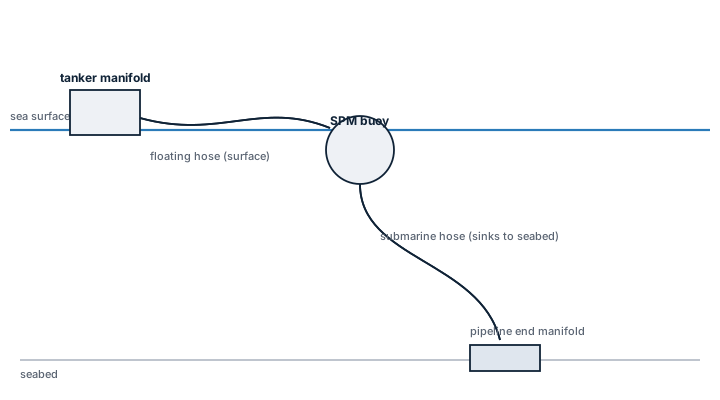
Legend
- tanker manifold
- SPM buoy
- floating hose (surface)
- sea surface
- submarine hose (sinks to seabed)
- pipeline end manifold
- seabed
Main components
Reinforced hose body
A thicker-walled construction than a floating hose, with additional helical reinforcement to resist collapse under external pressure and cover compounds selected for abrasion against sand, mud or rock on the seabed.
End fittings and flanges
Full-bore flanges at each section, connecting the hose string to the PLEM at one end and, through a series of floating and reeling hoses, to the tanker manifold at the other.
Read the full guide
Weight coating or ballast
Many designs use a concrete or dense elastomer weight coating bonded to the cover, tuned so the hose lies flat on the bottom without excessive tension at the connections.
Bend restrictors and stiffeners
Fitted at the PLEM connection and other fixed points to stop the hose kinking where movement concentrates, a failure mode this hose is far more exposed to than a hose used once and recovered.
Selection / Sizing
- Water depth and seabed profile at the mooring, which set the required hose length and the degree of external pressure resistance.
- Nominal bore matched to the terminal's throughput target, generally larger than a typical STS hose given continuous operation.
- Cargo type and tube compound, since a fixed installation is usually dedicated to one grade or a narrow range.
- Design service life, as replacement means a subsea operation rather than swapping a deck hose.
Regulations / Class
SPM and CALM hose strings are covered by the OCIMF/industry guidance for hose specification and testing used across the SPM sector, alongside the terminal operator's own inspection regime. Periodic retrieval for visual inspection, pressure testing and wall thickness or reinforcement checks is standard practice, with intervals set by the operator based on service conditions rather than a fixed universal figure.
Typical faults
| Fault | Consequence |
|---|---|
| Loss of weight coating over time | Hose lifts off the seabed, exposed to current and vessel-induced strain |
| Reinforcement corrosion under a compromised cover | Reduced burst strength, undetected until failure or a scheduled cut test |
| Seabed abrasion at fixed contact points | Localised wall thinning, eventual leak at that section |
| Fatigue at the PLEM connection from current-induced movement | Flange or first-section failure at the most consequential point in the string |
What to look for in a supplier
- Design calculations for the specific water depth and current conditions, not a generic hose rated only for working pressure.
- A retrieval and inspection plan included with the supply, since the hose cannot be visually checked in place.
- Documented weight coating specification and adhesion method, the detail most likely to fail quietly over years of service.
Log every retrieval and cut-test result against the section of hose it came from; a submarine hose string ages unevenly, and the section nearest the PLEM usually goes first.
Models in this type.
The best-documented model of each manufacturer first, then the next — 45 of 45 models in Submarine Cargo Hose. Every row links to full specifications, documents and service notes.
Manufacturers.
All 8 manufacturers with models of Submarine Cargo Hose. Names with a manufacturer page open it; the others open a search across the full library.
All manufacturers in the libraryAlso in Cargo Hoses & Manifolds.
The other equipment types in this category.
Write to us about this model — the answer comes by e-mail.
Name the make and the model and what the job is: a spare, a service call, a second opinion on a data sheet. We answer by e-mail.
No details at hand? A photo of the rating plate or the part is enough — simply attach it to the request.
Questions that come up with this equipment.
Is Submarine Cargo Hose data free?
Yes. Every model page, every guide and every datasheet for this type is readable without an account. An account adds saved searches and requests, nothing is taken away.
My model is missing — what now?
Send us the nameplate. We identify it by hand, add it to the library, and if you need a part or a service, the request is already on our desk.
Can you source a Submarine Cargo Hose part?
Yes. Tell us the manufacturer, the model and what you need — a person reads every request and replies by e-mail.